


Homeowner (Freehold)
You need buildings and contents insurance.
This will cover both the structure of your home and your personal belongings.
📍 Average cost: £248.16
Save up to £196


We compare prices from 95


Home insurance can financially protect your home and belongings from disasters like fire, flood or theft. In 2025, these sorts of incidents led to 560,000
Without home insurance, many of those families would have been left with very big bills: the average claim payout was £6,340
No, home insurance is not a legal requirement.
However, if you're a homeowner, your mortgage provider might insist on you getting buildings insurance before they’ll approve you for a loan.
Standard home insurance is split into buildings insurance and contents insurance. If you need both types, you can buy combined policies that often work out better value.
You need buildings and contents insurance.
This will cover both the structure of your home and your personal belongings.
📍 Average cost: £248.16

You likely only need contents insurance.
The freeholder usually arranges buildings cover, but you'll need to protect your belongings.
📍 Average cost: £69.05

You only need contents insurance.
Your landlord insures the building, but you'll need to protect your personal belongings.
📍 Average cost: £62
Yes, larger homes usually cost more to insure because they’re more expensive to repair or rebuild and often contain more belongings.
Number of bedrooms | Home insurance |
|---|---|
1 | £188.37 |
2 | £191.49 |
3 | £226.33 |
4 | £299.29 |
Yes. Detached homes generally cost more to insure due to higher rebuild costs, while flats are often cheaper because they share walls and are less exposed.
Property type | Home insurance |
|---|---|
Flat | £226.05 |
Terraced house | £222.09 |
Semi-detached house | £230.70 |
Detached house | £297.46 |
Most of your home insurance premium is determined by risk factors out of your control, such as the size and age of your property, the crime rate of the local area, and your own claim history. However, there are a few tweaks you can make to get cheaper home insurance:
Raising your voluntary excess can lower your overall premium. Setting your excess to £1000 would save you an average of £27.19
An excess is the amount you agree to pay towards a claim before your insurer pays the rest. There are two types of excess:
Compulsory excess – set by the insurer and not negotiable
Voluntary excess – the amount you choose to add on top
Insurers charge an excess to discourage small claims and reduce their overall risk. Increasing your excess is essentially agreeing to take on more of the risk yourself, which is why they'll usually charge you less for cover.
💡 Top tip: Some claims come with higher compulsory excesses than standard. In particular, subsidence claims often have a compulsory excess of over £1,000.
Paying annually is usually cheaper than paying monthly because insurers usually treat monthly payments like a loan, and charge interest and admin fees for spreading the cost. By paying upfront, you avoid these extra charges.
A no-claims discount rewards you for not making claims, as insurers see you as lower risk. In general, the longer you go without claiming, the bigger the discount.
💡 Top tip: Not all home insurance policies offer no claims discounts, so check your policy wording to see if one is included.
Investing in security measures like a safe to keep your jewellery in can help reduce your premiums. Some insurers may also offer a small discount if your home is in an active Neighbourhood Watch area, although this isn’t guaranteed.
Enhancing your home security is especially important if you live in a burglary hotspot.
Home insurance is based on the cost to rebuild your home and replace your belongings. Getting these values right can help keep your premium as low as possible while still fully protecting you.
To avoid overinsuring:
the rebuild cost isn’t the same as your home’s market value, so use a rebuild calculator rather than the sale price
check you’re not covering items twice (for example, some packaged bank accounts include gadget cover for phones or electronics)
make sure you only have the cover you need - for example, buildings insurance is often arranged by the freeholder in leasehold flats
Buying home insurance a few weeks in advance of when you want your cover to start can help you get a lower price. That's because insurers see policyholders who leave getting cover to the last minute as being slightly higher risk.
Our data shows that the cheapest day to buy your home insurance is 25
Usually covered by buildings insurance | Usually excluded from buildings insurance |
|---|---|
Structure of your home (walls, roof, floors) | Wear and tear or ageing (e.g. roof deterioration) |
Structural damage caused by burglary or vandalism (e.g. smashed window from a break-in) | Poor maintenance (e.g. untreated leaks) |
Permanent fixtures like kitchens, bathrooms and fitted wardrobes | |
Sheds, garages and outbuildings (although cover may be limited or have restrictions) | Negligence (e.g. leaving doors or windows unlocked) |
Fences and gates if damaged by vandalism or fire | Fences and gates if damaged by storms or subsidence |
Damage caused by Japanese knotweed | |
Trace and access (finding the source of water leaks) | Damage caused by undeclared renovations |
Long-term unoccupied homes (unless you have specialist cover) | |
Alternative accommodation if your home is unsafe to live in | Non-standard homes e.g. listed buildings |
Non-standard structures e.g. thatched roofs | |
Service charges and chancel repair liability |
Usually covered by contents insurance | Usually excluded from contents insurance |
|---|---|
Furniture e.g. sofas and beds | Wear and tear or gradual damage |
Home appliances e.g. fridges, microwaves and washing machines | |
Electronics inside the home e.g. TVs and laptops | Damage or theft from people you invited into your home |
Clothing and shoes | Garden contents e.g. barbecues, plants and patio furniture |
Jewellery and artwork, as long as they are under the single item limit | High-value items above policy limits e.g. expensive jewellery or works of art (unless specifically added) |
Carpets, curtains and furnishings | |
Water damage e.g. belongings damaged by a leaking pipe | Accidental damage e.g. spilling wine on a carpet (unless added as extra cover) |
Cash and credit cards (up to a set limit) | Loss or theft outside the home e.g. stolen phone while out (unless you add personal possessions cover) |
Food in the freezer | Personal items stored outside the home e.g. in storage units |
Negligence e.g. leaving valuables unattended in the garden |
These are the four most common types of home insurance extras:

Protects your home from accidental mishaps, like broken windows, cracked tiles, or stained carpet.
📍Home policies including this cover start from: £310.62

Covers emergency callouts and services from tradespeople, like plumbers, electricians.
📍Home policies including this cover start from: £308.75

Covers legal costs for issues like conveyancing, probate, and disputes with neighbours.
📍Home policies including this cover start from: £311.11

Protects individual belongings like laptops, phones, or jewellery when you take them outside your home.
Accidental damage is one of the most common reasons to claim on home insurance. It makes up 23.26%
But it’s not included as standard on most policies. Adding it will increase your premium, by around £7.38

For buildings insurance, you should cover the rebuild cost of your home. This is not the same as its market value.
You can calculate your rebuild cost using the Association of British Insurers' free tool.

For contents insurance, your cover should be enough to buy replacements of all your belongings. You can calculate your contents cover using our tool.
Unsure how much to insure your contents for? Tell us how many bedrooms you have and about any items over £1,000, and we'll estimate the value
Think of those items in your home that would cost over £1,000 to replace. This could include items like jewellery, watches, televisions, and gadgets.
| Name | Value |
|---|
Oops! That doesn't look quite right - can you check and enter again?
Our data shows people with the same number of bedrooms as you tend to choose a figure between . So, a reasonable level of cover could be:
It is important to check the cover amount you select meets your needs, to avoid potential claim rejections.
Note – the figures shown take into account any specified high value items you have added.
Oops! That doesn't look quite right - can you check and enter again?
Item | Average cost to replace |
|---|---|
Audio equipment | £4524.20^ |
Bicycles | £1725.72^ |
Cameras | £2705.18^ |
Clothing and personal effects | £3885.65^ |
Jewellery | £4631.11^ |
Laptops, tablets, notebooks | £1198.56^ |
Musical instruments (non-professional use) | £3741.62^ |
Paintings/works of art | £5708.10^ |
Sporting equipment | £3081.45^ |
TVs | £1972.74^ |
Watches | £5631.64^ |

Data from the Association of British Insurers (ABI) shows that home insurers paid out a huge £846 million to households in the first three months of 2026.
Part of the reason this number is so high is that the cost of fixing insurable problems is rising. Theft claims are 14% more expensive than last year, and subsidence claims 9% more expensive. But weather-related claims have seen by far the biggest jump, with an average claim cost increase of 38% compared to the first quarter of 2025.
This underlines the potential cost of going without home insurance cover. Whether you own or rent, you could be left paying thousands to repair damage or replace belongings if something goes wrong.
David McDermottroe Insurance & Personal Finance Expert
In most cases, the cost of cover is far lower than paying to repair or replace your home and belongings yourself if something goes wrong.
Combined home insurance prices start from £140.90
Claim Type | % of Home Claims | Average Claim Payout |
|---|---|---|
Escape of water | 29.42% | £33,000 |
Accidental damage | 23.26% | £615 |
Theft | 12.28% | £4,390 |
Storm damage | 13.03% | £6,040 |
Subsidence | 1.09% | £17,820 |
Comparing quotes from different insurers allows you to find the best deal out there.
We can do this work for you.

All our 95

Save up to £196

Compare quotes in minutes, and refresh them in seconds if you store your details with us

Buy through us and get up to £15

We’ll reward you every time you make a purchase. Exchange your earnings for a gift card for Amazon.co.uk

A year's worth of free experiences across the UK. From London Zoo and Go Ape, to Hussle Swimming and English Heritage, there’s an adventure for everybody. Worth £180
Whether you're buying clothing, homewares or takeaways, earn up to 10%

You and your friends each get up to £20 when they join the Club and make a qualifying purchase. Win-Win!

There are a few factors that will affect the price of your home insurance, including:
Location: crime rates, flood risks, number of claims in your area. Some insurers may also consider whether your property is in an active Neighbourhood Watch area as part of their risk assessment.
Value and size of your home: most insurers will value the size of your home, as bigger properties will require a larger payout
Age of the property: older properties are more of a risk and may be built from materials that are difficult to repair and replace
Level of cover: the more comprehensive your policy is, the more expensive your premiums are likely to be, and add-ons will likely increase your premiums
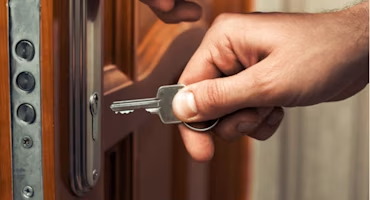
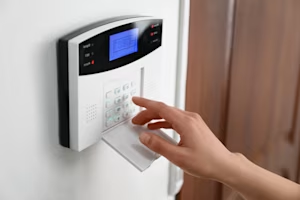
Security: having high quality door and window locks and a burglar alarm could help to improve your home security and result In cheaper premiums.
It is often cheaper to buy buildings and contents insurance as a combined policy if you want to take out both kinds of cover. A combined policy also has the benefit of being easier to manage. You are required to pay only one set of premiums and have the same provider for both types of cover, meaning fewer documents and contact details to keep track of.
You can find out when your property was built by:
checking your property deeds or survey
looking at HM Land Registry records
asking the estate agent or previous owner
using online property sites or local council records
However, you don’t usually need the exact year to fill in a home insurance application. An estimate or build period (e.g. pre-1900, 1930s, post-2000) is often enough for a quote.
Home insurers usually ask when your property was built because age affects risk - older homes can be more expensive to repair and may use materials that are harder to replace.
Yes, it is possible to get home insurance if your property has a history of subsidence, but it can be more difficult and expensive.
Subsidence makes a property higher risk, so some insurers may refuse cover or charge much higher premiums. You may need to go through a specialist insurer, especially if the issue is ongoing or hasn’t been fully resolved.
If the subsidence has already been treated and repaired, you may have more options, particularly if you stay with your existing insurer, who already understands the history of the property.
➡️ Read more: Should I buy a house with subsidence?
Yes, home insurance is generally still available even if you live in an area with a high risk of flooding, thanks to the government-backed Flood Re reinsurance scheme.
However, the Flood Re scheme only applies to properties built before 2009.
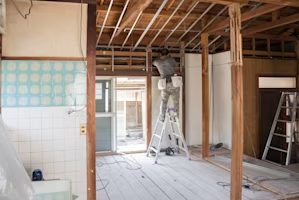
Yes, you can get home insurance if you're having building work done, but you’ll need to tell your insurer.
Building work increases the risk of damage, theft, or accidents, so your standard policy may no longer be valid if you don’t inform them. Your insurer might adjust your cover, increase your premium, or place restrictions while the work is ongoing.
For major renovations (like extensions or loft conversions), you may need specialist renovation insurance to stay fully protected.
No, most policies only cover your belongings while they’re inside your home.
To protect items like phones, jewellery or bicycles when you’re out and about, you’ll typically need personal possessions cover. This can often be added onto your home insurance for an extra cost, or you can take out a separate policy.
It depends how long you are away for. Home insurance typically covers unoccupied properties for up to 60 days. If anything happens outside this period you won’t be covered.
However, you can take out specialised unoccupied home insurance if you plan to be away longer than your standard home insurance covers you for.
Some contents insurance policies cover students’ belongings while they’re temporarily away from home at university. However, this usually comes with limits and conditions, and may only apply if the items are kept in secure accommodation.
It’s important to check the policy details, as you may need separate student contents insurance to be fully covered.
No, standard home insurance is designed for main residences and won’t usually cover a second home or holiday let.
These properties are considered higher risk because they’re often left unoccupied for longer periods and may have multiple occupants or guests.
However, you can get specialist second home insurance, holiday home insurance and holiday let insurance.
Some (but not all) home insurance policies will cover you if you have a lodger, but they will generally require you to inform them. Since having a lodger can increase risk, it is likely to increase your premium or terms.
Your home insurance will not generally cover the lodger's personal possessions - they will need to take out their own contents insurance.
Someone is only classed as a lodger if you also live at the property as your main residence and you share communal areas. If you rent out a large part or the whole of your property they would likely instead be classed as a tenant and home insurance will not cover you. You will instead need to take out landlord insurance.
To make a claim on your home insurance, you will need to fill out a claims form with your insurance provider. You should do this as soon as possible once an incident occurs, but there are a few things you'll need to get started:
Evidence to support your claim:
Any damage to your property needs to be documented. If the event is related to a crime, you'll also need a crime reference number from the police.
Your policy number:
This can be found in your policy documents, so it is wise to keep them safe. These days, most policy documents are sent to you digitally or available through your provider's online portal, but it’s worthwhile save some copies just in case.
Your provider contact details:
In your policy documents you'll also find the contact details of your provider when you want to make a claim. They will typically have a helpline phone number for you to call but many insurance providers now have an online claims process you can access through their website or portal.
In some cases, your insurer may appoint a loss adjuster to assess the damage and help determine how much should be paid out for your claim. They may contact you to arrange a visit to your property or request additional information.
You can cancel your home insurance at any time by contacting your insurer directly.
If you're outside your 14-day 'cooling-off' period, you may need to pay a fee, which is typically £30-50.
If you bought your home insurance through MoneySuperMarket, you can find your policy information by logging into our website or app. Your active policies will be shown on your dashboard.
You can also contact your insurer directly for your policy documents.
Home insurance has a lower claims payout rate than other common types of insurance like motor (98.8% of claims accepted) and pet (94.5% of claims accepted).
According to 2024 Financial Conduct Authority data, reported by Which?:
73.5% of contents insurance claims were accepted
70.7% of combined home insurance claims were accepted
63.2% of buildings insurance claims were accepted
It can therefore be a good idea to look beyond price when choosing a policy. Comparing what’s included and checking customer reviews can help you choose cover that’s more likely to pay out when you need it.
💡 Top tip: If your claim is rejected, you have the right to make a complaint to your insurer, and then to escalate it to the Financial Ombudsman Service if you’re still not satisfied.
At MoneySuperMarket, we want to give you clear, accurate and trustworthy information so you can make confident financial decisions for your circumstances.
Every page on our website goes through a careful editorial process before it is published. It’s written or reviewed by one of our experienced experts, checked for accuracy, and updated regularly to reflect the latest information.
We do use AI tools to support our research and drafting, but a human editor is always in the loop to review, fact-check and approve everything before it’s published, so you can trust that what you’re reading is both reliable and up to date.
You can read more in our editorial guidelines.
We get paid by the companies we work with, but the payment we get doesn’t have any bearing on the information we provide. We get paid in different ways, depending on the type of product or service you buy through us. Our goal is to search deals from as wide a range of companies as possible, but we only show results from our partner providers.
Our comparison service is, and will always be, free to use.
One of the best ways to get the lowest prices and best deals is to compare quotes from different companies. We do the work for you, comparing quotes side-by-side and giving you all the information you need so you can choose the right deal for your needs and your wallet.
We don’t give recommendations or financial advice, but we give you clear information so you can choose financial products that suit your circumstances.
No, not every company can be included in our service. This is because some companies don’t want their products included on comparison sites, and some decide that they would rather not pay a fee. There are also a few smaller providers who can struggle to cope with the volume of customers that can find their products if they appear on MoneySuperMarket.
Our goal is to search deals from as wide a range of companies as possible so that you can choose the deal that suits you.
Yes, you can earn SuperSaveClub rewards when you buy home insurance through MoneySuperMarket.
This includes:
Up to £15, which you can withdraw as a pre-paid Mastercard or a gift card for brands like Sainsbury's and Amazon.co.uk
Free Days Out pass (worth £180), which gives free entry to a range of UK attractions
Cashback of up to 10% when you spend at brands including eBay, Just Eat and Argos
To earn SuperSaveClub rewards on purchases you must:
Sign up to SuperSaveClub (it's free)
Be signed in to your account when you make the purchase
More information can be found on our SuperSaveClub homepage.
Yes, home insurance is included in our Super Save Price Promise.
If you buy through us then find the same deal for less we will:
refund the difference
give you a gift card worth £15
Terms and conditions apply. More information can be found on our Price Promise page.




Reviewed on 8 May 2026 by
An early repayment charge (ERC) is a fee for ending a mortgage deal before the term ends. Typical ERCs range between 1% and 5% of the remaining loan amount if you want to end it early.
ERCs often also apply if you attempt to pay back more than 10% of the outstanding loan amount in a single year.
Find out more in our guide to early repayment charges.
51% of consumers could save up to £196.36 Consumer Intelligence , Buildings and Contents Mar 2026 Exc NI, CI, IOM
YouGov Survey 1st July 2024 to 30th June 2025. Net Recommend score derived from “Which of the following online service websites would you recommend to a friend or colleague, or tell them to avoid?” Base: Current Customers of (MoneySuperMarket n=18,382, Compare the Market n=16,802, Go.Compare n=10,162, Confused.com n=8,229, Uswitch n=528).
Source: Association of British Insurers (ABI), 2026. 'Adverse weather pushes property insurance payouts to £6.1 billion in 2025' https://www.abi.org.uk/news/news-articles/2026/2/adverse-weatherpushesproperty-insurance-payouts-to-6.1-billionin-2025/
Source: Association of British Insurers (ABI), 2026. 'Home insurers pay out £846 million to support households' https://www.abi.org.uk/news/news-articles/2026/5/home-insurers-pay-out-846-million-to-support-households/
Data is for combined home insurance policies that include both buildings and contents cover.
Data based on the median premium of building and contents insurance policies sold through MoneySuperMarket in March 2026.
Data based on the median premium of building and contents insurance policies sold through MoneySuperMarket in March 2026.
Data based on the median premium of building and contents insurance policies sold through MoneySuperMarket in March 2026.
Data based on the median premium of building and contents insurance policies sold through MoneySuperMarket in March 2026.
Where the flat was purpose-built and self-contained.
Data based on the median premium of building and contents insurance policies sold through MoneySuperMarket in March 2026.
Data based on the median premium of building and contents insurance policies sold through MoneySuperMarket in March 2026.
Data based on the median premium of building and contents insurance policies sold through MoneySuperMarket in March 2026.
Data based on the median premium of building and contents insurance policies sold through MoneySuperMarket in March 2026.
SuperSaveClub restrictions and T&Cs apply. Click here for details.
Accurate as of 07 May 2026.
51% of consumers could save up to 53.61% Consumer Intelligence , Buildings and Contents Mar 2026 Exc NI, CI, IOM
The annual premium that 10% of our customers paid in March 2026 where the cover type purchased was building and contents insurance.
The annual premium that 10% of our customers paid in March 2026 where the cover type purchased was contents insurance.
Data based on enquiries made between February 2026 to April 2026 where the enquiry contained one or more claims.
Source: Association of British Insurers (ABI), 2026. 'The ABI issues advice for homeowners and drivers ahead of upcoming cold weather' https://www.abi.org.uk/news/news-articles/2026/1/abi-shares-cold-weather-advice-for-homeowners-and-drivers/
Data based on enquiries made between February 2026 to April 2026 where the enquiry contained one or more claims.
Source: Which?, 2024. 'Most common home insurance claims revealed' https://www.which.co.uk/news/article/the-most-common-home-insurance-claims-ajOQH1x0W5fK
Data based on enquiries made between February 2026 to April 2026 where the enquiry contained one or more claims.
Source: Association of British Insurers (ABI), 2026. 'Home insurers pay out £846 million to support households' https://www.abi.org.uk/news/news-articles/2026/5/home-insurers-pay-out-846-million-to-support-households/
Data based on enquiries made between February 2026 to April 2026 where the enquiry contained one or more claims.
Source: Association of British Insurers (ABI), 2026. 'Home insurers pay out £846 million to support households' https://www.abi.org.uk/news/news-articles/2026/5/home-insurers-pay-out-846-million-to-support-households/
Data based on enquiries made between February 2026 to April 2026 where the enquiry contained one or more claims.
Source: Association of British Insurers (ABI), 2026. 'Home insurers pay out £846 million to support households' https://www.abi.org.uk/news/news-articles/2026/5/home-insurers-pay-out-846-million-to-support-households/
Data based on the median premium of building and contents insurance policies sold through MoneySuperMarket in March 2026.
Data based on the median premium of contents insurance policies sold through MoneySuperMarket in March 2026.
Based on the median annual price where the type of tenant is private, furnished for home insurance policies sold through MoneySuperMarket between January 2026 and March 2026.
Based on Home Insurance enquiries on MoneySuperMarket between 31st December 2025 and 31st March 2026 where the quote was for buildings insurance.
Based on Home Insurance enquiries on MoneySuperMarket between 31st December 2025 and 31st March 2026 where the quote was for contents insurance.
Based on Home Insurance enquiries on MoneySuperMarket between 2025-01-01 and 2025-04-01 where the quote was for building and contents covertype.
Based on Home Insurance enquiries on MoneySuperMarket between 2025-01-01 and 2025-04-01 where the quote was for building and contents covertype.
Based on Home Insurance enquiries on MoneySuperMarket between 2025-01-01 and 2025-04-01 where the quote was for building and contents covertype.
Based on Home Insurance enquiries on MoneySuperMarket between 2025-01-01 and 2025-04-01 where the quote was for building and contents covertype.
Based on Home Insurance enquiries on MoneySuperMarket between 2025-01-01 and 2025-04-01 where the quote was for building and contents covertype.
T&Cs apply to SuperSaveClub and Price Promise.
SuperSaveClub restrictions and T&Cs apply. Click here for details.
Based on 1 visit per month – average ticket value £15.30 (Oct 24)
T&Cs and restrictions apply, see here for more information
Data based on the average cost to replace items listed by MoneySuperMarket customers between February 2026 and April 2026.
Data based on the average cost to replace items listed by MoneySuperMarket customers between February 2026 and April 2026.
Data based on the average cost to replace items listed by MoneySuperMarket customers between February 2026 and April 2026.
Data based on the average cost to replace items listed by MoneySuperMarket customers between February 2026 and April 2026.
Data based on the average cost to replace items listed by MoneySuperMarket customers between February 2026 and April 2026.
Data based on the average cost to replace items listed by MoneySuperMarket customers between February 2026 and April 2026.
Data based on the average cost to replace items listed by MoneySuperMarket customers between February 2026 and April 2026.
Data based on the average cost to replace items listed by MoneySuperMarket customers between February 2026 and April 2026.
Data based on the average cost to replace items listed by MoneySuperMarket customers between February 2026 and April 2026.
Data based on the average cost to replace items listed by MoneySuperMarket customers between February 2026 and April 2026.
Data based on the average cost to replace items listed by MoneySuperMarket customers between February 2026 and April 2026.
Based on Home Insurance enquiries on MoneySuperMarket between 2025-01-01 and 2025-04-01 where the quote was for building and contents covertype.
T&Cs and restrictions apply, see here for more information
T&Cs apply, click here for more information

