


Device installed
Depending on the policy and device you choose this could require professional installation, or you could need to plug in a device or download app.


Get answers in seconds with our AI chatbot.
Black box insurance, also called telematics insurance, is a type of car insurance that uses a device to monitor your driving habits and sends the data to your insurer.
The device could be a physical black box professionally fitted to your car, a plug-in device or a mobile phone app. It can record driving habits such as your speed, braking, acceleration and the time of day you drive.
Insurers use this data to build a personalised picture of your driving risk. If your driving is considered lower risk, you may be offered a lower premium.
Telematics insurance can be particularly useful for people who drive safely but belong to groups that insurers generally consider higher risk. This includes young people, new drivers and drivers with criminal records.

Insurers use data on your driving habits - like mileage or cornering - to calculate your risk.
Lower risk can mean cheaper premiums at renewal or after a monitoring period.
Depending on the policy and device you choose this could require professional installation, or you could need to plug in a device or download app.

The way you drive is monitored by your telematics device for a specified period of time (often a year), and the data is fed back to your insurer.

Risk scores are based on both how you drive (speed, harsh braking etc.) and where and when you drive (day, night, motorways etc.)

Different insurers will have different timeframes for adjusting your policy. Often, it's at your renewal.
An engineer installs this type of device into your car, usually behind the dashboard.
Best for: Drivers who won't switch policy or car soon, or who don't drive with a phone.
You install this type of device yourself. It goes in the USB slot or cigarette lighter.
Best for: Drivers who want a quick set-up and won't use telematics long-term.
You download an app to your smartphone, and use it while driving.
Best for: Tech-savvy drivers who want to monitor their driving habits in real time.
Speed - if you drive fast and if you break the speed limit
Acceleration - harsh acceleration can increase risk
Braking - sharp braking suggests late reactions
Time of day - driving at night is often higher risk
Cornering - including the speed and smoothness with which you take corners
Mileage - how far you drive overall
Location - noting areas with higher accident or theft rates
Road types - such as motorways versus residential roads
Sudden impacts - these may indicate a collision
Journey frequency - how often you drive

Your driving score helps your insurer assess how risky your driving is. Consistent lower-risk driving often reduces how much you pay for your car insurance, while consistently higher-risk driving could increase your costs or affect your cover.
Driving behaviours that lead to a good driving score usually include smooth braking and acceleration, keeping within speed limits and other lower-risk driving behaviours.
📍 Often lowers insurance costs
Common driving behaviours behind a poor driving score include frequent harsh braking or acceleration, speeding, and crashes.
📍 Can mean higher insurance costs, warnings, and even policy cancellation.
Your insurer uses data collected by your black box or app, which can include your speed, braking, acceleration and when you drive. Exactly what is measured and how your score is calculated varies by insurer.
Usually, yes. Many black box insurers let you check your score and get feedback on your driving through an app or online account.
This varies by insurer. Some provide regular or near real-time feedback, while others assess your driving over a longer period.
It depends on your insurer. Some black box policies can adjust your price during the policy if your driving score changes, while others use your driving data to help calculate your renewal price.
Night driving: Some policies restrict driving late at night, while others allow it but may give you a poorer score for regularly driving at higher-risk times
Mileage limits: You may agree to an annual mileage limit and could have to pay for additional miles if you exceed it
Phone requirements: App-based policies may require you to carry your phone while driving and keep location, Bluetooth or mobile data switched on
Connected devices: You may need to keep a plug-in or fitted device connected and working throughout the policy
Extra charges: Some insurers charge for installing or removing a device, or cancelling your policy early
Other drivers: Your black box monitors the car, so another person's driving could be recorded and affect your score

Telematics insurance is not guaranteed to make your insurance cheaper. It is most likely to save money for:
✔ good drivers
✔ with low-risk driving habits
who are also members of groups insurers consider high-risk:
✔ young drivers
✔ older drivers (70+)
✔ new drivers
✔ drivers with criminal records
✔ drivers who have recently claimed on their insurance
Insurers set premiums partly by using the claims history of people with similar characteristics to you to estimate how likely you are to claim. Age is one of their biggest indicators of risk, because young drivers are disproportionately represented in risky driving and claims data.
The problem is that these are group averages, not individual judgements. A careful 17-year-old driver can end up paying more than a reckless 40-year-old driver because insurers can't know from demographic information alone whether they're one of the safer drivers in their age group.
Telematics reduces this issue by giving insurers more information about how you actually drive. Having data proving you're a low-risk young driver can give the insurer the confidence to charge you less. This is why telematics usually offers bigger savings to people whose individual risk is lower than the average for their demographic.
Earn insurance discounts
May improve your driving skills
Provides reassurance for parents
Telematics data can be used as evidence to settle claims
GPS function can deter car thieves
Premiums can increase if you drive in riskier ways
Insurers may restrict where and when you drive
Other people driving your car may affect your score
May be additional installation or dismantling fees
Data doesn't automatically transfer if you switch insurer
These are the average annual prices of telematics policies sold through MoneySuperMarket.
Average prices for telematics insurance can look high because these policies are most commonly taken out by new or young drivers, who pay more for car insurance.
Drivers who selected telematics insurance saved £368.19[8] on average compared with a standard policy, according to MoneySuperMarket data. The young, new drivers of this group saw the biggest saving, of -£1590[4] on average.
Our figures only include the people who buy telematics insurance, who are likely to be higher-risk drivers with more to gain from proving they drive safely. Drivers in lower-risk groups may find standard insurance is already cheaper.
All car insurance prices depend on your individual circumstances, so your savings may be different.

Seeing several options and prices makes it easier to find the best deal for you.







🚩 Not all add-ons will be available for all telematics policies. Check with your insurer.

In case your car has a mechanical problem while you're driving it.

In case your car is unusable but you still need to drive.

In case your windscreen is chipped, cracked or broken.

In case you lose or damage your car keys and need replacements.

In case you put diesel in your petrol car, or vice versa.

In case you are taken to court for your role in a car accident.

In case you or your passengers are hurt or killed in a crash you caused.

In case your stuff is stolen from your car, or damaged while in the car.

80% of car users think that they arebetter-than-average drivers, according to research from the Open University.
Unfortunately for drivers who have an accurate assessment of their abilities, car insurers usually charge based on broad generalities, including the risk profile of the demographic group people fall into.
Telematics policies are the exception to this rule. For safe drivers who happen to belong to a high-risk group like new or young drivers, it can be a good deal. That's why 61% of drivers aged 18-24 are now considering it, according to data from The Green Insurer.
Beth Leslie Senior Insurance Content Editor
Standard car insurance is always an option, but drivers in higher-risk groups may face expensive premiums. Alternatives to telematics that could cost less include short-term, pay-as-you-go and named driver cover, although available savings will be dependent on how and when you need to use a car.

Pro: No monitoring or driving restrictions
Con: Can be more expensive for higher-risk drivers

Pro: Flexible cover for anything from a few hours to several weeks
Con: Can be expensive if you need regular or long-term cover

Pro: Can save money if you drive very few miles
Con: Costs can increase if you drive more than expected

Pro: Can be cheaper than taking out your own policy
Con: You won't usually build your own no-claims bonus
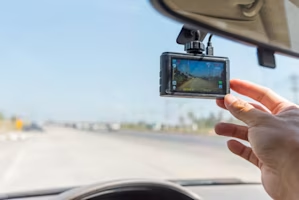

Yes. Black box insurance is a type of telematics insurance, which uses technology to monitor how you drive. Despite the name, you don't always need a physical black box. Some policies use a plug-in device or mobile phone app instead.
It depends on the type of telematics policy you choose, as installation and setup vary.
Some policies use a professionally installed black box. An engineer fits the device directly into your car, and your insurer usually arranges the appointment at a time that suits you. Installation typically takes place after the policy starts, and you may be given instructions on when you can drive.
Other policies use a self-install device. These are usually plug-in boxes that connect via the car’s OBD port, USB port or cigarette lighter. You fit them yourself by following the insurer’s instructions, and they can usually be moved to another car if you change vehicles.
Some telematics policies are app-based. Instead of a physical device, you download an app to your smartphone, which uses your phone’s sensors and GPS to monitor driving. These are often the quickest to set up but rely on you carrying your phone on every journey.
Not always. Black box insurance can be cheaper if you're in a higher-risk group but your driving habits show you're a lower-risk driver. This is why younger and newer drivers often have the most to gain.
However, telematics isn't guaranteed to save you money, so compare both telematics and standard car insurance quotes.
Depending on your insurer, a black box can monitor:
your speed
braking and acceleration
when you drive
how far you drive
where you drive
Your insurer uses this information to assess your driving risk and calculate a driving score.
It can. Many fitted black boxes and telematics apps use GPS, which means they can record where and when your car is driven.
Check your insurer's privacy policy to see exactly what location data it collects, how it's used and how long it's kept.
Not always. Some black box policies restrict driving during certain hours, while others let you drive at any time but may give you a higher-risk driving score for regularly driving late at night.
Check for night-driving rules before buying a policy if you regularly drive at night.
Yes, if they're insured to drive your car. Usually, this means you'll need to add them as a named driver on your policy.
Since telematics can't tell who is in the driver's seat, anyone who drives your car could affect your driving score, and therefore your premiums.
Your insurer may record the speeding and it could negatively affect your driving score. Depending on your policy, repeated or serious speeding could increase your costs, lead to a warning or even result in your policy being cancelled.
An occasional minor mistake won't necessarily result in cancellation, but each insurer sets its own rules.
Yes. Depending on your policy terms, an insurer could cancel your cover for consistently risky driving or for breaking the rules of your telematics policy.
This could include serious or repeated speeding, tampering with or disconnecting the device, or repeatedly failing to meet other policy requirements. Insurers will usually warn you first, but check your policy terms.
Tell your insurer before changing your car. Depending on the type of device, your insurer may transfer it, fit a new one or ask you to return or remove the old device.
If you switch insurer, check what you need to do with the equipment. You may also have to pay a removal or cancellation fee.
Yes. Not all telematics insurance uses a permanently fitted black box. Depending on the insurer, your driving can instead be monitored using a plug-in device or an app on your smartphone.
App-based policies may require you to keep your phone with you and have settings such as GPS, Bluetooth or mobile data switched on while driving.
At MoneySuperMarket, we want to give you clear, accurate and trustworthy information so you can make confident financial decisions for your circumstances.
Every page on our website goes through a careful editorial process before it is published. It’s written or reviewed by one of our experienced experts, checked for accuracy, and updated regularly to reflect the latest information.
We do use AI tools to support our research and drafting, but a human editor is always in the loop to review, fact-check and approve everything before it’s published, so you can trust that what you’re reading is both reliable and up to date.
You can read more in our editorial guidelines.
We get paid by the companies we work with, but the payment we get doesn’t have any bearing on the information we provide. We get paid in different ways, depending on the type of product or service you buy through us. Our goal is to search deals from as wide a range of companies as possible, but we only show results from our partner providers.
Our comparison service is, and will always be, free to use.
One of the best ways to get the lowest prices and best deals is to compare quotes from different companies. We do the work for you, comparing quotes side-by-side and giving you all the information you need so you can choose the right deal for your needs and your wallet.
We don’t give recommendations or financial advice, but we give you clear information so you can choose financial products that suit your circumstances.
No, not every company can be included in our service. This is because some companies don’t want their products included on comparison sites, and some decide that they would rather not pay a fee. There are also a few smaller providers who can struggle to cope with the volume of customers that can find their products if they appear on MoneySuperMarket.
Our goal is to search deals from as wide a range of companies as possible so that you can choose the deal that suits you.
Yes, you can earn SuperSaveClub rewards when you buy car insurance through MoneySuperMarket.
This includes:
Up to £15, which you can withdraw as a pre-paid Mastercard or a gift card for brands like Sainsbury's and Amazon.co.uk
Free Days Out pass (worth £180), which gives free entry to a range of UK attractions
Cashback of up to 10% when you spend at brands including eBay, Just Eat and Argos
To earn SuperSaveClub rewards on purchases you must:
Sign up to SuperSaveClub (it's free)
Be signed in to your account when you make the purchase
More information can be found on our SuperSaveClub homepage.
Yes, car insurance is included in our Super Save Price Promise.
If you buy through us then find the same deal for less we will:
refund the difference
give you a gift card worth up to £15
Terms and conditions apply. More information can be found on our Price Promise page.
Reviewed on 15 Oct 2026 by
SuperSaveClub restrictions and T&Cs apply. Click here for details.
Accurate as of 13 October 2026.
YouGov Survey 1st July 2025 to 30th June 2026. Net Recommend score derived from "Which of the following online service websites would you recommend to a friend or colleague, or tell them to avoid?" Base: Current Customers of (MoneySuperMarket n=17,883, Compare the Market n=16,193, Go.Compare n=8,523, Confused.com n=7,918, Uswitch n=514)
Based on the median annual price of the cheapest telematics quoted vs none telematics quoted on MoneySuperMarket for a given search in August 2026.
Based on the median annual price of comprehensive policies sold through MoneySuperMarket in August 2026.
Based on the median annual price of third party, fire & theft policies sold through MoneySuperMarket in August 2026.
Based on the median annual price of third party only policies sold through MoneySuperMarket in August 2026.
Based on the median annual price difference between telematics policies sold through MoneySuperMarket in August 2026 and the cheapest non telematics policy offered.


