

Tethered vs untethered
Tethered chargers have a fixed cable for convenience, while untethered chargers offer more flexibility if you change cars or share charging.

A home electric vehicle (EV) charger is a charging point that's usually fitted on a driveway or in a garage. It charges your electric car much faster than a standard three-pin plug, making it easier to keep your battery topped up and ready to go.
If you've bought an electric car – or you're thinking about making the switch – installing a home EV charger is one of the first things to consider.
Charging at home is one of the biggest benefits of owning an EV. In fact, according to the Zapmap EV Charging Survey, there were around 1.4 million home chargers installed at UK properties with driveways by the end of 2025.
Many chargers also offer smart features, letting you schedule charging overnight to take advantage of cheaper electricity tariffs.
Charging at home can be more convenient and, with the right energy tariff, could help lower your overall running costs.

Here are some factors to think about before you invest in an EV charger for your home:
Tethered chargers have a fixed cable for convenience, while untethered chargers offer more flexibility if you change cars or share charging.

Most homes use a 7kW charger, which gives a good balance of charging speed and cost.

Expect to pay around £800–£1,500+ for a charger and installation, depending on the model and your home setup.

Smart chargers can schedule charging, track usage and help you save money with cheaper energy tariffs.

Check your parking space, cable route and electrical supply before choosing a charger.

Make sure the charger works with your EV’s connector type and charging capacity.

Choose a reliable smart charger that can support future EVs and energy technologies.
Installing a home EV charger is usually straightforward, but it should always be carried out by a qualified installer. Here's what you can expect:

Decide whether you want a standard or smart charger. Smart chargers let you schedule charging and can help you make the most of cheaper off-peak electricity tariffs.

Your charger supplier or energy provider will arrange for a qualified installer to fit the charger at your home.

Before installation, you'll normally be asked to complete a survey with details and photos of your property, parking space and electricity meter. This helps the installer check your home is suitable.

Most installations take around two to four hours. The charger is usually fitted on an external wall close to where you park, then connected to your home's electricity supply.

Once installed, you can plug in your EV and, if you have a smart charger, schedule charging for when electricity is cheapest.
Most installers will ask you to have:
Off-street parking, such as a driveway or garage.
A reliable Wi-Fi signal if you're installing a smart charger.
Enough space near your electricity supply to install the charger safely.
Permission from your landlord if you rent your home.
If you're unsure whether your property is suitable, your installer can advise you before the work begins.

Generally speaking a standard 7kW charger and installation costs vary but are typically in the region of £500-£1200 but this can vary widely depending on your individual circumstances and home charging requirements e.g. sockets, connectors, charging cables, and additional factors.
How your home is built: If you live in an older house with thick exterior walls, the extra time and effort needed during your installation may add to the installation cost.
The difficulty of the install: Some chargers are themselves more challenging to install, which may also add to installation costs.
The state of your electrics: An EV charger will place high demands on your home electrical system, so homes that haven’t been updated in a long time may need additional work compared to a standard installation.

Choosing the right EV charger is about matching a range of items to your needs, such as speed, type, and flexibility to connect to your vehicle. Charging speeds range from slow 3kW to fast 22kW, which affects costs, while Type 1 and Type 2 compatibility is crucial, especially for used EVs. Tethered chargers are simple but limited to one type, whereas untethered models offer cables for both, helping to futureproof your setup.
“If you get an EV charger at home, pairing it with a dedicated EV energy tariff can save you cash on running costs, as you’ll get a cheaper electricity rate when you charge your car during specific periods.
Ashton Berkhauer Home & Utilities Expert
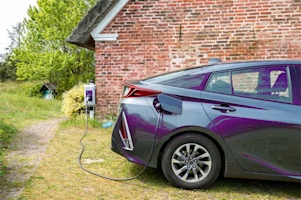
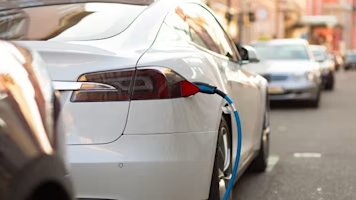
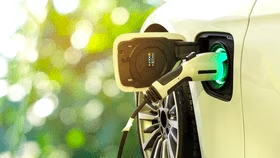
A standard home EV charger installation usually takes a few hours. The exact time depends on your property, where the charger will be fitted, the distance from your electricity supply and whether any additional electrical work is needed. Your installer should be able to give you a clearer timeframe before installation.
No, you shouldn’t install a home EV charger yourself. EV chargers need to be connected to your home’s electrical system and should be installed by a qualified, certified installer to make sure they’re safe and meet the required regulations.
Yes, some EVs can be charged using a standard three-pin plug, but it is much slower than using a dedicated home charger.
Manufacturers only recommend this for occasional use or emergency top-ups rather than everyday charging. A wallbox charger is usually recommended for regular charging.
No, but switching to an EV-friendly tariff could help you save money. Some tariffs offer cheaper electricity at certain times, such as overnight, when you’re more likely to charge your car.
It depends on your property and parking situation. If you rent or live in a flat, you may need permission from your landlord, managing agent or freeholder before installing a charger.
Some chargers can be removed and reinstalled at a new property, although this depends on the charger, your new home and installation costs.
Charging times depend on your car’s battery size and the charger’s power. Most home chargers are around 7kW and can usually charge an electric car overnight, making them suitable for everyday use.
Charging at home is often one of the cheapest ways to power an electric car, especially if you use an off-peak electricity tariff. Public chargers can be more expensive, particularly rapid chargers.
You work hard to earn your money, and we don’t think you should waste a penny of it paying over the odds on your household bills. That’s why at MoneySuperMarket, we’re on a mission to save Britain money.
Whip your credit score into shape with Credit Score
Super save over and over again with Energy Monitor
There are always more ways to save with MoneySuperMarket
So how do we make our money? In a nutshell, when you use us to buy something, we get a reward from the company you’re buying from.
You might be wondering if we work with all the companies in the market, or if our commercial relationships with our partners might make us feature one company above another. We’ve got nothing to hide, and we want to give you clear answers when it comes to questions like these, so we’ve pulled together everything you need to know on this page.
Reviewed on 25 Oct 2026
YouGov Survey 1st July 2025 to 30th June 2026. Net Recommend score derived from "Which of the following online service websites would you recommend to a friend or colleague, or tell them to avoid?" Base: Current Customers of (MoneySuperMarket n=17,883, Compare the Market n=16,193, Go.Compare n=8,523, Confused.com n=7,918, Uswitch n=514)
