


Single trip
Covers one holiday, usually for trips up to 30–90 days. Best for one main family holiday, such as a summer trip.

Find tailored travel cover at the right price by comparing deals from the UK’s leading travel insurers.







Family travel insurance is a type of travel insurance that covers multiple members of the same family under one policy, rather than buying separate cover for each person.
While covered by the policy, all insured family members are protected against common travel problems such as medical emergencies, cancellations, and lost or delayed luggage.
What counts as a family can vary by insurer. Most policies cover one or two adults and their dependent children, which may include biological children, step-children, foster children or children under legal guardianship.
Family travel insurance usually has eligibility rules, such as:
Children must be under a set age (commonly under 18, though some policies allow older dependants in full-time education)
Adults may or may not be covered if they travel separately
Single-parent families are generally treated the same as two-adult families, but this should be confirmed
Some insurers require everyone to live at the same address, while others don’t, so it’s important to check the policy wording

Travel insurance policy inclusions and exclusions vary. The following information provides a general overview of common travel insurance inclusions and exclusions. Always read your policy documents thoroughly to understand what is and isn't covered before your trip.
Trip cancellation before travel (e.g. a child falls ill and the family has to cancel)
Trip curtailment after travel starts (e.g. a parent needs to return home early due to a family emergency)
Travel disruption such as delayed, missed or cancelled flights, or involuntary abandonment
Emergency medical treatment abroad for illness or injury
Medical expenses for children, including hospital treatment overseas
Repatriation costs if a serious illness, injury or bereavement means you must return home
Personal liability and legal costs if a family member accidentally injures someone or damages property
Lost, stolen or damaged personal belongings
Loss of essential medication
Loss or damage to baby equipment such as pushchairs, car seats or travel cots (within item limits)
Standard holiday activities like swimming, sightseeing and family sports
Events you knew about or could reasonably have expected before booking
Cancelling or cutting a trip short because you change your mind
Airline strikes (usually the airline’s responsibility, though accommodation may be covered in some cases)
Non-emergency or elective medical treatment
Pre-existing medical conditions unless declared and accepted by the insurer
Returning home early when there is no insured reason
Intentional, reckless or illegal acts
High-value items above policy limits (such as expensive electronics)
Unattended belongings or items not properly looked after
Children travelling alone or with non-insured adults
High-risk activities not included in the policy or not covered by add-ons
Activities excluded even when adventure or winter sports cover is purchased
Incidents involving alcohol or drugs
There are three main types of travel insurance available for families. The right policy depends on how often your family travels and how long each trip lasts:
Covers one holiday, usually for trips up to 30–90 days. Best for one main family holiday, such as a summer trip.

Covers multiple holidays over 12 months, with a maximum length per trip (often 21–45 days). Best for families taking several trips each year.

Covers extended travel, often up to 12–18 months, and multiple destinations. Best for Long holidays or sabbatical travel.
The average cost of a family travel insurance policy is £35.21
Single-trip policies are usually cheapest for one holiday, while annual multi-trip or long-stay policies can work out better value for families who travel more often.
More people on the policy usually means a higher price, and some insurers charge more for older children or teenagers.
Travel to countries with high medical costs (such as the USA or Caribbean) is more expensive than Europe-only cover.
Declaring pre-existing medical conditions can increase the cost, but failing to declare them can invalidate your policy entirely.
Longer trips generally cost more, particularly for single-trip and long-stay policies.
Extras like winter sports, adventure activities, cruise cover or gadget cover will increase the price.
A higher excess usually lowers the premium, but it’s important to check whether the excess applies per person or per claim, as this can add up for families.
There are a few steps that you can take when shopping for family travel insurance that can help you cut down the cost of your policy:

Raising your excess can lower your premium, but it means you’ll pay more out of pocket if you claim, which can matter for families where claims are more likely, especially if the excess applies per person.

If you travel more than once or twice a year, annual multi-trip insurance can often be cheaper than buying several single trip policies. Just check the maximum trip length allowed under the policy to make sure each holiday is fully covered.

Comparing policies helps you find better value for family cover, as prices, excesses and medical limits vary widely between insurers.

Picking a policy that matches how often and how long your family travels can save money, while the wrong type may cost more or leave you underinsured.

Add-ons such as gadget cover, winter sports cover, or cruise cover can increase the price of your policy. Removing extras you don’t need may reduce the premium, but only if those activities or items aren’t already included or something you plan to use.

With single-trip policies, longer holidays usually cost more to insure. Make sure your policy covers the full length of your trip, but avoid adding unnecessary days as this can increase the price.
Choosing the right policy is about balancing cost with the level of cover you need, so it’s worth comparing options carefully before you buy.

Easier to manage: One policy covering multiple family members is simpler to arrange and manage than several individual policies
Often cheaper but not always: Family policies can work out better value when covering multiple children, but they may be more expensive if family members are different ages, one person has a serious medical condition, or only one adult travels frequently
Flexible travel for parents: Some annual family policies allow parents to travel without their children during the year, but this isn’t guaranteed and must be checked in the policy wording
Free or discounted cover for young children: Some insurers offer free cover for children under a certain age, though age limits and eligibility vary by provider
Shared bookings and cover: Family policies are usually designed for trips where everyone is on the same booking, and cover may be limited if family members travel separately
Yes but it depends on the type of policy.
Annual multi-trip family policies: Each named adult (usually 18+) can usually travel independently, as long as they’re named on the policy and follow the same destination, trip-length and activity rules
Single-trip family policies: These are designed to cover one shared family holiday and usually do not cover solo travel by an individual family member
Children travelling alone: Children under 18 are normally only covered when travelling with an adult listed on the policy. Unaccompanied minors or children travelling with someone not named on the policy are typically excluded
You can avoid gaps in cover by making sure all travelling adults are named on the policy, checking whether adults are covered when travelling separately, and never assuming children are covered unless travelling with a listed adult.
Policy terms vary by insurer, so always check the policy wording before you travel, especially if family members plan to travel independently.


Travel insurance is often at the bottom of a long to-do list when it comes to holidaying with the kids, even if we all know it should be a priority.
Take some time to work out the best deal for your circumstances. Larger families, with several children, may benefit more on the cost-saving from a family travel insurance policy than those with one child.
Try to work out how often you’ll travel as a family in a 12-month period too. The big summer holiday may take all the glory, but if there’s a chance of a couple of other trips, then an annual policy may work out cheaper than single trip cover.
Jake Edmonds Travel & Commercial Insurance Expert
Some insurers offer enhanced cover for pushchairs, car seats and travel cots, plus mobility aids or medical equipment. Standard baggage cover may include these items, but limits can be low, so check whether additional cover is needed.
Can be useful if your family is travelling with multiple or high-value devices, such as phones, tablets, laptops, and gaming devices.
Provides cover for winter activities such as skiing or snowboarding, including emergency medical treatment on the slopes, and ski passes, lessons and specialist equipment. Winter sports are not usually covered by default, so this add-on is essential if you’re taking a ski holiday.
Designed for cruise-specific risks, including medical treatment on board and missed port departures or itinerary changes. Cruises are often excluded from standard policies, so specialist cruise cover is usually essential.
Helps cover the cost and support involved in replacing a lost or stolen passport or obtaining an Emergency Travel Document (ETD).
Provides protection for injuries or equipment linked to activities like surfing, horse riding, cycling tours and watersports that aren’t usually covered by standard travel insurance.

MoneySuperMarket has won the Feefo Platinum Trusted Service Award, an independent seal of excellence, which recognises businesses that consistently deliver a world-class customer experience.


Give a few details about you, your travel plans, preferred level of cover, and what you need cover for

We’ll put together a list of travel insurance quotes, so you can pick one that works for you

Once you’ve chosen, you can purchase your policy and you’ll be covered for your trip
Whether you need worldwide cover, a single trip, or a multi-trip policy, at MoneySuperMarket, we’re here to make sure your holiday planning is a breeze. Here’s what you’ll get:

We're also the UK's most recommended price comparison website

Compare quotes from the UK's leading travel insurers and filter through a range of policies that suit your budget

Buy through us and get up to £5
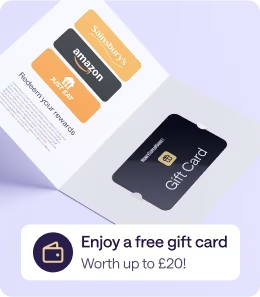
We’ll reward you every time you make a purchase. Exchange your earnings for a gift card for Amazon.co.uk
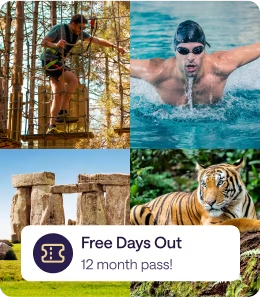
A year's worth of free experiences across the UK. From London Zoo and Go Ape, to Hussle Swimming and English Heritage, there’s an adventure for everybody. Worth £180

Whether you're buying clothing, homewares or takeaways, earn up to 10%

You and your friends each get up to £20 when they join the Club and make a qualifying purchase. Win-Win!
Yes but it depends on the insurer and the policy. Most family travel insurance policies cover children up to age 17 or 18.
Some insurers allow older children in full-time education to stay on a family policy, while others require anyone over 18 to take out their own travel insurance, even if they’re travelling with their parents.
If a child is over the insurer’s age limit, they’re usually treated as an adult and must be named separately or insured under their own policy, even when travelling on the same trip.
Single-trip family policies often have no upper age limit, but annual multi-trip policies commonly do, and premiums usually increase as adults get older.
Because age rules vary between providers, it’s important to check eligibility carefully, especially for mixed-age families or when buying annual cover.
Usually no, but it depends on the insurer. Most family policies only cover immediate family members.
Children usually must live with the policyholder or be under their legal guardianship, and cover is typically limited to biological, adopted, step or foster children.
However, some insurers may allow nieces or nephews if they live with you permanently or you’re their legal guardian, but this must be confirmed in advance.
Otherwise, you may need a separate child policy or group travel insurance.
Yes, having a pre-existing condition doesn’t automatically stop you from getting family travel insurance.
Each person on the policy usually completes a medical screening, and the insurer prices the policy based on the conditions declared.
One family member’s condition can increase the overall cost of the policy, but it doesn’t normally prevent others from being covered.
Minor conditions (such as asthma or controlled diabetes) are often covered for an extra premium.
More serious conditions, especially those involving recent hospital treatment, regular medication, or medical equipment, may mean you need specialist travel insurance.
Specialist policies are more expensive, but they’re designed to cover higher-risk medical needs and may include cover for medication, equipment and treatment abroad.
To get the right cover, compare both standard and specialist family policies, and always check whether recent hospitalisation, prescribed medication or medical devices affect eligibility.
A GHIC (Global Health Insurance Card) lets you access state-provided healthcare in EU countries (and a small number of other participating countries) on the same terms as residents.
This usually includes emergency or medically necessary treatment, and in some cases care for pre-existing conditions or pregnancy-related issues.
However, a GHIC has significant gaps. It doesn’t cover:
Private medical treatment
Repatriation to the UK
Trip cancellation or curtailment
Lost or stolen luggage
Accommodation, travel disruption or care outside Europe
For families, this means a GHIC may cover emergency treatment at a state hospital, but if a child becomes seriously ill and you need to return home early, or you’re travelling outside Europe, only family travel insurance will cover those extra costs.
You work hard to earn your money, and we don’t think you should waste a penny of it paying over the odds on your household bills. That’s why at MoneySuperMarket, we’re on a mission to save Britain money.
Whip your credit score into shape with Credit Score
Super save over and over again with Energy Monitor
There are always more ways to save with MoneySuperMarket
So how do we make our money? In a nutshell, when you use us to buy something, we get a reward from the company you’re buying from.
You might be wondering if we work with all the companies in the market, or if our commercial relationships with our partners might make us feature one company above another. We’ve got nothing to hide, and we want to give you clear answers when it comes to questions like these, so we’ve pulled together everything you need to know on this page.
Reviewed on 10 Apr 2026 by
YouGov Survey 1st July 2024 to 30th June 2025. Net Recommend score derived from “Which of the following online service websites would you recommend to a friend or colleague, or tell them to avoid?” Base: Current Customers of (MoneySuperMarket n=18,382, Compare the Market n=16,802, Go.Compare n=10,162, Confused.com n=8,229, Uswitch n=528).
Data based on the 51st percentile price of travel insurance sold through MoneySuperMarket for a family in 2026.
Selected providers. SuperSaveClub restrictions and T&Cs apply. Click here for details.
Based on 1 visit per month – average ticket value £15.30 (Oct 24)
T&Cs and restrictions apply, see here for more information
T&Cs and restrictions apply, see here for more information
T&Cs apply, click here for more information
The number of providers for travel insurance in April 2026

