

Telematics installed
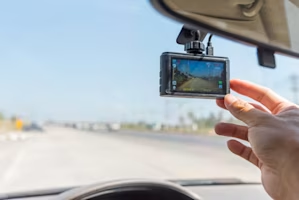
An engineer may do this, you may plug it in yourself, or you may just download a smartphone app.
Get answers in seconds with our AI chatbot.
Black box car insurance, also called telematics insurance, is a type of policy that involves having a device in your vehicle that allows your insurer to monitor your driving habits. This includes speed, braking, acceleration and time of day.
If you have low-risk driving behaviours your insurer will often offer you lower premiums when you renew.
Telematics insurance can be particularly valuable for drivers who personally drive in a low-risk way but belong to demographic groups insurers consider higher-risk. This includes young people, new drivers and drivers with criminal records.

Insurers use data on your driving habits - like mileage or cornering - to calculate your risk.
Lower risk can mean cheaper premiums at renewal or after a monitoring period.
An engineer may do this, you may plug it in yourself, or you may just download a smartphone app.

The way you drive is monitored by your telematics device, and the data is fed back to your insurer.

Different insurers will have different timeframes for adjusting your policy. Often, it's at your renewal.
Telematics monitors how, when and where you drive to help insurers assess your risk more accurately. This information is combined into a driving score, which insurers use to adjust your premiums. Safer driving habits usually mean a lower risk of accidents and lower insurance costs.
Telematics car insurance typically tracks:
the time of day you drive, as driving at night is often higher risk
the locations you drive in, including areas with higher accident or theft rates
the types of roads you use, such as motorways versus residential roads
sudden impacts on the vehicle, which may indicate a collision
how quickly you accelerate, as harsh acceleration can increase risk
how you brake, with sharp braking suggesting late reactions
how you take corners, including speed and smoothness
how often you drive
how far you drive overall

An engineer installs this type of device into your car, usually behind the dashboard.
Best for: Drivers who won't switch their policy or car soon, or who don't drive with a phone.
You install this type of device yourself. It goes in the USB slot or cigarette lighter.
Best for: Drivers who want a quick set-up and won't use telematics long-term.
You download an app to your smartphone, and use it while driving.
Best for: Tech-savvy drivers who want to monitor their driving habits in real time.
Earn insurance discounts
May improve your driving skills
Provides reassurance for parents
Telematics data can be used as evidence to settle claims
GPS function can deter car thieves
Premiums can increase if you drive in riskier ways
Insurers may restrict where and when you drive
Other people driving your car may affect your score
May be additional installation or dismantling fees
Data doesn't automatically transfer if you switch insurer
The table below shows the price difference between the cheapest non-telematics and the cheapest telematics car insurance that was available for MoneySuperMarket customers who ultimately bought a telematics policy.
Age group | % price difference: non-telematics vs telematics | Absolute price difference: non-telematics vs telematics |
|---|---|---|
17-19 | -42%^ | -£1209^ |
20-29 | -18%^ | -£280^ |
30-39 | 9%^ | £74^ |
What the data tells us: On average, the cheapest telematics policy for a 17-19 year old cost -£1209^ (-42%^) less than the cheapest non-telematics policy. But 30-39 year olds, on average, pay £74^ more (9%^) for a telematic policy compared to a standard car insurance policy.
Car insurance quotes are based on your individual circumstances, so your own savings may be different. Overall, however, you are most likely to benefit from black box car insurance if you are a younger or first-time driver. The longer you've been driving, the less likely it is that a telematics policy will save you money.
These are the average annual prices of telematics policies sold through MoneySuperMarket.
Average prices for telematics insurance can look high because these policies are most commonly taken out by new or young drivers, who pay more for car insurance.
You can choose telematics cover with any of the three main types of standard car insurance: fully comprehensive, third party fire and theft, and third party only.
Fully comprehensive car insurance:
✔ Covers you and your car
✔ Covers fire damage and theft of your car
✔ Covers other people and their cars
Third-party, fire and theft car insurance:
✔ Covers other people and their cars
✔ Covers fire damage and theft of your car
Third-party only car insurance:
✔ Covers other people and their cars
Fully comprehensive cover can be cheaper than lower levels of cover.
That's because insurers often see drivers who choose comprehensive policies as lower risk, which can reduce the price despite the wider protection.
🚩 Not all add-ons will be available for all telematics policies. Check with your insurer.

In case your car has a mechanical problem while you're driving it.

In case your car is unusable but you still need to drive.

In case your windscreen is chipped, cracked or broken.

In case you lose or damage your car keys and need replacements.

In case you put diesel in your petrol car, or vice versa.

In case you are taken to court for your role in a car accident.

In case you or your passengers are hurt or killed in a crash you caused.

In case your stuff is stolen from your car, or damaged while in the car.
Seeing several options and prices makes it easier to find the best deal for you.








One Protect
Great for
But be aware that

80% of car users think that they are better-than-average drivers, according to research from the Open University.
Unfortunately for drivers who have an accurate assessment of their abilities, car insurers usually charge based on broad generalities, including the risk profile of the demographic group people fall into.
Telematics policies are the exception to this rule. For safe drivers who happen to belong to a high-risk group like new or young drivers, it can be a good deal. That's why 61% of drivers aged 18-24 are now considering it, according to data from The Green Insurer.
Beth Leslie Senior Insurance Content Editor
MoneySuperMarket has won the Feefo Platinum Trusted Service Award, an independent seal of excellence, which recognises businesses that consistently deliver a world-class customer experience.



Car insurance group checker - check which insurance group your car falls into as cars in lower groups typically have cheaper premiums
Car insurance cover advisor - helps you find the right type of provisional licence insurance, depending on how many days cover you need and whether you have your own car or not
Car insurance job picker - find out if tweaking your job title could save you money as insurers consider some jobs as higher risk than others
Annual mileage calculator - work out your annual mileage before getting a quote so you don’t overestimate your mileage and unnecessarily pay more for cover

No, you'll be insured to drive your vehicle as soon as your policy starts, even if you haven't had your black box installed yet.
Yes. Your insurance provider will usually have an online portal or app which you can log into to see a dashboard with your driving information and how it is being 'scored'.
You will generally be able to see your journey history, speed patterns, and a breakdown of how your score is being calculated.
Yes. Black box insurance policies are designed to reward lower-risk driving habits. If the data from your device suggests you are a higher-risk driver your insurer will consider you more likely to make a claim and may respond by increasing your insurance premiums.
Higher-risk driving isn't just about having bad driving skills. If you often drive at night or on more dangerous roads insurers will consider you more likely to claim from them, even if your actual driving is very good.
However, as your telematics data will not be shared outside of your specific insurer, if black box insurance is increasing your premiums you always have the option to switch to a non-telematics policy.
Yes, if they're insured to drive your car. Usually, this means you'll need to add them as a named driver on your policy.
Since telematics can't tell who is in the driver's seat, anyone who drives your car could affect your driving score, and therefore your premiums.
No. Turning off or tampering with a black box while your telematics policy is active can invalidate your car insurance.
If your car insurance is invalidated, your insurer will not have to pay out if you make a claim, and your insurance premiums will likely be higher in the future. Plus, since driving without insurance is illegal, if you use your car while your policy is invalid you could face fines, penalty points, and having your vehicle seized.
If you no longer want to use your black box, you can cancel your telematics policy at any time. As with all car insurance policies, you may be charged some fees for doing this, especially if you've had the policy in place for more than two weeks.
Exceeding your estimated annual mileage is rarely a problem as long as your insurer is aware of it. Your provider will generally just charge you a bit extra to reflect the additional risk.
Some telematics policies adjust premiums automatically based on your recorded mileage, while others require you to contact your insurer to increase your mileage allowance. In this case, it's best to update your insurer in advance of going over your mileage to avoid unexpected charges or issues with your cover.
Depending on the type of telematics device and your insurer, the black box may detect a crash by measuring the force of impact. It can also send your location, which may help emergency services respond more quickly.
The data recorded before and during the incident, such as speed, braking and direction of travel, may be reviewed by insurers when investigating the claim. This information can be used to help establish what happened and, in some cases, support or challenge fault decisions if there is a dispute between drivers or insurers.
Many black boxes use GPS to track your car’s location. If your car is stolen and the device is still active and has not been removed or damaged, your insurer may be able to share location data with the police to help recover it.
GPS tracking is not guaranteed. Signals can be lost if the device is disabled, removed, or the car is taken somewhere with poor reception. Insurers are not responsible for recovering the vehicle, but they can support the investigation once you report the theft.
You must report the theft to the police as soon as possible and provide your insurer with the crime reference number to progress your claim.
The time, cost and process of switching your telematics insurance to a new car will vary depending on what type of monitoring system you have.
Plug-in device or smartphone app
If you use a plug-in device or a smartphone app, switching cars is usually straightforward. You’ll still need to tell your insurer so they can update the policy details, but no new installation is required.
2. Hard-wired black box
If your policy uses a hard-wired black box, the process is more involved. Your insurer will usually deactivate the old device and arrange for a new one to be fitted in your new car. This can take a few days to organise, depending on installer availability, and you may not be able to drive the new car until the box is installed.
Some insurers cover the cost of transferring or refitting the black box, but others may charge a fee. This fee is usually within the £100-£200 range. For example, as of 2026 Wise Driving charges £120 to move a black box between vehicles.
It’s worth checking specific costs and timescales with your insurer before changing cars so you can avoid delays or unexpected charges.
Yes, you can cancel your telematics policy at any time. However, you may have to pay fees for both cancelling the policy and for removing your black box.
Cancellation fees
With all types of car insurance, if you cancel after the 14-day cooling-off period you will usually pay a cancellation fee. These vary by insurer and are often around £50. For example, as of 2026 Hastings Direct charges £45 to cancel a car insurance policy early, while Aviva charges £38.
Refunds
If you cancel mid-policy, any refund of your premiums is normally calculated on a pro-rata basis. This means you get back the unused portion of your premium, minus the cancellation fee and any non-refundable costs, such as black box installation.
Black box removal (optional)
Once the policy is cancelled, your insurer will deactivate your telematics device. If you have a professionally installed black box, you can usually choose whether to have it removed. This often comes with an extra charge, which commonly ranges from £100 to £200.
It depends on your insurer. Some will cover driving in certain other countries as standard, or you may be able to add this cover to your policy for a fee.
It depends on the type of telematics policy you choose, as installation and setup vary.
Some policies use a professionally installed black box. An engineer fits the device directly into your car, and your insurer usually arranges the appointment at a time that suits you. Installation typically takes place after the policy starts, and you may be given instructions on when you can drive.
Other policies use a self-install device. These are usually plug-in boxes that connect via the car’s OBD port, USB port or cigarette lighter. You fit them yourself by following the insurer’s instructions, and they can usually be moved to another car if you change vehicles.
Some telematics policies are app-based. Instead of a physical device, you download an app to your smartphone, which uses your phone’s sensors and GPS to monitor driving. These are often the quickest to set up but rely on you carrying your phone on every journey.
It depends on your insurer and policy type. But as a general rule of thumb:
You will not be charged anything extra for black box installation
You will be charged around £50-£100 for removal if you have the type of black box that needs to be uninstalled by an engineer
Some insurers will also charge a no-show fee if you miss a scheduled installation appointment.
It depends on your insurer.
Some will offer a discount upfront when you take out a black box policy. But it is more common for insurers to monitor your driving habits for a period of time, or number of miles, before offering low-risk drivers a discount. This timeframe is generally between 3 and 12 months.
At MoneySuperMarket, we want to give you clear, accurate and trustworthy information so you can make confident financial decisions for your circumstances.
Every page on our website goes through a careful editorial process before it is published. It’s written or reviewed by one of our experienced experts, checked for accuracy, and updated regularly to reflect the latest information.
We do use AI tools to support our research and drafting, but a human editor is always in the loop to review, fact-check and approve everything before it’s published, so you can trust that what you’re reading is both reliable and up to date.
You can read more in our editorial guidelines.
We get paid by the companies we work with, but the payment we get doesn’t have any bearing on the information we provide. We get paid in different ways, depending on the type of product or service you buy through us. Our goal is to search deals from as wide a range of companies as possible, but we only show results from our partner providers.
Our comparison service is, and will always be, free to use.
One of the best ways to get the lowest prices and best deals is to compare quotes from different companies. We do the work for you, comparing quotes side-by-side and giving you all the information you need so you can choose the right deal for your needs and your wallet.
We don’t give recommendations or financial advice, but we give you clear information so you can choose financial products that suit your circumstances.
No, not every company can be included in our service. This is because some companies don’t want their products included on comparison sites, and some decide that they would rather not pay a fee. There are also a few smaller providers who can struggle to cope with the volume of customers that can find their products if they appear on MoneySuperMarket.
Our goal is to search deals from as wide a range of companies as possible so that you can choose the deal that suits you.
Yes, you can earn SuperSaveClub rewards when you buy car insurance through MoneySuperMarket.
This includes:
Up to £15, which you can withdraw as a pre-paid Mastercard or a gift card for brands like Sainsbury's and Amazon.co.uk
Free Days Out pass (worth £180), which gives free entry to a range of UK attractions
Cashback of up to 10% when you spend at brands including eBay, Just Eat and Argos
To earn SuperSaveClub rewards on purchases you must:
Sign up to SuperSaveClub (it's free)
Be signed in to your account when you make the purchase
More information can be found on our SuperSaveClub homepage.
Yes, car insurance is included in our Super Save Price Promise.
If you buy through us then find the same deal for less we will:
refund the difference
give you a gift card worth up to £20
Terms and conditions apply. More information can be found on our Price Promise page.
Reviewed on 17 Mar 2026 by
SuperSaveClub restrictions and T&Cs apply. Click here for details.
Source: Consumer Intelligence, 2026, 'Young drivers are not disappearing. The under-25 motor market is changing.' report.
Based on the median annual price of the cheapest telematics quoted vs none telematics quoted on MoneySuperMarket for a given search in January 2026.
Based on the median annual price of the cheapest telematics quoted vs none telematics quoted on MoneySuperMarket for a given search in January 2026.
Based on the median annual price of the cheapest telematics quoted vs none telematics quoted on MoneySuperMarket for a given search in January 2026.
Based on the median annual price of the cheapest telematics quoted vs none telematics quoted on MoneySuperMarket for a given search in January 2026.
Based on the median annual price of the cheapest telematics quoted vs none telematics quoted on MoneySuperMarket for a given search in January 2026.
Based on the median annual price of the cheapest telematics quoted vs none telematics quoted on MoneySuperMarket for a given search in January 2026.
Based on the median annual price of third party only policies sold through MoneySuperMarket in January 2026.
Based on the median annual price of comprehensive policies sold through MoneySuperMarket in January 2026.
Based on the median annual price of third party, fire & theft policies sold through MoneySuperMarket in January 2026.


