


Pay-as-you-go car insurance
What is it?
Car insurance that charges you per mile
When is it best?
You do under 6,000 miles per year

Pay-as-you-go car insurance is a type of policy that charges you based on how much you drive.
It’s ideal if you’re a low-mileage driver, driving under 6,000 miles a year. You might have to pay more with a standard annual car insurance policy.
🚩 Regardless of how much you drive, car insurance is a legal requirement
Pay-per-mile insurance - charges you a set amount per mile driven
Pay-per-hour/pay-per-day insurance - charges you based on how much time you’ve driven
Usage-based insurance - charges you based on the way you drive using telematics or a black box device
If you drive fewer than 6,000 miles a year, pay-as-you-go car insurance could work out cheaper than a standard policy.
Students
People who usually use public transport
Remote workers
Weekend or holiday drivers
High-mileage drivers
People who like certainty about bills
Pay-as-you-go car insurance uses a telematics or black box device to work out how much you pay. This can be:
A device you plug in to your car
A smartphone app
The amount of data collected differs depending on whether you have pay-per-mile insurance or usage-based insurance (also known as pay how you drive insurance). The way you pay is different too.
💡 Top tip: To find the best deal, get quotes for each type of PAYG insurance, and also look at alternative short term options to compare prices.
Yes, you can usually see quotes from pay-as-you-go providers like ByMiles if you tell us you drive below 6,000 miles a year. You'll be able to tell us how many miles you drive when getting car insurance quotes.
Pay-per-mile insurance | Pay how you drive insurance | |
|---|---|---|
What data is recorded? | The number of miles you drive | How you drive e.g. harsh braking or accelerating, car speed Your mileage What time of day you drive |
What do I pay? | A set monthly amount plus a per mile rate | An annual amount * |
* Your insurer might adjust your premium during the year based on how you’re driving or wait until renewal to lower your annual premium
What is it?
Car insurance that charges you per mile
When is it best?
You do under 6,000 miles per year

What is it?
A short-term car insurance policy that lasts for a few hours, days, weeks, or months
When is it best?
You’re borrowing a car or making occasional trips

What is it?
A traditional, annual premium but you may get a discount for low mileage
When is it best?
You drive regularly but have below-average mileage
Pay-as-you-go car insurance policies usually offer fully comprehensive cover.
However, you may be able to find third-party only or third-party fire and theft PAYG policies.

✔ Highest level of protection
✔ Injuries and damage to you and your car
✔ Medical expenses
✔ Fire and theft
✔ Injuries and damage to others
✔ Legal protection

✔ Injuries and damage to others
✔ Fire damage to your car
✔ Theft of your car

✔ Legal requirement
✔ Injuries and damage to others
Pay-as-you-go car insurance provides the same core protections as standard car insurance - the main difference is how you pay.
Based on a fully comprehensive policy, here is what is and isn't covered with pay-as-you-go car insurance:
Taking your driving test: Your insurance policy will typically be active while you sit your test but your cover will cease as soon as you pass
Damage to your vehicle: You’ll be able to claim on your policy for damage done to your own car from an accident, fire, vandalism or a natural disaster such as storm damage, as well as a replacement vehicle if yours is stolen
Third-party damage caused by your vehicle: You’ll be covered for damage you cause to a third-party, their vehicle or their property
Legal costs: Fully comprehensive cover often includes motor legal protection, which pays out for legal costs you may face related to a claim
Serious or fatal injuries: A personal accident policy offers compensation if you’re seriously or fatally injured in a road accident
Windscreens: You’ll often be able to claim for a windscreen repair or replacement if you get a windscreen chip or a cracked windscreen
Driving without supervision: Some insurers will also specify that your supervising driver is at least 25 years old
Driving once you’ve passed your test: You won’t be covered driving back home from the test centre or afterwards
Vehicles and drivers not named on your policy: Drivers that haven't been named on your policy and driving other cars is not covered
Standard wear and tear: Fully comprehensive cover doesn't extend to normal wear and tear that's expected over time
Accidents if you're under the influence: You won't be covered in the event of an accident while you're under the influence of alcohol or drugs
Invalid driving licence: If you or another named driver are driving without a valid licence (e.g. if it's out of date), you won't be covered
Mileage beyond agreed limits: May not be covered or your premium may be adjusted if you exceed the thresholds set by your insurer
Add-ons will cover you for scenarios and costs that are not typically included in car insurance policies.
While add-ons like breakdown cover can provide extra peace of mind, they do come with an extra cost that will be added to your policy.
If your car breaks down, breakdown cover provides assistance at the roadside to get your vehicle moving again. This may be particularly useful if you have an older vehicle which is more likely to suffer mechanical problems than a new one. You can sometimes get cheaper breakdown cover by combining it with your car insurance.
Provides a replacement vehicle while yours is being repaired. This is ideal if you rely on your car daily for commuting. Courtesy car cover is often included for free in comprehensive car insurance policies.
Your insurance may cover you for driving abroad but it may be third-party only cover so you’ll need to speak to your insurer if you want to upgrade it to comprehensive cover.
Protects your no-claims discount by letting you make a certain number of claims within a year before it affects your premiums. Building a no-claims discount will reduce your premiums over time and if you’ve had no claims for several years you might want to protect it. But you’ll need to pay extra to do so.
Covers the cost of replacing lost, damaged or stolen keys. If your car has keyless entry it will be more expensive to replace your key fob than if you have a standard car key so this might be a worthwhile add-on to your insurance. Some comprehensive policies may include cover for car keys.
Covers the cost of draining and cleaning the fuel tank if you accidentally put the wrong fuel type in your car (known as misfuelling).
Pays for the cost of repairing or replacing a cracked windscreen.
Personal belongings cover offers protection for your belongings in the event your car is stolen. Some comprehensive car insurance policies may include this or it may be covered under your home insurance.
Pay-as-you-go car insurance works quite differently to standard car insurance policies, so it’s useful to be aware of the pros and cons of this type of cover:
Cost: Often cheaper for low-mileage drivers or high-risk drivers facing high premiums already
Flexibility: You’re not tied into an annual commitment with pay-per-mile insurance
Discounts: Telematics insurance rewards you for good driving
Expensive for high mileage: Likely to cost you more than a standard policy you if you need to drive over 6,000 miles
Age restrictions: Some providers set a minimum driver’s age
No-claims bonus: Might be unavailable or limited
Privacy: You might not like the idea of a device tracking your car’s movements
Budgeting: Although you have a set monthly amount with pay-per-mile the mileage fee you pay on top will vary
The cost varies depending on factors such as:
Pay-per-mile is a set monthly fee plus a per-mile charge, pay how you drive can go up or down depending on your driving habits
For pay how you drive (telematics) insurance, riskier late night driving will increase costs
If you park your car off the road, ideally in a locked garage, this extra security is likely to lower premiums
Younger and new drivers tend to face higher premiums
The make, model and car insurance group it falls under
Having a lower mileage generally makes your car insurance cheaper.
Drivers who spend less time on the road are considered less of a risk, as they aren't as likely to get into an accident as drivers who spend more time on the road.
However, our data shows that the cheapest average annual comprehensive policies are offered to those who drive between 10,001-20,000 miles.
There are a couple of reasons this could be:
Insurers correlate having limited driving experience with a higher accident risk
Some higher-risk groups, like young drivers, also tend to drive fewer miles so are over-represented in those mileage groups
🚩 These are figures for standard car insurance. Specialist low-mileage insurance, including pay-as-you-go policies, is likely to be cheaper the fewer miles you drive.
Mileage band | Average cost of comprehensive annual policy |
|---|---|
0-5,000 | £519.07^ |
5,001-10,000 | £501.57^ |
10,001-20,000 | £488.44^ |
20,001-30,000 | £580.09^ |
30,001-40,000 | £618.05^ |
50,000+ | £631.85^ |

If you’re a low mileage driver or you’re a new driver facing a high premium, you should consider pay-as-you-go car insurance as it could work out cheaper for you. Having telematics or black box insurance, where a device or app monitors how the car is being driven, will reward you for safe driving whereas pay-per-mile insurance only tracks the miles you do. Make sure you check the small print for an annual mileage limit, cancellation fees or other restrictions
Sarah Tooze Car & Van Insurance Expert



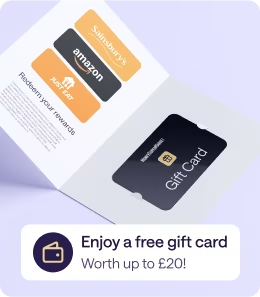
We’ll reward you every time you make a purchase. Exchange your earnings for a gift card for Amazon.co.uk
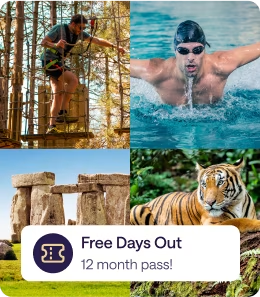
A year's worth of free experiences across the UK. From London Zoo and Go Ape, to Hussle Swimming and English Heritage, there’s an adventure for everybody. Worth £180
Whether you're buying clothing, homewares or takeaways, earn up to 10%

You and your friends each get up to £20 when they join the Club and make a qualifying purchase. Win-Win!
MoneySuperMarket has won the Feefo Platinum Trusted Service Award, an independent seal of excellence, which recognises businesses that consistently deliver a world-class customer experience.

Pay-as-you-go car insurance is similar to short-term car insurance, but not exactly the same. While a pay-as-you-go policy charges by the mile or by the hour, temporary car insurance policies offer the standard level of protection – and you pay a set price for a set amount of time you’ll be covered.
They can be more economical than year-long policies in certain situations – for example, if you only need cover for a day to move home, or for a month if you’re borrowing a car from a friend.
Some insurers providers offer black box insurance, but it's not always necessary to have a black box to get PAYG car insurance. Black box car insurance involves having a black box installed into your car by an approved mechanic – however they may also offer a plug-in device that goes into your cigarette lighter, or an app that uses your mobile phone’s GPS tracker.
Pay-as-you-go car insurance can be cheaper than an annual policy – it really depends on how, when and where you drive.
Your insurer will keep your driving data safe and secure, generally just using it to monitor your driving habits and checking any claims you make or someone else makes against you. They may also share it with their business partners, but they won’t sell it.
Pay-as-you-go policies are likely to have all the same standard exclusions as a regular policy – but specific exclusions you might look for include:
Commercial or business usage: You’ll likely need specialist business car insurance if you use your car for commercial reasons – you might find some pay-as-you-go providers won’t offer commercial cover at all
Track days or rallies: You may also not be able to attend track days, rallies or trials if you use telematics or pay-as-you-go cover
Device tampering: If you tamper with your device, whether it’s a black box or a plug-in device, this will almost certainly void your cover
With pay-per-mile or pay-per-hour policies it’s only the time or distance you drive that will be tracked, but for full telematic policies they’ll also track your speed, cornering, braking and other aspects of your driving performance.
At MoneySuperMarket, we want to give you clear, accurate and trustworthy information so you can make confident financial decisions for your circumstances.
Every page on our website goes through a careful editorial process before it is published. It’s written or reviewed by one of our experienced experts, checked for accuracy, and updated regularly to reflect the latest information.
We do use AI tools to support our research and drafting, but a human editor is always in the loop to review, fact-check and approve everything before it’s published, so you can trust that what you’re reading is both reliable and up to date.
You can read more in our editorial guidelines.
We get paid by the companies we work with, but the payment we get doesn’t have any bearing on the information we provide. We get paid in different ways, depending on the type of product or service you buy through us. Our goal is to search deals from as wide a range of companies as possible, but we only show results from our partner providers.
Our comparison service is, and will always be, free to use.
One of the best ways to get the lowest prices and best deals is to compare quotes from different companies. We do the work for you, comparing quotes side-by-side and giving you all the information you need so you can choose the right deal for your needs and your wallet.
We don’t give recommendations or financial advice, but we give you clear information so you can choose financial products that suit your circumstances.
No, not every company can be included in our service. This is because some companies don’t want their products included on comparison sites, and some decide that they would rather not pay a fee. There are also a few smaller providers who can struggle to cope with the volume of customers that can find their products if they appear on MoneySuperMarket.
Our goal is to search deals from as wide a range of companies as possible so that you can choose the deal that suits you.
Yes, you can earn SuperSaveClub rewards when you buy car insurance through MoneySuperMarket.
This includes:
Up to £15, which you can withdraw as a pre-paid Mastercard or a gift card for brands like Sainsbury's and Amazon.co.uk
Free Days Out pass (worth £180), which gives free entry to a range of UK attractions
Cashback of up to 10% when you spend at brands including eBay, Just Eat and Argos
To earn SuperSaveClub rewards on purchases you must:
Sign up to SuperSaveClub (it's free)
Be signed in to your account when you make the purchase
More information can be found on our SuperSaveClub homepage.
Yes, car insurance is included in our Super Save Price Promise.
If you buy through us then find the same deal for less we will:
refund the difference
give you a gift card worth up to £20
Terms and conditions apply. More information can be found on our Price Promise page.
Reviewed on 27 Mar 2026 by
YouGov Survey 1st July 2024 to 30th June 2025. Net Recommend score derived from “Which of the following online service websites would you recommend to a friend or colleague, or tell them to avoid?” Base: Current Customers of (MoneySuperMarket n=18,382, Compare the Market n=16,802, Go.Compare n=10,162, Confused.com n=8,229, Uswitch n=528).
Based on 1 visit per month – average ticket value £15.30 (Oct 24)
T&Cs and restrictions apply, see here for more information
Based on the median annual price of comprehensive policies sold through MoneySuperMarket in January 2026.
Based on the median annual price of comprehensive policies sold through MoneySuperMarket in January 2026.
Based on the median annual price of comprehensive policies sold through MoneySuperMarket in January 2026.
Based on the median annual price of comprehensive policies sold through MoneySuperMarket in January 2026.
Based on the median annual price of comprehensive policies sold through MoneySuperMarket in January 2026.
Based on the median annual price of comprehensive policies sold through MoneySuperMarket in January 2026.
T&Cs and restrictions apply, see here for more information
T&Cs apply, click here for more information

