

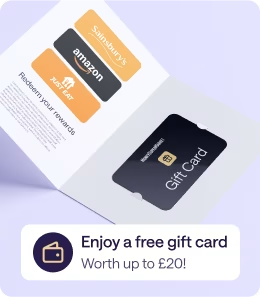
Earn up to £20^ every time you buy
We’ll reward you every time you make a purchase. Exchange your earnings for a gift card for Amazon.co.uk

Provisional licence insurance, also commonly known as learner driver insurance, provides car insurance cover while you are practising to pass your driving test.
It covers you for:
Injury or damage you cause to other people, their vehicles or property
Damage to the car you’re driving (if you choose comprehensive cover)
Yes - it is illegal to drive on UK roads without valid car insurance in place, including for learner drivers.
You can be fined £300 and get 6 penalty points on your licence if you drive without insurance.
Most driving schools will cover you with their own insurance policy, but if you’re taking private lessons in your car, or using a friend's or family member's car while supervised, getting your own provisional licence insurance is a must.
Learner drivers can be covered through standard car insurance or on a specialist learner driver policy.
Parents and other qualified drivers can usually add learner drivers to their own car insurance as a named driver. This is likely to raise your premiums and may affect your no claims bonus if the learner driver has an accident.
Regardless of the car insurance type, learner drivers are typically only covered:
When the learner is supervised
While driving in the UK
During practice sessions, not the driving test, unless the policy confirms otherwise
Once you pass your UK driving test, cover arranged for a provisional licence holder will no longer apply. You’ll need to update your car insurance or take out a new policy that reflects your full driving licence.
🚩 MoneySuperMarket does not show quotes for specialised learner driver insurance. We show quotes for standard car insurance policies which may be suitable for learners.

There are three main types of car insurance a learner driver and new drivers can choose from:
Covers damage to your own or other people's vehicle, medical expenses, fire damage, and theft of your vehicle
Covers property damage and injury to third-parties, fire damage to your vehicle, and theft of your vehicle
The minimum level of cover legally required, it only covers third-party property damage and injury
💡 Top tip: Check age restrictions. Some specialist providers have upper age limits of 25 or 34. All insurers will require you to be at least 17 years old.
A UK resident
A UK provisional licence holder with no penalty points, motoring convictions or offences
Supervised by someone who:
is at least 21 years old
has held a full UK driving licence for at least three years
is not currently banned from driving
is qualified to drive the type of car you're learning in (manual or automatic)
Less than 40 years old
Roadworthy and taxed
Registered in the UK with a valid MOT
Displaying L plates (or you can use D plates in Wales)
Usually worth less than £40,000
A car you own or one you have permission to drive from the registered keeper (it can’t be a rental car)
Unmodified
Based on a fully comprehensive policy, here is what is and isn't covered with learner drivers insurance:
Taking your driving test: Your insurance policy will typically be active while you sit your test but your cover will cease as soon as you pass
Damage to your vehicle: You’ll be able to claim on your policy for damage done to your own car from an accident, fire, vandalism or a natural disaster such as storm damage, as well as a replacement vehicle if yours is stolen
Third-party damage caused by your vehicle: You’ll be covered for damage you cause to a third-party, their vehicle or their property
Legal costs: Fully comprehensive cover often includes motor legal protection, which pays out for legal costs you may face related to a claim
Serious or fatal injuries: A personal accident policy offers compensation if you’re seriously or fatally injured in a road accident
Windscreens: You’ll often be able to claim for a windscreen repair or replacement if you get a windscreen chip or a cracked windscreen
Driving without supervision: Some insurers will also specify that your supervising driver is at least 25 years old
Driving once you’ve passed your test: You won’t be covered driving back home from the test centre or afterwards
Vehicles and drivers not named on your policy: Drivers that haven't been named on your policy and driving other cars is not covered
Standard wear and tear: Fully comprehensive cover doesn't extend to normal wear and tear that's expected over time
Accidents if you're under the influence: You won't be covered in the event of an accident while you're under the influence of alcohol or drugs
Invalid driving licence: If you or another named driver are driving without a valid licence (e.g. if it's out of date), you won't be covered
Mileage beyond agreed limits: May not be covered or your premium may be adjusted if you exceed the thresholds set by your insurer
Car insurance prices for 17-24 year olds who hold a provisional UK driving licence start from £199.02
Yes, your car insurance will probably become more expensive after you pass your test. The average cost of car insurance for a driver who has held their licence for less than a year is £1457.53
Insurance premiums are based on your risk of making a claim, and insurers generally see learner drivers as lower risk than newly qualified drivers. That’s because learners are supervised by a more experienced driver and face certain restrictions, such as not being allowed to drive on motorways (unless with an approved instructor).
Short-term temporary cover or being a named driver is likely to be the cheapest option if:
Most of your driving is going to be done in your driving instructor’s car
You will only occasionally practise in your parents’ car or a friend’s car
But you might want to consider a standalone or annual policy if:
You’re not taking formal driving lessons
You don’t want to risk impacting your parents’ no claims discount
You have your own car as you’ll need learner driver insurance
Before making a decision it’s a good idea to compare the cost of short-term, annual and standalone learner policies, as well as being a named driver on another policy.

We’ll reward you every time you make a purchase. Exchange your earnings for a gift card for Amazon.co.uk
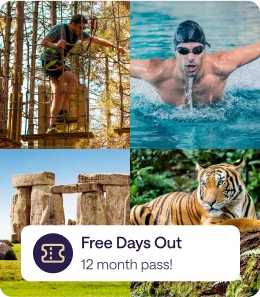
A year's worth of free experiences across the UK. From London Zoo and Go Ape, to Hussle Swimming and English Heritage, there’s an adventure for everybody. Worth £180
Whether you're buying clothing, homewares or takeaways, earn up to 10%
You and your friends each get up to £20 when they join the Club and make a qualifying purchase. Win-Win!
Compare quotes from 194
Add-ons will cover you for scenarios and costs that are not typically included in car insurance policies. While add-ons like breakdown cover can provide extra peace of mind, they do come with an extra cost that will be added to your policy.
If your car breaks down, breakdown cover provides assistance at the roadside to get your vehicle moving again.
Provides a replacement vehicle while yours is being repaired.
Personal accident cover pays out a lump sum if you’re injured or killed in a road accident.
Motor legal protection will covers any legal fees you might face in relation to a road accident.
Windscreen cover will pay for the cost of repairing or replacing a chipped, cracked or smashed windscreen.
Covers the cost of replacing lost, damaged or stolen keys.
Covers the cost of draining and cleaning the fuel tank if you accidentally put the wrong fuel type in your car (known as misfuelling).
Personal belongings offers protection for your belongings in the event your car is stolen, which can be handy if you tend to leave them in your car.
Protects your no-claims discount by letting you make a certain number of claims within a year before it affects your premiums. Building a no-claims discount will reduce your premiums over time.
You’ll need learner driver insurance until you pass your test. While there is no minimum number of hours or driving lessons you need to have, it typically takes 45 hours of lessons, plus 22 hours of practising, according to BBC research.

Annual cover lasts a whole year or until you pass your driving test when you’ll need to contact your insurer to upgrade it or cancel and change to a different provider.
But be aware that cancellation might come with extra fees. If you plan to keep using the same car once you’ve got your licence, annual cover might be best.

If you’re using a car solely for lessons, consider short-term cover. Short-term cover usually costs more per day than annual cover.
It insures you on any car, as long as the licence holder is with you when you're learning to drive. Once you pass your test it becomes invalid so you’ll need to arrange new cover.

According to our survey, 95% of people underestimate the cost of learning to drive. The MoneySuperMarket Household Money Index in March 2024 revealed that the average 17-20 year-old pays £7,609 to get on the road. The three biggest costs contributing to that figure are buying a car (£2,987.45), paying for driving lessons (£1,690.59), and the cost of insuring a car if you’re 17-20 years-old (£1,699.69). If you have children who are approaching 17, knowing the breakdown of the £7,609 total average cost means you can prepare and discuss early on how much you might be able to help.
Sara Newell Motor & Home Insurance Expert


MoneySuperMarket has won the Feefo Platinum Trusted Service Award, an independent seal of excellence, which recognises businesses that consistently deliver a world-class customer experience.


All the insurers we work with are authorised and regulated by the Financial Conduct Authority (FCA)

We're also the UK's most recommended price comparison website

Save up to £513

Buy through us and get up to £15
Car insurance group checker - check which insurance group your car falls into as cars in lower groups typically have cheaper premiums
Car insurance cover advisor - helps you find the right type of provisional licence insurance, depending on how many days cover you need and whether you have your own car or not
Car insurance job picker - find out if tweaking your job title could save you money as insurers consider some jobs as higher risk than others
Annual mileage calculator - work out your annual mileage before getting a quote so you don’t overestimate your mileage and unnecessarily pay more for cover

Yes, your parent can drive your car provided they have the correct insurance, such as:
Being a named driver on your insurance policy
Having a car insurance policy which allows them to drive other cars. Although they may only have third-party cover when they drive your car
Taking out temporary cover
If a learner driver causes an accident they are responsible but their driving instructor can also be held responsible if:
They didn’t make sure the learner driver followed the rules of the road and drove safely
They didn’t intervene to prevent the learner driver causing an accident by using dual controls
They were under the influence of drugs or alcohol
They were distracted by using their mobile phone
If you’re driving with a provisional licence, there are some rules you need to follow, including:
Driving with supervision: You can’t legally drive unless you’re supervised by another driver aged 21 or older who’s had their licence for at least three years and is qualified to drive the type of vehicle you want to learn in i.e. a manual or automatic car. Some insurance providers require the supervising driver to be over 25 years old
Motorway use: You cannot legally drive on the motorway unless you’re with a certified driving instructor and the car has dual controls
Using ‘L’ plates: You need ‘L’ plates on the car whenever you’re behind the wheel – or ‘D’ plates in Wales. Failure to display the right plates can result in 6 penalty points
Insurance: You need the correct insurance in place to cover you if you’re practising in your own car or someone else’s otherwise you risk an unlimited fine, be banned from driving and get up to 8 penalty points
Usually, your supervisor can be anyone – a friend, a family member, or a private teacher. But they need to be:
Over the age of 21 with at least three years’ driving experience.
Qualified to drive the type of vehicle you want to learn in i.e. a manual or automatic
Remember that:
You can’t drive on the motorway if you’re being supervised by a family member or friend
Your friend or family member can’t use their mobile phone while supervising you
Some insurers might have extra criteria, such as requiring a supervising driver to be over 25, so make sure you check the small print before you buy
Once you’re a fully licensed driver, your learner driver insurance policy is no longer valid. You’ll need to contact your insurer as soon as you pass your test to avoid accidentally driving uninsured.
They’ll be able to update your policy or you can switch to a new provider if you find a cheaper deal.
Remember, it’s illegal to drive without valid insurance – even if you’re just driving back from your test.
Fronting is an illegal practice in which a less experienced motorist is added as a secondary driver on a car’s insurance policy, when they’re actually the main driver. Fronting is always against the law, and if you’re caught you could end up in court – better to be honest with your insurer about who’ll be doing most of the driving.
Yes, if you’re a fully qualified driver and you add a learner driver (such as your child) to your policy, your premiums are likely to go up. But the increase will often be smaller than if you’d added a newly qualified driver, since insurers assume that learners won’t be using the car as much – lowering the risk of an accident.
Yes, some insurers do allow you to start building a no-claims bonus if you take out learner driver insurance in your name and you’re practising in your own car.
Yes, you can add a learner driver to your existing car insurance policy, but it may be better for learner drivers to take their own cover out so they can start building a no-claims bonus.
You also need to be aware that adding them to your policy:
Could increase the cost of your premium
Will impact your no-claims bonus if they have an accident in your car
Yes, learner driver insurance often includes taking your driving test in your own car (check your policy documents to be sure). However, as soon as you pass your test you will need to upgrade your insurance from learner driver insurance to standard cover for a qualified driver.
At MoneySuperMarket, we want to give you clear, accurate and trustworthy information so you can make confident financial decisions for your circumstances.
Every page on our website goes through a careful editorial process before it is published. It’s written or reviewed by one of our experienced experts, checked for accuracy, and updated regularly to reflect the latest information.
We do use AI tools to support our research and drafting, but a human editor is always in the loop to review, fact-check and approve everything before it’s published, so you can trust that what you’re reading is both reliable and up to date.
You can read more in our editorial guidelines.
We get paid by the companies we work with, but the payment we get doesn’t have any bearing on the information we provide. We get paid in different ways, depending on the type of product or service you buy through us. Our goal is to search deals from as wide a range of companies as possible, but we only show results from our partner providers.
Our comparison service is, and will always be, free to use.
One of the best ways to get the lowest prices and best deals is to compare quotes from different companies. We do the work for you, comparing quotes side-by-side and giving you all the information you need so you can choose the right deal for your needs and your wallet.
We don’t give recommendations or financial advice, but we give you clear information so you can choose financial products that suit your circumstances.
No, not every company can be included in our service. This is because some companies don’t want their products included on comparison sites, and some decide that they would rather not pay a fee. There are also a few smaller providers who can struggle to cope with the volume of customers that can find their products if they appear on MoneySuperMarket.
Our goal is to search deals from as wide a range of companies as possible so that you can choose the deal that suits you.
Yes, you can earn SuperSaveClub rewards when you buy car insurance through MoneySuperMarket.
This includes:
Up to £15, which you can withdraw as a pre-paid Mastercard or a gift card for brands like Sainsbury's and Amazon.co.uk
Free Days Out pass (worth £180), which gives free entry to a range of UK attractions
Cashback of up to 10% when you spend at brands including eBay, Just Eat and Argos
To earn SuperSaveClub rewards on purchases you must:
Sign up to SuperSaveClub (it's free)
Be signed in to your account when you make the purchase
More information can be found on our SuperSaveClub homepage.
Yes, car insurance is included in our Super Save Price Promise.
If you buy through us then find the same deal for less we will:
refund the difference
give you a gift card worth up to £20
Terms and conditions apply. More information can be found on our Price Promise page.
Reviewed on 3 Apr 2026 by
YouGov Survey 1st July 2024 to 30th June 2025. Net Recommend score derived from “Which of the following online service websites would you recommend to a friend or colleague, or tell them to avoid?” Base: Current Customers of (MoneySuperMarket n=18,382, Compare the Market n=16,802, Go.Compare n=10,162, Confused.com n=8,229, Uswitch n=528).
Accurate as of 03 April 2026.
Based on the median annual price of comprehensive policies sold through MoneySuperMarket in February 2026.
Based on 1 visit per month – average ticket value £15.30 (Oct 24)
T&Cs and restrictions apply, see here for more information
51% of consumers could save up to £513.25 Consumer Intelligence , Jan 2026 Exc NI, CI, IOM
T&Cs apply to SuperSaveClub and Price Promise.
SuperSaveClub restrictions and T&Cs apply. Click here for details.
T&Cs and restrictions apply, see here for more information
T&Cs apply, click here for more information
Based on the 10th percentile of annual prices for car insurance policies sold through MoneySuperMarket in February 2026 , where the policyholder had a licence type of provisional (uk) car licence and the policyholder was aged 17-24.

