

LTV ratio explained
With a lower loan-to-value ratio, you could get access to lower interest rates on your mortgage.







A 100% mortgage is a type of home loan where you borrow the full amount of the property you are purchasing. If the home costs £150,000, you would borrow £150,000.
Banks and building societies normally insist on at least a 5% deposit before they agree to lend you the remainder, but these mortgage terms are designed to help renters and first-time buyers get onto the property ladder.
Almost all available 100% mortgages will be guarantor mortgages or family-deposit mortgages. This is where a family member or close friend commits to using their own savings or property as security against the loan.
No deposit mortgages can be complex to arrange. If you're unsure if this type of mortgage is for you, call 0800 470 3740 to discuss your options with our broker partner Fluent Mortgages.

Some high-street banks and challenger banks will offer 100% mortgages. However, they'll tend to attach conditions to give the lender additional security, should the homeowner start struggling financially.
The most common types of 100% mortgages are guarantor mortgages and family-deposit mortgages. In both cases, family members or close friends agree to put up the collateral for the loan. This could be in the form of their savings or a charge on their own property. Newer products include track record mortgages, which look at the buyer’s previous ability to make regular monthly rental payments.
Once you’ve been accepted for a 100% mortgage, mortgage payments will be paid every month, just like rental payments. However, compared with a mortgage that has the backing of a deposit, monthly mortgage payments will be higher and likely include a bigger interest rate.
As with other mortgages, you will most likely be taking out a fixed rate mortgage for a two or five year term, meaning your payments will be the same each month for that period.
For a no deposit or 100% mortgage, you will be borrowing the entire purchase price of the property you plan to buy. As lenders tend not to lend more than 4.5x your salary, either alone or together as a couple, that means you cannot borrow more than the value of the property.
For example, if your combined earnings with a partner are £50,000, you will be able to borrow a maximum of £225,000. Anything greater than this will affect your affordability assessment, meaning lenders will not be willing to give you any more money.
If you want to borrow more money and buy a more expensive home, the best way is to get a pay rise or work towards a job with better pay.
You might be able to get a no deposit mortgage as a first-time buyer, but usually only if you have a family member or close friend who will agree to be your guarantor. The best way to find out if a no deposit mortgage is right for you is to speak to a mortgage broker. For help, call 0800 470 3740 to discuss with our broker partner Fluent Mortgages.
For first-time buyers struggling to raise a deposit, there are other options to consider, such as the 95% mortgage guarantee scheme that is backed by the Government.
Depending on your situation, gifted deposits may also be an option – that’s when someone else (usually a parent or grandparent) gives you a cash gift, which you can use as some, or all, of the cash deposit.

A guarantor mortgage may have no deposit, but a family member or close friend will legally agree to make up any shortfall on monthly repayments should the homeowner run into financial difficulty.
Guarantors can be close friends or family. However, be aware that if they cannot support you with repayments, they may have their own home repossessed.
It’s also good to remember that such mortgages attract a higher interest rate as the loan represents a bigger risk to lenders. That means monthly repayments could be prohibitively expensive.
Family deposit mortgages are similar to a guarantor mortgage, but the family member is likely to be required to keep funds equivalent of between 10% and 20% of the property’s value in a designated savings account, which they cannot touch for a set period (for example, five years).
At the end of this period, the family member will be able to get their money, plus any interest accrued, back. That’s as long as you haven’t missed monthly repayments and have made them on time. However, if you fail to do so, the money in this savings account will be used to pay your mortgage.
Some family mortgage loans may see family use their home instead of cash as security. As with guarantor mortgages, this means that if you fail to keep up repayments, they may be under threat of their house being repossessed.
The type of home you can buy with a 100% mortgage really comes down to what you can afford.
As 100% mortgages or no deposit mortgages are likely to be taken out by first time buyers, it’s likely the case that buying your own home is limited to cheaper, more affordable options such as a flat or terraced house.
Depending on the value, you may be able to buy a new build property, which has the advantage of guarantees from builders and the possibility of growing in value once the area is built up and fully developed.
Getting a buy-to-let mortgage with a 100% loan is more challenging. Usually, specialist lenders will only allow this if you already have a portfolio and are willing to put it up as collateral.

You won’t need to put down a deposit to buy your home
With no deposit, you may be able to get onto the property ladder faster and benefit from rising house prices
Mortgage repayments might be cheaper than renting
You can build up equity in your home and remortgage to a better deal once your introductory mortgage deal ends
You may face higher interest rates then you would if you put down a deposit – even if that deposit was only 10%
It’s easier to fall into negative equity. If property prices fall, your loan-to-value ratio (LTV) could be less than you owe on the mortgage, meaning you cannot move
You may have to use a loved one or family member as a guarantor, which can risk damaging your personal relationship – particularly if you run into financial trouble
If your family contribute to a family-deposit mortgage, their own savings will be tied up for a set period of time even if you stay on top of repayments
Making repayments may be challenging, as taking a 100% mortgage is usually a sign you have not been able to make large monthly payments previously
Taking out a 100% mortgage exposes you to the risk of negative equity, where the value of your property drops to less than the value of the mortgage you have taken out on it. There is less risk of this happening when you put down a deposit, even 5%, as this can cushion the blow of any fall in house prices.
This may not be an issue if you are planning on staying at your home in the long term or don’t have to remortgage. However, if you fall into either of these two categories, the first thing to do is speak with your lender for help and advice.
Some are able to offer dedicated negative equity mortgages. This means that when you move, the negative equity can be transferred to your new home. However, these are only available from specialists, often require a deposit, and may have a higher interest rate. What’s more, you may need to pay an early repayment charge to leave your old mortgage deal.
If you are able to, try and overpay your mortgage as often as you can. Lenders tend to let you pay as much as 10% of the mortgage’s balance each year, and overpayments do not attract interest. This will help you build up more equity and avoid slipping into negative equity.
If you can’t get a 100% mortgage, then don’t worry. There are some great alternatives designed to help get you onto the property ladder.
The mortgage guarantee scheme: This government backed scheme is aimed at those with a 5% deposit. It allows lenders to use government money to cover any losses in the event of repossession. Mortgage brokers are able to advise on such mortgages. The scheme is set to end in June 2025.
Lifetime ISA: Lifetime ISAs, also called LISAs, are designed to help you save a deposit. They can be opened by those aged between 18 and 40, but can be used beyond that age once you have one. They have an annual deposit limit of £4,000, but get a 25% top up from the government, meaning you can get as much as £1,000. You will also earn annual interest. There is, however, a penalty if you withdraw the money and don’t use it to buy your first home.
Equity loan to build your own home: Such loans are available from the government and are designed to help with the construction of new properties
Shared ownership: Shared ownership schemes let you buy between 25% and 75% of a property and pay the rest of the value in rent to a developer or council.
Gifted deposit: Family members or friends can gift you the money for a deposit. This must be declared as such on any mortgage application. But it may give you access to better mortgage rates than if the money stayed in a savings account, as it would with a family deposit mortgage.
Loans from developers: These are available from some new build developers and can help towards the cost of buying a new home. They will need to be repaid alongside a new mortgage, however.
A strong credit rating is the key to securing a mortgage offer with attractive terms. A good credit score shows lenders you’re less of a risk. Find out your credit score with our Credit Score tool. We’ll also send you tips and tricks on how to improve your credit score

MoneySuperMarket has won the Feefo Platinum Trusted Service Award, an independent seal of excellence, which recognises businesses that consistently deliver a world-class customer experience.



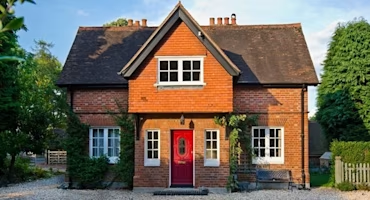
You might be able to get a 100% mortgage in the UK. However, they’re not available from all mortgage providers and it may have to be a guarantor mortgage or a family-deposit mortgage.
Yes, 95% mortgages are available in the UK, including as part of a Government-backed scheme which encourages mortgage providers to lend to those with only a 5% deposit. You may be able to get a fixed-rate or variable-rate 95% mortgage.
Putting down a deposit means you won’t owe as much to the mortgage lender, so won’t have to pay back as much interest over time.
The bigger the deposit you can muster, the better your chances are of securing an improved mortgage deal – as these are reserved for borrowers with the lowest loan-to-value ratios (LTVs).
A further benefit of putting down a deposit is that it will reduce your chances of slipping into negative equity, should property prices fall.
You can apply for a no deposit mortgage either by contacting the lender directly or going through a mortgage broker.
Make sure you understand the terms and conditions before you apply, and have someone willing to act as a guarantor, as this will almost certainly be required.
You’ll still have to go through the usual mortgage affordability checks so the lender is confident you can meet the repayments.
The loan-to-value (LTV) ratio is a financial term that represents the proportion of a property's value that is financed through a mortgage loan.
It is calculated by dividing the loan amount by the property's value or purchase price and is expressed as a percentage.
For example, if you purchased a property for £200,000 and borrowed £140,000 through a mortgage the LTV would be 60% (£140k divided by £200k).
Lower LTVs can often allow you access to lower mortgage interest rates, so building equity in your property (such as through overpayments) can make things cheaper down the road.
Reviewed on 30 Mar 2026 by

