What is trace and access insurance?


Key takeaways
Trace and access insurance covers the cost of locating and accessing the source of a water leak in your home
It’s included as standard in many home buildings insurance policies - but it won’t cover the cost of fixing the leak itself or repairing the resulting damage
Cover limits can vary between providers, and not all will offer it as standard, so it’s important to check your policy details and claim limits

What is trace and access cover?
Trace and access cover reimburses the costs involved in finding and getting to leaking pipes. It does not include repairing the leak itself.
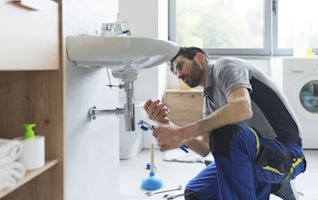
Finding the source of a water leak at your home can be complicated and expensive – especially if it’s underground. Trace and access cover includes detection, which may involve technology such as thermal imaging, and getting to the source of the leak, which could involve a plumber ripping up your kitchen floor or removing your toilet.
Most – but not all – buildings insurance policies include trace and access cover
What does trace and access insurance cover?
Trace and access cover will pay out for any work required to locate a leak at your home, as well as the work needed to repair damage caused during the search.
That’s why it’s called trace - locate the source, and access – make way for the necessary repairs to be done.
If the source of the leak is obvious, like a burst pipe, or if you have a gas leak, you’ll usually have to make a claim under home emergency cover instead.
What isn’t covered by trace and access insurance?
Trace and access cover comes with some exclusions - it won’t include the cost of repairing the leak itself, or any damage the leak has caused to your home.
If you need to make a claim for fixing the leak or damage to your home's structures, you can do so through your main buildings insurance policy. If your possessions, including furniture and appliances, have been damaged by the leak, these will be covered by home contents insurance.
Home insurance is unlikely to cover the cost of water damage caused by leaks resulting from poor maintenance on your part. However, even in this case trace and access cover should still reimburse you for the cost of finding the leak.
Does trace and access insurance come as standard?
It's common for home insurance companies to offers trace and access cover as standard. However, not every insurer does - you should check your policy documents thoroughly so you know what you’ll be covered for.
The amount you can claim via trace and access cover also varies - some insurers will cap it at around £5,000, while others might offer unlimited cover.
How much does trace and access cost?
The cost of finding the source of a leak (and repairing anything that has been damaged looking for it) can be hundreds or even thousands of pounds.
Trace and access insurance will cover most of those costs - you will only have to pay an excess. The excess is your contribution towards any claim. It is set by you and your insurer in advance. Increasing your excess can lower your insurance premiums, but will make claiming more expensive for you.
How do I know if my home has a leak?
It’s not always easy to spot a hidden leak. Signs you might have one include:
Higher water bills
A damp patch on the wall or ceiling
Reduced water pressure
Mould and mildew
Peeling paint or wallpaper
Once you suspect a leak, you should take action as quickly as possible to minimise the damage and reduce the risk that your insurer will refuse to pay out for it.
What should I do if there is a leak in my home?
First, turn off the water supply. You should also turn off the electricity supply if the leak is near any electrical fittings.
You’ll need an emergency plumber or specialist company to come out and locate the source of the problem. But call your insurer first to see:
if it has a list of approved tradesmen (using these can often make claims faster and easier)
what evidence of the work undertaken you’ll need to provide when you make your trace and access claim
What might cause a leak in the home?
Leaks could be caused by a few things, such as:
Broken, burst, or frozen pipes
A broken water tank
A faulty boiler
A washing machine or dishwasher breakdown
Poorly connected pipes in sinks, baths, and showers
Leaking radiators and central heating systems
Are underground pipes included in trace and access cover?
Yes, trace and access insurance will often help cover the cost of identifying the source of a leak coming from pipes underneath your property. This includes gas and sewage pipes as well as underground water pipes.
However, some insurers exclude pipes that run beneath your garden, rather than your house.
You may also find the water company that owns the pipes will offer to repair the leak for free to meet its leak reduction target.
Either way, it’s important to take action when you spot an underground leak on or near your property - over time, excess and escaped water can cause bigger problems such as flooding and subsidence. Escape of water damage is one of the most common home insurance claims, with data from the Association of British Insurers showing that £1.8 million is paid out for it every day.
Who is responsible for water pipes between the road and the house?
According to Ofwat, the water regulator, responsibility of the pipe depends on exactly where it lies.
The pipes under the public roads and footpaths are the water company’s responsibility
The personal supply pipes on your property, such as those under your driveway or garden, are the homeowner’s responsibility
Shared pipes that lie on your property, such as pipes that supply water to both you and your neighbour(s), are the joint responsibility of all the property owners whose homes are supplied by the pipe
However, if any of those pipes are water mains pipes that just happen to be on your personal property, they’re the water company’s responsibility.
How do I make a trace and access insurance claim?
Get in touch with your insurance provider
Do this straight away - they may have a list of emergency plumbers or leak detection companies for you to contact. If not, they’ll usually ask you to keep a record of any work you have carried out.
Take photos and videos
Of both the leak and surrounding area, in case your insurer asks for evidence.
Keep receipts
Ask your tradesperson for documentation of the work they've done, and submit these receipts to your insurer. It’s a good idea to take photos of the work they do too.
Make sure the workers only damage what is necessary
Insurers will only cover costs that are directly related to finding the leak. For example, if the leak is underneath your shower but the plumbers rip out your bathtub too, you may find only the cost of replacing the shower is covered.
Can a trace and access claim be refused?
Yes. You might have your trace and access claim refused if:
The water came from outside
Trace and access cover only applies to ‘escape of water’ claims, meaning water has leaked from a closed system such as an appliance or pipes.
It doesn’t apply to ‘ingress of water’, where water has come in from the outside – such as through doors, windows, or the roof.
No water damage has occurred
Trace and access claims are usually only covered if your home has suffered water damage that needs fixing.
Your policy doesn’t cover it
Sometimes home insurance policies don't cover water damage or the particular type of water damage that has occurred.
How can I find cheap trace and access insurance?
Finding and comparing home insurance that includes trace and access cover is easy with the MoneySuperMarket comparison tool. You can see whether or not trace and access cover comes as standard, and check how much cover you will get – all in just a few minutes.
Author
Mehdi Punjwani
Insurance specialist
Mehdi is a financial writer and editor with over six years of experience in personal finance. He has written for organisations and publications including Equifax, The AA, and USAToday, covering a...

Reviewer
Beth Leslie
Senior Insurance Content Editor
Beth is an experienced writer and editor who specialises in financial and economic content. She is currently the Senior Insurance Content Editor for MoneySuperMarket. Beth is passionate about making...