What door locks do I need for my insurance to be valid?


Key takeaways
To get home insurance you will generally need a front door lock that meets British Standards Institution's BS3621 lock standard and contains at least five locking points
Insurers often offer discounts if you add more secure locks to your home
If you leave your home unlocked or someone uses a copy of your keys your insurance probably won't pay out

Do door locks impact home insurance?
Yes. The type of front door lock you have can change how much your home insurance costs. Door locks can also influence if your home insurance pays out. Insurers may refuse your claim if your door lock does not meet certain standards, or malfunctioned.
When you look for a new home insurance policy, you’ll usually be asked what type of locks you have fitted to your doors, and sometimes your windows too. Insurers do this so they can work out how easily someone could break in. The more secure your property is, the lower your premiums are likely to be.
Whatever type of locks you have fitted, you are unlikely to be able to claim on your home insurance if you leave your doors unlocked or if someone gains access to your house using a copy of your keys.
What door locks are insurer approved and can installing them save money?
Different insurers have different rules when it comes to the type of locks you need on your doors and windows. The safest bet is to always opt for locks that conform to industry standards and kitemarks.
Most home insurers reward those who take steps to make their homes more secure with discounts to reflect the reduced probability of the property being burgled.
If your locks are out of date, you may be able to get a lower quote by replacing them before taking out your cover.
What are the industry standards for front door locks?
Lock standards are set by The British Standards Institution (BSI), the UK national standards body.
For five-lever mortice deadlocks, window locks, and night latches, the standard you want is BS3621
For multi-point locking systems, look out for the codes SS312 or TS007.
The BSI also gives out certification marks called Kitemarks for locks that have been independently tested and have been found to be of acceptable quality.
What are the different types of door locks?
The main door lock types are:

Five-lever mortice deadlocks
One of the most common types of lock, five-lever mortice deadlocks are fitted within a cavity in the door, which is called a mortice.
The levers are what the key must move in order to ‘throw’ the ‘deadlock’ – i.e. to move the block of metal that prevents the door from opening. The more levers a mortice lock has, the more secure it is.
You can buy three-lever mortice locks, but most insurers want you to have at least five levers. This is what’s needed for the locks to meet the British Standards Institute (BSI) BS3621 lock standard.
You may need BS3621 standard five-lever mortice deadlocks on all your external doors to get home insurance. Most companies will provide contents cover for a bit less if you have BS3621 locks on all your doors and ground-floor windows.
Key-operated multi-point locks
A multi-point locking system has three, four or five locking points, all of which lock simultaneously when you turn the key. It’s a very secure system that strengthens the top and bottom of the door as well as the middle, but it’s only usually used on uPVC and composite – rather than wooden – doors.
For insurance purposes, you will generally need at least five locking points to secure the main entrance to your home.
The Master Locksmiths Association also recommends the use of multi-point locking systems with cylinders that are SS312 Diamond Approved or conform to the newer TS007 three-star Kitemark standard, both of which should protect against attempted burglaries.
Night latches
Night latches, or Yale Locks, lock the door automatically when it closes and are often used alongside mortice deadlocks. From the inside, they can be opened by turning the latch; from the outside, they can only be opened using the key.
Insurers don’t generally view locks of this kind as secure enough on their own, but as an extra lock they can earn you a discount on your home insurance. (As long as they meet the BS3621 standard.)
Euro cylinder lock
Euro cylinder locks are often used in conjunction with multi-point locking systems on uPVC doors, and they work by using a pin and tumbler system. Euro cylinder locks can be replaced without having to replace the multi-point locking mechanism, so they’re relatively inexpensive and easy to replace.
They can be vulnerable to ‘lock snapping’, however, you can install an anti-snap lock to prevent this. Look for locks that have a TS008 3-star rating.
Rim cylinder
Rim cylinder locks have a pin and tumbler design and are often used alongside nightlatches as the external operating point. Rim cylinder locks are replaceable without having to also replace the nightlatch.
You can upgrade rim cylinder locks to conform to BSI lock standards. It’s likely insurers will request this in order to qualify for cover, as without this extra security these locks can be picked relatively easily. As such they should also always be used in conjunction with a nightlatch or mortice lock.
Padlocks
Padlocks come in multiple shapes, sizes, and levels of security designed for different functions, and they’re a useful extra layer of protection for items in and outdoors.
Many people use padlocks to secure shed or gate doors, but keep in mind cheaper models can be broken easily with tools like saws or bolt cutters.
Upper-end models are often close-shackled, making them harder to break open, and some even come with fingerprint security.
Security bolts
A key-operated security bolt can again be a useful extra layer of security for shed doors or gates, are easily fitted and operated and also fairly affordable.
However, they aren’t extremely secure so insurers may require you to place a bolt lock on both the top and bottom of doors they’re used on.
Smart locks and electric locks
Smart locks can be controlled via a key tag, keypad or mobile phone, using wireless technology to lock and unlock rather than a physical key.
Some come with extra functions, such as allowing you to monitor when someone leaves or enters through the door, or creating virtual keys for visitors.
For insurance purposes, you'll want to make sure it’s approved to meet the BS3621 standards and has the BSI Kitemark.
Giving incorrect information about your locks could result in any claims being rejected, so it’s important to provide the right details.
How do I know what door lock I have?
Look at the door type
If you have wooden doors, they are probably fitted with mortice deadlocks and/or night latches.
If you have uPVC or composite doors (or a patio door), you’re more likely to have a multi-point locking system.
Look at what is written on the lock
5 lever means it’s a five-lever mortice deadlock
Yale generally means it’s a night latch
A serial number starting BS3621 means it meets the BSI standard; SS312 and TS007 are codes more commonly linked with multi-point locking systems and cylinders
More clues to help you identify your lock type
Lock Details | Lock Type |
|---|---|
The door automatically locks behind you | You almost certainly have a night latch fitted |
The door lock at various different points | It’s a multi-point locking system |
The lock is fitted inside a cavity in the door | It’s a mortice deadlock |
You have to lift the handle to lock it | It’s a multi-point locking system |
What are the different types of window locks?
You’ll usually be able to install the following lock types on your windows:
Latch
Window latches are standard for double and single hung windows, connecting each window sash and preventing movement. These should only be used alongside other window locks.
Folding lock
Also known as casement locks, these are turned down to lock the window and turned up to release them. Casement windows come with folding locks as standard.
Window pin lock
Window pin locks work in a similar way to chain locks, with a cable attached to part of the lock on the sash and another part on the frame - they stop the window from opening further than desired.
Window wedge
Window wedges limit how far a window can be opened, and can be adjusted as required from the inside.
Key-operated locks
Key-operated locks are often used in conjunction with latch locks, requiring a key to open and close the window - insurers will generally prefer these, but check if your insurer lists window locks as a requirement.
Sliding window locks
Sliding window locks are also like chain locks but specifically for sliding windows, and will stop the window from opening further than wanted.
It’s a good idea to fit key-operated locks to all your downstairs windows. They can be fitted to the top or bottom of a window, or on the handle you use to close it.
Providing you remember to lock up when you leave the house, locked windows should knock a few quid off your premiums.
When should I change my door locks?
You should change your locks if:
You move into a new home
You have no way of knowing who has access to the existing lock and how many copied keys there may be.
When someone moves out
Even if they return their key and you completely trust them, you won’t know if someone has made a copy of the key.
If someone breaks in
A burglar may use the same weakness in the lock as the last time they broke in. It's also possible that they may have stolen a key to copy.
If you lose your key
You don’t want to risk it being found by someone who has bad intentions and figures out where you live, so it’s best to replace your locks if you lose a key.
If the lock is damaged
Broken or damaged locks are vulnerable and should be replaced as soon as possible. You may not be covered by your home insurance if you keep a faulty lock.
Every seven years or so
General rule of thumb is that you should replace your locks every seven years to combat wear and tear.
The cost of replacing a lock in 2025 should be around £100-£150
Will my locks be covered by my home insurance if they break?
Some home insurance policies cover replacement locks and keys. If yours does not you might be able to purchase lock cover as an add-on to your existing policy.
If you have home emergency cover, locksmith services might be included.
What else can I do to keep my house safe?
Fitting secure locks to your doors and windows is not the only way to reduce the risk of your home being targeted by burglars. Other security measures that can help – and can also cut the cost of your home insurance – include:
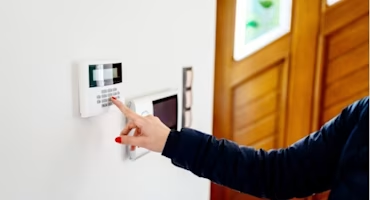
Installing a burglar alarm – and making sure it’s visible to any potential thieves
Putting in external lights that come on when people are on your property
Storing garden tools and ladders in a secured shed or garage
On a day-to-day level, you can also keep your home and its contents safer by:
Always taking keys out of door and window locks
Avoiding publicising when you go away on holiday
Only giving spare keys to trusted friends and family members
Keeping your valuables out of sight
Using timers to turn the lights on and off while you’re away
Author
Mehdi Punjwani
Insurance specialist
Mehdi is a financial writer and editor with over six years of experience in personal finance. He has written for organisations and publications including Equifax, The AA, and USAToday, covering a...

Reviewer
Beth Leslie
Senior Insurance Content Editor
Beth is an experienced writer and editor who specialises in financial and economic content. She is currently the Senior Insurance Content Editor for MoneySuperMarket. Beth is passionate about making...