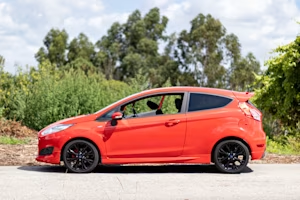
What is car insurance group 3?


If your car went on sale in the UK from 1 August 2024 and is part of a brand-new model range then it will be assessed under a new insurance rating system. ➡️ Find out more.
Key takeaways
Cars are categorised into insurance groups from 1 to 50, with 1 the cheapest to insure, and 50 the most expensive, based on factors like cost, engine size, and repair costs
Examples of group 3 insurance cars include the Chevrolet Spark, Citroën C1, Dacia Sandero, Ford Fiesta, and Toyota Aygo
Insurers consider a range of factors when setting premiums, not just what group a car is in, so it’s always good to compare your options

What is car insurance group 3?
Car insurance group 3 is one of the lowest car insurance categories out of 50, encompassing vehicles that are considered safe, affordable, and low-risk by insurers. While higher than group 1 and group 2, these vehicles are still among the cheapest to insure.
But remember that insurers consider a number of factors before setting your premiums, not just your car’s insurance group.
Which cars are in car insurance group 3?
While it completely depends on the model and make of car, group 3 cars tend to be smaller and cheaper. Cars in group 3 include:
Chevrolet Spark
Citroën C1
Dacia Sandero
Dacia Logan MCV
Fiat Fiorino
Fiat Panda
Fiat Qubo
Ford Fiesta
Ford Ka
Hyundai i10 Hatchback
Kia Picanto
Kia Rio
Peugeot 107
Peugeot Partner Tepee
Renault Clio Hatchback
Seat Ibiza Sport Coupe
Skoda Fabia
Toyota Aygo
Toyota Yaris
Vauxhall Corsa
Volkswagen Polo
Volkswagen Up
💡 Top tip: The trim level of your car and its engine size affect which group your car is in so different versions of the same car model can sit in different groups. Use our free car insurance group checker to find out which group your car is in
Why are cars in group 3 cheaper to insure?
Cars in group 3 are among the cheapest to insure as they are considered to be a lower risk for insurers, based on factors like their price when new, engine size, and repair costs.
What are group 3E cars?
You might see letters after group numbers. These give a bit more information about the vehicle, usually whether the safety or security of the car is better or worse than usual for that make and model. A group 3E car, for example, indicates the vehicle’s security requirement is exceeded (hence the ‘E’), which is good news for the insurer and therefore for your car insurance costs.
At the other end of the scale, a ‘U’ label means the vehicle’s security level is unacceptable, making it more likely to be stolen and a ‘D’ label means the safety requirement hasn’t been met.
Are group 3 cars good for 17-year-olds?
Young drivers face the highest average cost of any driver. That’s because statistically they are more likely to be involved in an accident. Choosing a cheaper car to insure, such as one in group 3, is one way these drivers - and anyone else - can cut costs. There are lots of other ways to cut costs if you’re a 17-19-year-old driver too though, check out our guide to comparing car insurance for teenagers.
Although it’s not just young drivers – anyone looking to buy a car may be able to cut their insurance bill by picking a car in insurance group 3.
What are car insurance groups?
UK car insurance groups, which run from group 1 to 50, help insurers work out how risky cars are to insure.
Thatcham Research, a not-for-profit automotive risk intelligence organisation, gives each car a rating based on a number of factors, such as its repair costs, and safety and security features. The scores Thatcham Research sets are then reviewed by a group rating panel, which is made up of insurance representatives.
The group your car falls into will influence how much you pay for car insurance:
Cars in group 1 are typically the cheapest to insure as they are usually smaller, lower value cars that are cheaper to repair
Cars at the top end of the scale (group 50) are typically the most expensive to insure as they are often high value or high-performance cars that are desirable to thieves and have more expensive parts
How important are insurance groups to overall car insurance costs?
While car insurance groups are important, insurers consider a number of details about you before setting premiums.
For example, they’ll look at your:
Age
Driving history and whether you’ve made any claims on car insurance policies in the past
These factors all contribute to your overall risk profile.
Your insurance costs will also depend on the type of cover you take out and the provider you choose - which is why it’s always good toshop around for a car insurance quote.
Which car insurance group will my hybrid or electric car be in?
Hybrid and electric cars are rated in the same way as petrol and diesel models so you’ll find electric and hybrid cars throughout the different groups.
Some small electric cars that are in the lower insurance groups include:
The Volkswagen E-up is in group 10
The Smart EQ forfour is in groups 9-11, depending on the version
However, electric cars can be more expensive to repair than petrol and diesel cars and more likely to be written off if the battery is damaged in an accident, which can push up electric car insurance costs.
See our Electric Car Insurance Index to find out the top 10 cheapest and most expensive electric cars to insure.
📣 Did you know? Electric vehicles are about 25% more expensive to repair than equivalent petrol and diesel models and their repair times can be 14% longer, according to Thatcham Research.
Which car insurance group will my classic car be in?
Classic car group ratings can vary hugely depending on the make, model and variant, as different cars will have different values, accident and theft risks and repair costs. You should look into your specific model to understand what insurance costs might look like.
Which car insurance group will my modified car be in?
Some modifications can increase the risk of theft or cost of repairs, while others can improve your car’s safety and security and therefore bring down costs. Some insurers might even request that you upgrade a car’s features before they will insure it - these cars, whichever group they’re in, will have a ‘U’ rating alongside their group number.
How do car insurance groups change my premiums?
Cars are sorted into car insurance groups, from 1 to 50, based on how much they cost, the size of their engine, and how much repairs are. If an insurer has to pay out on a claim, the cost of that claim will probably be lower, which is reflected in the price of your premiums.
In fact, while an annual comprehensive car insurance policy on a group 41-50 vehicle could set you back an average of more than £805.96
Of course, this isn’t the only area insurers look at when calculating a premium, as your age, postcode, driving experience, and even your profession can all affect the price you pay for car insurance. However, choosing a cheaper car – such as one in group 3 – could be a way of dramatically cutting your costs.
Do car insurance groups change over time?
No, the group rating system gives each car a score at launch that never changes. However, the new vehicle risk rating system is different as the scores update regularly to reflect changing market conditions.
Which car insurance group is my car in?
You can quickly find out what insurance group a car is in with our free car insurance group checker.
When you’re buying a new car it’s a good idea to check which insurance group it’s in case the version you’re interested in falls into a higher group than a lower specification model and could therefore have a higher insurance cost.
Looking for car insurance?
Author
Kate Hughes
Money & Savings Expert
Multi award-winner and best-selling author Kate Hughes has been a financial journalist for more than 20 years. She started out at the Financial Times at just 21 years old, holding several senior...
Reviewer
Sarah Tooze
Car & Van Insurance Expert
Sarah Tooze has been a motoring journalist for more than 15 years, specialising in company cars and vans, and has won a number of awards during her career, including the Newspress ‘Automotive...