

Provide us with a few details
We'll need information about you and your car. We aim to make this as quick and easy as possible.


Classic car insurance, also known as heritage or vintage car insurance, is designed for older cars that are primarily used for leisure purposes.
It often works out cheaper than standard car insurance.
Insurance companies reckon that if you have a classic car you’re likely to drive it fewer miles than you would your everyday vehicle, and that you'll look after it better.

This is what is typically covered in a fully comprehensive classic car insurance policy.
Different insurers have different inclusions and exclusions. Always read your policy documents carefully.
Damage to your classic car - from accidents, theft, fire or vandalism
Third-party damage caused by your vehicle
Motor legal protection, which pays out for legal costs you may face related to a claim
Serious or fatal injuries - compensation if you’re seriously or fatally injured in a road accident
Agreed value cover - your insurer will pay out a pre-agreed sum if your classic car is written off or stolen rather than the market value
Spare parts cover - if you already own parts for your classic car and they are stored securely
Restoration cover - in addition to an agreed valuation, your insurer may cover the cost of restoration work if you have an accident
Laid-up cover - if your vehicle is off the road for a period of time, perhaps because it is being restored, you will be covered for fire and theft
Non-named drivers - Anyone who was not named on your policy
Standard wear and tear to your car such as damage due to rust
Drugs and alcohol - Accidents if you're under the influence (this can include prescription drugs)
Driving without a valid licence - if you’re driving after your licence has been revoked (cancelled)
A no-claims bonus - but you may get other discounts. For example, by being a member of a classic car club
💡 Top tip: Some classic car policies include some add-ons as standard. Check for these extras when comparing quotes to find the best value insurance for you.
Keeps your car protected against any damage or accidents that happen while it’s being restored.
Protects your car while it is at events and provides public liability cover in case anyone is harmed because of your car.
Covers you for any accidents or damage caused while using your classic car at a race or track parade.
Extends your cover so your vehicle can be used at formal events such as wedding and proms.
Provides specialised roadside assistance and recovery, as older vehicles can be harder to repair at the roadside.
Insures spare or hard-to-find parts against loss or damage, whether they’re stored at home, in a garage or being transported.
Classic car insurance is designed for vehicles that are driven less often and kept in controlled conditions, which is reflected in how the cover works.
It typically offers agreed value cover, where the car’s value if it is written off or stolen is agreed in advance, rather than relying on market value at the time of a claim.
In return, policies often come with restrictions that are less common with regular car insurance. These can include lower annual mileage limits, limited or no commuting cover, and requirements to store the car in a garage or secure location.
Classic car insurance may also include extras such as spare parts cover and restoration protection, which can help cover the extra costs of repairing or restoring classic vehicles.
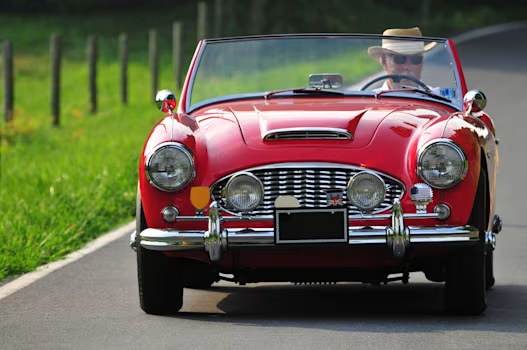
We'll need information about you and your car. We aim to make this as quick and easy as possible.

Based on your criteria, we'll search the market to offer you the best deals at competitive prices.

Simply click through to your chosen provider when you're ready. Get covered the same day.
Classic cars are usually driven less often and often have mileage limits set by the insurer. Fewer miles on the road generally means a lower risk of accidents, which can reduce premiums.
Insurers often see classic car owners as lower risk because these vehicles are typically well maintained and carefully driven. Membership of a recognised classic car club can sometimes support this assessment.
🚩 Classic car insurance is not always the cheapest option. Premiums can be higher if the car has a high agreed value, higher mileage limits, significant modifications, or if the driver is younger or less experienced.
Although premiums are often lower, classic car insurance usually comes with restrictions that reflect how the vehicle is expected to be used.
Common restrictions include:
annual mileage caps
requirements to store the car in a garage or secure location
limits on commuting or daily use
Check that any mileage limit suits how often you drive and that the car is insured on an agreed value rather than market value.
Car insurance premiums are tailored to your individual circumstances. Factors insurers take into consideration include:
The make and model of your car will have a large impact on the cost of your premium
Older cars may not have modern safety and security features, so may have a higher risk of theft and accidents
Classic car insurers usually demand a lower annual mileage - often ranging from just 2,000 to 5,000 miles
If your vehicle is off the road being restored then your premium should reflect the fact your car isn’t being driven
The payout you'd receive if your car is written off or stolen should be agreed with your insurer in advance
Your insurer may give you a discount as it shows you’re an enthusiast and suggests you’ll take good care of your vehicle

Your insurer may give you a discount as it shows that you’re an enthusiast and suggests you’ll take good care of your vehicle.

You’ll have more classic car insurers to choose from as many impose a mileage restriction or offer a discount for low mileage.

Providers often specify that your classic car is kept in a secure location such as a locked garage. You could also fit a tracking device, car alarm or immobiliser.

If you can afford to, it is worth paying for your car insurance in one go rather than in monthly instalments which have interest added.

✓ Cars built before 1985
Classic cars that are at least 40 years old are exempt from paying road tax (also known as vehicle excise duty or VED).
You will still need to register your car as tax-exempt with the UK government. You can do this at a Post Office.

✓ Cars built before 1985
Classic cars that were built or first registered over 40 years ago do not have to have an MOT.
To qualify, they must be roadworthy and not have had any major changes in the last 30 years, such as replacing the chassis, body, axle or engine to change the way the vehicle works.

✓ Cars built before 1965
If your classic car was manufactured before 1965 and did not have seat belts when it was made, you do not need to install them.
This is because seat belts were not standard equipment on cars made before 1966. However, this means that children under three years old can’t travel in your classic car.

If you own a classic car, you'll want to ensure that your vehicle gets the protection it deserves.
It can be a real privilege owning and driving a classic car, and while it's cheaper than standard car insurance, you won’t want to scrimp on basic cover. However, there are ways to save money on your policy.
Arranging a secure place to park at night can help protect your cherished motor as well as reducing the cost of cover.
Sara Newell Motor & Home Insurance Expert
MoneySuperMarket has won the Feefo Platinum Trusted Service Award, an independent seal of excellence, which recognises businesses that consistently deliver a world-class customer experience.




Agreed value is the fixed amount your insurer will pay if your classic car is written off or stolen. This figure is set when you take out the policy and is agreed by both you and the insurer.
To set an agreed value, insurers will usually ask for evidence such as recent photographs of the car, a professional valuation, and details of restoration work or modifications. This helps them confirm the car’s condition and true worth.
Unlike market value policies, agreed value cover recognises that classic cars can be difficult to price accurately. To avoid underinsurance, it’s a good idea to review and update the agreed value regularly, especially after restoration work or if the car’s value changes.
Your insurer will decide if your car qualifies as a 'classic', as the definition can sometimes vary. Whether you need a specialist policy for your classic car may depend on how often you use your car, rather than its age or model.
No. Classic car insurance is usually designed for limited leisure use rather than regular commuting or everyday driving. Most policies restrict use to social, domestic and pleasure journeys, and many exclude commuting altogether.
Insurers often also set annual mileage limits, which are typically much lower than standard car insurance. Policies may also require you to have another vehicle insured as your main car.
If you need to drive your vehicle regularly or commute, a standard car insurance policy or a specialist classic car policy with higher mileage and commuting cover is likely to be more suitable.
You can, but only if your insurer agrees and adds the right cover to your policy. Business use usually includes commuting to a regular place of work and using the car for paid activities, such as hiring it out for weddings or events.
Because this type of use increases risk, insurers often charge extra or apply specific conditions. Not all classic car policies will allow business use at all.
You must tell your insurer how you plan to use the car. If you use your classic car for work or hire without disclosing it, your cover could be invalid and you may not be paid if you make a claim.
Yes, but modifications can affect both your premium and how your car is insured. Insurers often see modified vehicles as higher risk, which can increase the cost of cover. Declared modifications can also change your car’s agreed value, particularly if they increase its overall worth.
You must tell your insurer about any modifications, including cosmetic changes such as resprays, interior upgrades or non-standard parts. Insurers may then ask you for photographs, receipts or details of the work carried out.
If you don’t disclose car modifications, your cover could be invalid and you may not be paid if you make a claim.
Generally, modifications will increase the cost of your insurance.
However, it depends on the modification as there is a wide range of changes that count - everything from an electric conversion of your classic car, which will push up your premium to fitting parking sensors, which is more likely to lower your premium.
Joining a classic car club comes with various benefits, from finding a new hobby to insurance discounts:
Insurance discounts: Classic car clubs are a great indicator to your insurer that you take good care of your vehicle and are more likely to practise safe driving.
Connections: Joining a car club means getting to meet other classic car enthusiasts. With this, you can get technical car advice and find where to buy car parts!
Valuations: Some car clubs can help you value your car or help out if you’re looking to buy or sell a classic car.
Vehicle verification: If your vehicle has been off-road for a while and has no log book, some car clubs can help you restore an original registration to your vehicle if it’s been removed before.
A car is generally considered a classic because of its age, condition and historical interest, but there is no single definition that applies in every situation. Outside the UK, such as in the US or the European Union, there may be different definitions of a classic car.
For road tax purposes, a car is classed as a historic vehicle once it is 40 years old. At that point it can be exempt from vehicle excise duty (VED), which is why this age is often used as a rough guide.
For HMRC purposes, a classic car is usually defined as being at least 15 years old and worth £15,000 or more. This definition is mainly relevant for capital gains tax and does not determine how the car is insured.
For insurance purposes, each insurer sets its own criteria. Some may accept cars from 15 years old, while others use 20, 25 or additional conditions such as limited mileage, originality or usage.
Because definitions vary, it’s best to check your insurer’s specific criteria rather than relying on a single age threshold.
Insurers usually have set criteria for a classic car, including:
Age - typically your classic car must be at least 15 years old but some insurers may stipulate 20 or 25 years
Condition - your classic car should be well-maintained and in good condition
Secure storage - you’ll usually need to keep your classic car in a locked garage
Mileage - you’ll often be expected to do low mileage and the insurer may set a mileage cap, such as 5,000 miles
Use - you’ll usually be expected to use your classic car as a second car rather than for daily driving
Veteran: Any vehicle built before World War One (before 1914)
Vintage: Any vehicle built before 1930
Post-vintage: Any vehicle built between 1930 and 1945
More modern cars can be considered ‘future classic cars’, usually because they have:
Limited production numbers
A distinctive design
Performance pedigree
An enthusiast following
For example, earlier versions of the sports car the Porsche 911, which was first launched in 1963, are already considered classic cars and the latest iterations are likely to follow suit due to the 911’s heritage and timeless design.
Some insurers already treat these kinds of vehicles differently by offering a higher agreed value or specialist policies, and if you own a future classic you might benefit from taking extra precautions to protect its value.
At MoneySuperMarket, we want to give you clear, accurate and trustworthy information so you can make confident financial decisions for your circumstances.
Every page on our website goes through a careful editorial process before it is published. It’s written or reviewed by one of our experienced experts, checked for accuracy, and updated regularly to reflect the latest information.
We do use AI tools to support our research and drafting, but a human editor is always in the loop to review, fact-check and approve everything before it’s published, so you can trust that what you’re reading is both reliable and up to date.
You can read more in our editorial guidelines.
We get paid by the companies we work with, but the payment we get doesn’t have any bearing on the information we provide. We get paid in different ways, depending on the type of product or service you buy through us. Our goal is to search deals from as wide a range of companies as possible, but we only show results from our partner providers.
Our comparison service is, and will always be, free to use.
One of the best ways to get the lowest prices and best deals is to compare quotes from different companies. We do the work for you, comparing quotes side-by-side and giving you all the information you need so you can choose the right deal for your needs and your wallet.
We don’t give recommendations or financial advice, but we give you clear information so you can choose financial products that suit your circumstances.
No, not every company can be included in our service. This is because some companies don’t want their products included on comparison sites, and some decide that they would rather not pay a fee. There are also a few smaller providers who can struggle to cope with the volume of customers that can find their products if they appear on MoneySuperMarket.
Our goal is to search deals from as wide a range of companies as possible so that you can choose the deal that suits you.
Yes, you can earn SuperSaveClub rewards when you buy car insurance through MoneySuperMarket.
This includes:
Up to £15, which you can withdraw as a pre-paid Mastercard or a gift card for brands like Sainsbury's and Amazon.co.uk
Free Days Out pass (worth £180), which gives free entry to a range of UK attractions
Cashback of up to 10% when you spend at brands including eBay, Just Eat and Argos
To earn SuperSaveClub rewards on purchases you must:
Sign up to SuperSaveClub (it's free)
Be signed in to your account when you make the purchase
More information can be found on our SuperSaveClub homepage.
Yes, car insurance is included in our Super Save Price Promise.
If you buy through us then find the same deal for less we will:
refund the difference
give you a gift card worth up to £20
Terms and conditions apply. More information can be found on our Price Promise page.
Reviewed on 6 Mar 2026 by
YouGov Survey 1st July 2024 to 30th June 2025. Net Recommend score derived from “Which of the following online service websites would you recommend to a friend or colleague, or tell them to avoid?” Base: Current Customers of (MoneySuperMarket n=18,382, Compare the Market n=16,802, Go.Compare n=10,162, Confused.com n=8,229, Uswitch n=528).
Excludes one month contracts
SuperSaveClub restrictions and T&Cs apply. Click here for details.
SuperSaveClub restrictions and T&Cs apply. Click here for details.
Based on 1 visit per month – average ticket value £15.30 (Oct 24)
Amazon.co.uk Gift Card value varies based on the first monthly premium of the policy and will be confirmed on the results page T&Cs apply

