

Lifetime
Covers the majority of vet bills for injury and illness up to an annual limit. At the end of the year, that limit is reset, and cover continues.
Earn up to £130 in rewards every year with SuperSaveClub^
You’re protected with Price Promise - we price match and more
Compare tailored quotes from 39^ trusted UK insurers
We compare quotes from 39


Kitten insurance offers peace of mind by protecting your furry friend from unexpected veterinary costs. From playful accidents to potential illnesses, kittens can face various health challenges. With insurance, you can provide the best possible care without worrying about the financial burden.
It's best to get kitten insurance as soon as possible. Ideally, you should insure your kitten within the first few weeks of bringing them home. Early coverage helps prevent pre-existing condition exclusions later in life. By insuring your kitten early, you ensure comprehensive protection for their entire life, giving you the freedom to focus on their well-being without worrying about unexpected veterinary costs.
There are four common types of pet insurance to choose from, each with different levels of cover and cost:
Covers the majority of vet bills for injury and illness up to an annual limit. At the end of the year, that limit is reset, and cover continues.

Covers only health problems (mostly injury) related to accidents. It will not cover illnesses nor chronic conditions.

Covers vet bills for a limited time per condition (usually up to 12 months). Once that time has run out, insurance will no longer cover the condition.

Covers vet bills up to a certain amount per condition. When you have reached the maximum amount you can claim, the condition is no longer covered by the policy.
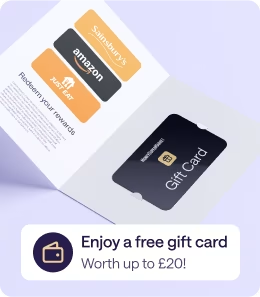
We’ll reward you every time you make a purchase. Exchange your earnings for a gift card for Amazon.co.uk

A year's worth of free experiences across the UK. From London Zoo and Go Ape, to Hussle Swimming and English Heritage, there’s an adventure for everybody. Worth £180

Whether you're buying clothing, homewares or takeaways, earn up to 10%

You and your friends each get up to £20 when they join the Club and make a qualifying purchase. Win-Win!
Not every policy is the same and providers may offer different add-ons to increase your cover. Typically, a lifetime pet insurance policy will cover the following:
Vet bills
The costs of vet bills can add up very quickly. Some policies cover certain vet costs that others do not. be sure to check what types of vet treatments are covered in your policy.
Recovery of lost/ missing kittens
Your policy can cover advertising costs for your lost pet and can also contribute to funding a reward.
Euthanasia
It's difficult to think about and is hopefully a long way off, but in the event that this becomes necessary, your policy can help cover some of the costs
Elective and preventative treatments
Conditions that arise within the first 2 weeks of taking out your policy
Pre-existing conditions
Routine check-ups and treatments
Vaccinations
Pregnancy and giving birth
Pet insurance for kittens can start at as little as £3.29
If your kitten has already experienced health problems, you may have to pay more for cover.
The average cost of vet bills varies depending on where you live.
Some cat breeds are more expensive or prone to more health problems than others.
More expensive cats require increased cover to reimburse owners if anything happens to their kitten.
Each type of pet insurance its own level of cover and cost. The more cover your policy offers, the more expensive it’s likely to be.
By volunteering to pay part of your kitten’s vet bills, you can reduce the cost of your pet insurance.
Compare quotes with MoneySuperMarket to find the perfect policy to suit your needs at the best price.
The excess amount if the amount you voluntarily have to pay any time you make a claim. If you increase your excess amount you can lower your premium amounts. Be sure you are able to to pay the excess amount you choose.
Paying your premiums annually will be cheaper than paying monthly.
If you have more than one pet, a multi-pet insurance policy can house your pets all under one policy. These policies often also provide a discount per added pet to the policy.
Spaying, neutering and keeping on top of your all vaccinations can help keep your rabbit as healthy as possible.

Insurance is something to seriously consider once your kitten reaches two months. While comparing quotes to find the cheapest policy will help keep the cost down, also look at other steps such as microchipping your pet, having it spayed or neutered and having all vaccinations up to date.
Saarrah Mussa Former Content Writer
Keep up to date and find out all you need to know with our latest guides.


We’ll use the details you give us to find policies that give the right cover for your kitten

After you answer a few questions, we’ll show you quotes from the top UK providers for you to choose from, with the best deals front and centre

Join the thousands of people using MoneySuperMarket to find great value deals on insurance and more.
Finding the right insurance provider for you is easy, all you need to do is follow these three steps:

Give us a few details about each pet you want to be covered and the level of protection you’re looking for. Remember – you can tailor cover levels and excesses for each pet.

We’ll put together a list of providers with appropriate cover for your specific needs

Pick the policy that is perfect for you and your pets.
Kittens can get into all sorts of trouble, and insurance can help cover the costs of an unexpected trip to the vet, as well as covering the costs of advertising if they’re lost or stolen.
Kitten insurance does not cover vaccinations – in fact, it’s usually a condition of most cat insurance policies that you keep them up to date with all vaccinations.
You can get specialist pet insurance if your cat has a pre-existing medical condition. This type of policy is designed for those whose pets already have a medical condition before they take out an insurance policy.
While you’ll be able to take our standard pet insurance if your cat has a pre-existing injury or condition, it’s unlikely that your insurer will cover veterinary treatment for that particular condition – as there’s a risk that the condition may flare up again.
Cat breeds have a significant effect on premiums. Pedigree cats are more prone to health conditions than moggies, and your insurer is likely to increase your premium as a result.
They are often also much more valuable and therefore more attractive to thieves.
Yes, cat owners have until June 10, 2024 to ensure their feline friends are microchipped. Failing to do so could result in a fine of up to £500.
Regular grooming and health checks are a great way to keep your kitten healthy and monitor any changes that may occur. While routine visits to the vet are not usually covered by pet insurance, having a check-up while your cat's young is a great way to ensure they are healthy.
Be sure you are up to date with all their vaccinations. If your kitten develops a condition that could be prevented with the appropriate vaccination, some providers do not provide cover for that condition.
While it can be tempting to let your cat out when they start wandering around, most people wait 3-6 weeks to allow them to get used to their new environment before letting them go outside.
Before they go outside, it's always best to be sure they are fully vaccinated.
There are many health conditions that kittens are susceptible to, but the two most common ones you should be wary of are ear mites and fleas. Upper respiratory conditions are also quite common amongst young kittens.
You work hard to earn your money, and we don’t think you should waste a penny of it paying over the odds on your household bills. That’s why at MoneySuperMarket, we’re on a mission to save Britain money.
Whip your credit score into shape with Credit Score
Super save over and over again with Energy Monitor
There are always more ways to save with MoneySuperMarket
So how do we make our money? In a nutshell, when you use us to buy something, we get a reward from the company you’re buying from.
You might be wondering if we work with all the companies in the market, or if our commercial relationships with our partners might make us feature one company above another. We’ve got nothing to hide, and we want to give you clear answers when it comes to questions like these, so we’ve pulled together everything you need to know on this page.
Reviewed on 15 Jun 2026 by
Up to £130 if every qualifying product purchased once. T&Cs apply. Click here for details.
Accurate as of 05 June 2026.
Based on the 10 percentile of monthly premiums our customers were quoted less than £3.29 per month for kitten insurance based on quotes created on MoneySuperMarket in the month of May 2026 where only 1 pet was included in the quote and was less than 1 year old.
Based on 1 visit per month – average ticket value £15.30 (Oct 24)
T&Cs and restrictions apply, see here for more information
T&Cs and restrictions apply, see here for more information
T&Cs apply, click here for more information

