

We're trusted
We've been around since 1993 and are the UK's most recommended price comparison website[5].


Dog walker insurance is business insurance for people who are paid to walk dogs. It can cover risks such as a dog injuring someone, a client’s pet being harmed while in your care or an employee being injured at work.
You can buy different types of insurance:
Public liability insurance: Covers costs if members of the public are harmed
Employers liability insurance: Covers costs if employees are harmed
Dogs in your care cover: Covers injury, illness, loss or death involving a client’s dog while it is in your care.
No, dog walker insurance is not usually a legal requirement if you work alone. However, it can cover eligible costs if a dog is lost or injured, someone makes a claim against you or your business equipment is stolen.
You will usually need employers’ liability insurance if you employ staff, although exemptions can apply. Some clients, councils and landowners may also ask you to have public liability insurance before you walk dogs on their behalf or use certain areas.
If you use a car or van for work, tell your motor insurer. You may need to add business use or take out suitable commercial vehicle cover.
When you are responsible for someone else’s pet, you are also responsible for their safety. Even the most experienced dog walkers can face unexpected situations such as dogs escaping, fighting, or becoming injured during exercise.
Specialist dog walking insurance can help cover eligible vet bills, emergency treatment, or compensation if a client’s dog is injured, lost, or killed while in your care. In the UK, pet-related insurance claims can run into thousands of pounds, particularly if emergency surgery or extended treatment is required, making this cover an important financial safeguard.
Public liability insurance is one of the most important protections for dog walkers because accidents involving third parties are relatively common.
A dog could knock over a pedestrian, bite someone, or cause a road accident by running into traffic. It can also cover damage to property, such as gardens, vehicles, or public spaces.
Industry insurers frequently report that liability claims are among the most common types of claims in pet care services, with costs ranging from minor compensation payments to legal settlements that can exceed £10,000 depending on severity.
If you employ staff in your dog walking business, UK law requires you to have employers' liability insurance. This protects you if an employee becomes ill or injured while working for you, such as being bitten by a dog or slipping during a walk.
The law requires a minimum cover level of £5 million, and failure to have this insurance in place can result in fines of up to £2,500 for every day you're not insured[3]. Even if you only employ part-time or casual walkers, this requirement still applies, making it a legal necessity rather than an optional extra.
Dog walkers often rely on expensive equipment such as smartphones for tracking routes, GPS devices, leads, harnesses, and sometimes even tablets for managing bookings. Business contents insurance can help repair or replace these items if they are lost, stolen, or accidentally damaged while working.
With the average smartphone now costing over £800 and professional GPS tracking devices adding further expense, replacing essential tools out of pocket can quickly become costly and disruptive to your business operations.
Legal disputes can arise in a variety of situations, from a client alleging negligence to disagreements over responsibility for an incident. Liability insurance can help cover legal defence costs, which in the UK can easily run into thousands of pounds even for straightforward cases.
It may also cover compensation payments if you are found liable. Without insurance, these costs would need to be paid personally, which could be financially damaging for small or self-employed dog walking businesses.
Many clients, particularly private homeowners, dog boarding facilities, local councils, and landowners, now require proof of public liability insurance before allowing dog walkers to operate on their property or care for their pets. This is especially common in urban parks, managed estates, and commercial dog-walking areas.
Having insurance not only helps you secure more work but also builds trust with clients, as it demonstrates professionalism and accountability in a growing and competitive industry.
That's how much was paid out in 2025. Without business insurance, those customers would have faced paying that bill themselves.
Comparing quotes from different insurers allows you to find the best deal out there.
We can do this work for you.
We've been around since 1993 and are the UK's most recommended price comparison website[5].

We take the effort out of shopping around. Get quotes from top insurers in minutes.

Our mission is to save you money. We save our customers £1 bn+ on their bills every year[6]
Protects you if your work harms members of the public.
Protects you if your staff become ill or injured at work.
Protects you if you are accused of negligence.
Protects your work vehicle and its contents.
Protects against disruption from events like fires.
This covers injury, illness, loss or death involving a client’s dog while it is in your care.
The table shows the average prices paid by our customers for dog walking insurance. Public liability insurance for dog walkers costs £81[8] a year, on average.
Average price means 51% of customers paid this amount or less. Cheapest price means 10% of customers paid this price or less.
According to our latest data, 10% of customers paid this when taking out an annual dog walking insurance policy.
Although paying for insurance can feel like yet another expense, it could protect you from much higher costs if you experience one of the serious, unexpected problems it covers.
Very likely, as long as your premiums are up to date and you are claiming for an incident covered by your policy. Almost 8 in 10[10] of business insurance claims made by MoneySuperMarket customers were accepted in the 2024-5 financial year.
Most rejected claims happen because they fall outside the policy's terms, conditions or exclusions. To give yourself the best chance of a successful claim:
read your policy documents carefully to make sure you know what is and isn't covered
look at policies beyond the cheapest option - sometimes it is worth paying a little more to get a much better level of cover
Based on MoneySuperMarket customers claiming in the 2024-5 financial year.
The specific cover you'll get with your policy depends on the insurer and level of cover you choose - but most policies will offer the following:
Public liability insurance: Can cover eligible legal and compensation costs if a dog in your care injures someone or damages their property
Care, custody and control: Can cover eligible costs if a client’s dog is injured, lost or killed while it is under your supervision
Employers’ liability insurance: Can cover claims if an employee becomes ill or injured through their work. You will usually need it if you employ staff
Personal accident cover: Can provide financial support if an accident leaves you injured and unable to work, subject to the policy terms
Legal expenses insurance: Can help with eligible legal costs arising from issues such as employment disputes, property disputes or tax investigations
Financial loss cover: Can cover eligible claims for financial loss that did not result from physical injury or damage to property
Intentional harm or damage: Claims will not usually be covered if you or an employee deliberately caused the injury, loss or damage
Dogs in your care: A general public liability policy may exclude clients’ dogs unless you add care, custody and control cover
Alcohol or drugs: Claims may be refused if you or an employee was under the influence when the incident happened
Wear and tear: Tools and equipment cover will not usually pay for damage caused by age, regular use or poor maintenance
Breaking a contract: Some policies exclude claims resulting solely from breaking the terms of a contract
Unapproved vehicle use: Motor claims may not be covered if the vehicle was used for an undeclared purpose or driven by someone not insured
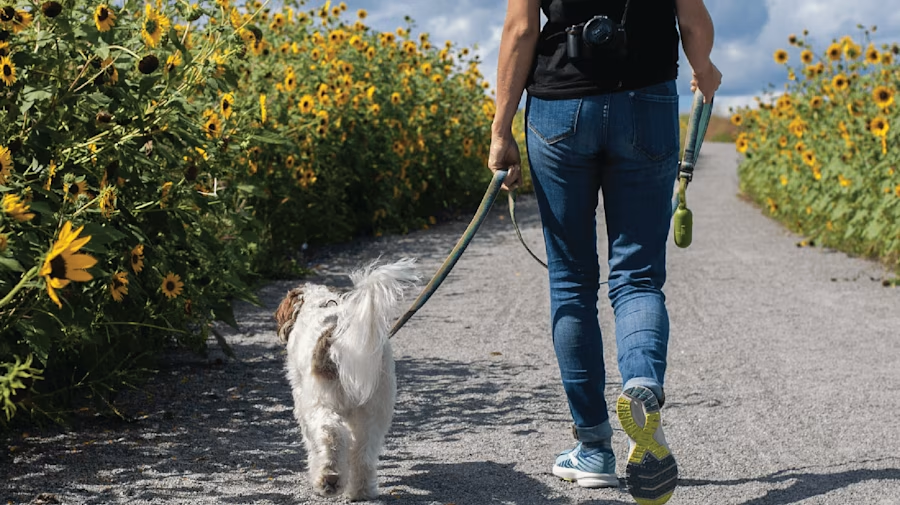
Possibly, but only if your policy includes suitable cover for dogs in your care - standard public liability insurance may have a care, custody and control exclusion. This means it may not cover a client’s dog if it is lost, injured or killed while you are responsible for it.
Look for specialist cover that includes dogs in your care, and be sure to check your policy’s vet-fee limits, excesses, conditions and exclusions before buying, as no policy will cover every incident.
Yes, if you use your car for work journeys, you should tell your insurer and arrange suitable business-use cover. This could include:
Travelling between clients
Collecting and returning dogs
Driving to different walking locations
Carrying equipment for your business
Normal commuting cover may not be enough. You should also check that your insurer allows you to transport clients’ dogs and whether crates, leads or other equipment need separate cover.
Possibly - you should check each platform’s terms and conditions rather than assuming its protection replaces your own dog walker insurance. Find out:
Who is covered
Which services and bookings are included
When the protection begins and ends
What excesses and cover limits apply
Whether dogs in your care are covered
Which incidents and costs are excluded
You may need your own policy if the platform’s protection does not cover every service you provide or the full time a dog is in your care.
Check that your chosen policy suits how your dog-walking business operates, rather than choosing on price alone. You should look at whether care, custody and control cover is included, as well as how many dogs you are allowed to walk at once.
It is also important to check the public liability cover limit and whether the policy includes cover for employees or subcontractors. You should consider whether lost-dog and emergency vet-fee cover is included, along with any requirements for business vehicles and equipment.
Make sure you understand the excess you would need to pay towards a claim, and check for any exclusions relating to dog breeds, off-lead walking or home boarding. Finally, compare the policy documents carefully, as insurers may offer different limits, conditions and exclusions.

Unless you hire staff, or you’re using your car for your dog-walking business, there’s no requirement to buy insurance but it can be very valuable. The costs you would need to cover yourself without insurance can be significant. If someone were to sue you because of damage your dog walking business has caused, for example, you would need to pay for the court fees.
On top of that, if you’re unable to work for any reason, if you’re self employed you would need to cover your lost income. These costs can cause significant financial problems and stress, and having insurance provides the peace of mind that you wouldn’t need to pay out if something were to go wrong.
Rebecca Goodman Personal Finance & Insurance Expert
You must keep every dog in your care under control and follow the rules applying to the place where you walk it - it's against the law for a dog to be dangerously out of control. A dog may be considered dangerously out of control if it injures someone or makes them reasonably fear that they could be injured.
This applies to all dogs and in both public and private places. Depending on what happens, penalties can include an unlimited fine, imprisonment, restrictions on owning dogs and the dog being destroyed.
There is no single national licence for ordinary dog walking, but some councils and landowners require professional walkers to have a licence or permit to use particular parks and open spaces. For example, professional dog walkers must be licensed to operate in Lambeth and Wandsworth council parks.
Separate animal activity licensing rules may apply if you provide dog day care at business premises or look after dogs in your own home. Ordinary dog walking and caring for dogs in their owner’s home are not covered by England’s dog day-care licensing rules.
No, you do not normally need a Disclosure and Barring Service check to work as a dog walker - however, some clients may prefer to hire someone who has completed a basic check.
A basic DBS check shows unspent convictions and conditional cautions. It currently costs £21.50 and takes an average of three days to process, although some applications take longer.
Public Spaces Protection Orders set rules for particular public areas in England and Wales. Depending on the order, you may have to:
Keep dogs on leads
Put a dog on a lead when instructed
Keep dogs out of certain areas
Limit how many dogs you walk
Clean up after dogs
Carry waste bags
Check for signs and your local council’s website, as the rules vary between areas. Breaking an order can lead to a £100 fixed penalty notice or a court fine of up to £1,000.
Not automatically - rules for banned types of dog differ across the UK, so check any specific requirements for where you work. In England and Wales, a banned-type dog can only be legally kept in limited circumstances, such as when it has a valid Certificate of Exemption.
An exempt dog must be kept on a lead and muzzled in public - for an XL Bully, the lead must be securely held by someone aged 16 or over.
Before accepting the dog, ask the owner to confirm that all legal requirements have been met - you should also check whether your insurance or local walking licence has breed-related conditions.
There is no single UK-wide limit on how many dogs a professional dog walker can walk at once. Your insurance may set a maximum, while councils, landowners and Public Spaces Protection Orders can impose separate local limits.
For example, Wandsworth generally limits walkers to four dogs but allows licensed walkers to walk up to six. Check your policy and the rules for every area you use before accepting multiple dogs.
Yes, you can work as a self-employed dog walker, join an existing company or set up a limited company.
If your gross self-employed income is more than £1,000 in a tax year, you will usually need to register as a sole trader for Self Assessment. You should also keep records of your income and business expenses from the date you start trading.











At MoneySuperMarket, we want to give you clear, accurate and trustworthy information so you can make confident financial decisions for your circumstances.
Every page on our website goes through a careful editorial process before it is published. It’s written or reviewed by one of our experienced experts, checked for accuracy, and updated regularly to reflect the latest information.
We do use AI tools to support our research and drafting, but a human editor is always in the loop to review, fact-check and approve everything before it’s published, so you can trust that what you’re reading is both reliable and up to date.
You can read more in our editorial guidelines.
We get paid by the companies we work with, but the payment we get doesn’t have any bearing on the information we provide. We get paid in different ways, depending on the type of product or service you buy through us. Our goal is to search deals from as wide a range of companies as possible, but we only show results from our partner providers.
Our comparison service is, and will always be, free to use.
One of the best ways to get the lowest prices and best deals is to compare quotes from different companies. We do the work for you, comparing quotes side-by-side and giving you all the information you need so you can choose the right deal for your needs and your wallet.
We don’t give recommendations or financial advice, but we give you clear information so you can choose financial products that suit your circumstances.
No, not every company can be included in our service. This is because some companies don’t want their products included on comparison sites, and some decide that they would rather not pay a fee. There are also a few smaller providers who can struggle to cope with the volume of customers that can find their products if they appear on MoneySuperMarket.
Our goal is to search deals from as wide a range of companies as possible so that you can choose the deal that suits you.
No, at this time business insurance is not an eligible product for unlocking our SuperSaveClub rewards. It is also not included in our Price Promise.
Simply Business is one of the largest insurance brokers in the UK. They work with leading and specialist insurers to provide cover for small business owners, landlords and self-employed workers.
MoneySuperMarket has a commercial partnership with Simply Business. They offer various business and landlord insurance policies from different insurers through our platform, allowing our customers to find affordable quotes and policies that suit your specific needs.
Reviewed on 20 Oct 2026 by
According to Simply Business data, 10% of customers paid this amount or less monthly for a dog walker insurance policy. Figure based on annual policies purchased in 2024.
Simply Business is one of the UK's leading providers of business insurance, serving 1 million customers across 1,500 trades.
Source: Gov.uk
Simply Business data 2025
YouGov Survey 1st July 2025 to 30th June 2026. Net Recommend score derived from "Which of the following online service websites would you recommend to a friend or colleague, or tell them to avoid?" Base: Current Customers of (MoneySuperMarket n=17,883, Compare the Market n=16,193, Go.Compare n=8,523, Confused.com n=7,918, Uswitch n=514)
From 01.06.23 to 31.05.24 MoneySuperMarket customers received £1.59bn estimated savings based on (i) SuperSaveClub reward redemptions, and (ii) savings claims per product multiplied by the number of sales. Products included - Car, Home, Pet and Travel insurance, Broadband, Credit Cards, Loans and Mortgages.
According to Simply Business data, 10% of customers paid this amount or less for an annual dog walking insurance policy. Figure based on policies purchased between 1st Feb - 30th Apr 2026.
According to Simply Business data, 51% of customers paid this amount or less for an annual dog walking insurance policy. Figure based on policies purchased between 1st of Feb - 30th April 2026.
Average claim payout for Simply Business customers who claimed on their business insurance from from 1 September 2025 to 31 August 2026.
79% of business insurance claims made by MoneySuperMarket customers were accepted between 1st September 2025 and 31st August 2026. Data from Simply Business.
Percentage of business insurance claims made by MoneySuperMarket customers between 1st September 2025 and 31st August 2026 that were accepted. Data provided by Simply Business.


