

Choose your currency
Select the currency you need from an extensive range of worldwide currencies on offer, including euros and US dollars.
Travel money is the cash you take abroad, exchanged into the local currency before you set off. It can be useful in places where cards aren’t widely accepted, like small shops, markets, or taxis.
It’s also handy for tipping in restaurants or hotels, where cash is still the norm. Buying travel money before you go often works out cheaper than changing it at the airport or once you’ve landed, where rates and fees can be higher.

The fastest and cheapest way to buy travel money is usually online:
Select the currency you need from an extensive range of worldwide currencies on offer, including euros and US dollars.

Tell us how much you want to change either by entering the total in pound sterling or by how much of the chosen currency you need.

Results are ordered by total cost. Check the terms as delivery charges can be higher for lower amounts. Once happy, click through to buy.

Choose a convenient time for your travel money to be delivered or collected ahead of your trip overseas.
Taking travel money with you on holiday could be a smart decision, giving you cash in the local currency for essentials like food and drink, tips and taxis. But there are some downsides...
Cash will usually be accepted everywhere
You won’t face card transaction fees
Can help if you’re sticking to a budget instead of swiping a card and losing track
Risk of loss or theft if you’re travelling with large amounts of cash
Travel insurance typically only covers you up to a certain amount of cash (typically between £200 and £500)
An increasing number of retailers only accept card payments
There are several places you can purchase money for your holiday, including:

Travel money companies, such as our partners MoneySavingExpert, allow you to order currency online with the option of home delivery or collection

You can visit travel money companies on the high street or at the airport to convert your pound sterling into a foreign currency in person

You can withdraw money using your credit or debit card at a foreign ATM, but this can be quite expensive due to foreign usage fees
You’ll usually have options when it comes to delivery of your travel money. If you need it the following day, delivery costs are likely to be higher. If you can plan ahead, it will cost less or you may even get free delivery.
Each travel money company has their own minimum and maximum amount they will let you order for exchange. This is worth considering when comparing deals.
The cost of travel money can vary widely, so it’s worth checking online deals to make sure you get the best value. Here are our top tips:

Don’t just look at best exchange rates, consider commission and delivery charges, which can change depending on how much you order

Consider using a debit card as credit cards may incur extra fees. A bank transfer may also be an option but it comes with less protection

Get organised and shop around in advance so you can compare deals and benefit from free delivery before you place your order

Our partner MoneySavingExpert can show providers that offer competitive buyback rates for any currency that you don’t use on your travels
There are two ways for you to receive your travel money:

You’ll usually have the option of recorded home delivery. It is often free if you order more than the stipulated minimum amount, but fees may apply if you need next day or fast delivery.

Depending on the bureau you order your travel money from, you may be able to collect it in person from a local branch or retailer.
Companies often charge commissions to exchange Sterling into a foreign currency. The commission might be a percentage of the transaction or a flat fee, but it should always be included in your cost comparison so you know you’re comparing like with like.

Comparing travel money with MoneySuperMarket’s partner MoneySavingExpert is straightforward and could save you money.

We’ll show you how much travel money you’ll get – including all charges such as delivery costs and any fees for the amount you want to exchange
Online travel money orders can not only be completed in a few clicks, but are usually cheaper than in-branch or at the airport money exchanges
You can choose from a wide range of currencies worldwide, from euros to US dollars and from Argentine pesos to Vietnamese dong

Taking some local cash on holiday is handy for taxis, tips or small purchases, and as a back-up if your card isn’t accepted. But don’t rely on cash alone. It’s risky if stolen and insurers cover only small amounts. A mix of cash and travel cards is your safest bet.
Rebecca Goodman Personal Finance & Insurance Expert
If you’d rather not take cash to cover all your costs when travelling overseas, you have other options, including:

A prepaid travel card is a preloaded card that you top up with one or more currencies before you go abroad, then use just like a debit or credit card wherever it’s accepted

A travel credit card comes with travel-related benefits and works much like any other credit card. The key difference is that these cards typically won’t charge you extra fees for spending overseas

Pre-printed cheques with a designated balance which travellers can use worldwide across a range of currencies. Available at currency exchange offices, banks, post offices, and travel agents
Comparing travel money with MoneySuperMarket’s partner MoneySavingExpert can help you get the most holiday cash for your money.

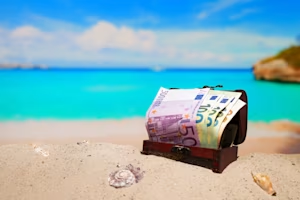

It depends on which country you are visiting. Most have their own currency but some share with other nations. You can check which currencies to use for all the countries worldwide at fxtop.com.
You might not be able to buy or change up some countries’ currencies due to local restrictions. It may only be possible to change your GBP or other currency up when you’re in the country, or you may be able to withdraw cash in the foreign currency from their cash machines.
Some countries may even let you pay in one of the major world currencies, but it’s a good idea to compare what the exchange rate would be if you paid in your own currency versus withdrawing the money or exchanging it in the foreign country.
Other countries, such as Cuba, have separate currencies for locals and tourists, which each have different exchange rates.
Whether or not it’s cheaper to withdraw cash abroad rather than exchanging it in the UK will depend on the foreign transaction fee charged by your card provider to withdraw cash abroad, and the ATM fee charged when withdrawing money in the foreign country.
A travel credit card is designed for spending abroad, and can be a better option if you regularly travel or purchase items from international stores.
You can use a credit card to get travel money, but you will usually have to pay a fee to do so.
A buy back guarantee is when a bureau commits to buying back any unused currency when you return from your travels at the same exchange rate you purchased it. You may have to pay a small upfront charge for the buy back guarantee. Check terms and conditions first.
How much travel money you need to take on your holiday depends on the length of stay, your spending habits and the destination. It’s typically good to have a mixture of ways to pay, such as card and cash, and the ability to top up or access more as you need it. You should take more foreign currency for more remote locations where cash may be more frequently used.
It's also a good idea to ensure that any overseas cash you do take is a range of denominations. If you can help it, you don't want to have to pay for small items with large notes.
Rules on how much money you can take in and out of a country vary across the globe. You should check before you travel as you might need to declare it at customs.
You must declare cash of £10,000 or more to UK customs if you’re carrying it between Great Britain and a country outside the UK.
You can arrange for travel money to be delivered to your home or you can arrange a click & collect. There may be a fee for delivery, which will increase if you need quick or next day delivery.
There are pros and cons to both. A travel credit card is designed for spending abroad, and can be a better option if you regularly travel or purchase items from international stores.
Travel money can be more convenient for small payments such as tipping, and for use in more remote locations where cards are not always accepted.
You work hard to earn your money, and we don’t think you should waste a penny of it paying over the odds on your household bills. That’s why at MoneySuperMarket, we’re on a mission to save Britain money.
Whip your credit score into shape with Credit Score
Super save over and over again with Energy Monitor
There are always more ways to save with MoneySuperMarket
So how do we make our money? In a nutshell, when you use us to buy something, we get a reward from the company you’re buying from.
You might be wondering if we work with all the companies in the market, or if our commercial relationships with our partners might make us feature one company above another. We’ve got nothing to hide, and we want to give you clear answers when it comes to questions like these, so we’ve pulled together everything you need to know on this page.
Reviewed on 10 Sep 2026 by


