When was my house built?


Key takeaways
Check your title deeds, home survey, mortgage offer, or contact your local authority or HM Land Registry to find when your house was built
It can be harder to pin down an exact construction date for very old homes
Older homes are more expensive to insure thanks to higher repair costs and risks like asbestos, lead pipes, woodworm, and damp

How old is my house?
The easiest ways to find out the age of your house are by:
Checking your title deeds
The title deeds or title register is a property’s official proof of ownership and contains current and past information about a registered building, including the age of the property.
The title deeds are held by the property owner. If your home has a mortgage, the lender will have them, but if the home belongs to you or your family, they should be somewhere in your possession.
You can buy a copy of the deeds from HM Land Registry for around £7.
Checking your home survey
The survey that was carried out when you bought the property or took out a mortgage should also show the property's age.
Checking your mortgage offer
If you’re in the process of getting a mortgage, your mortgage offer documents are another place you may be able to find details about your home, including the age of the property.
Contacting your local authority
Local authorities will often hold information about properties and buildings in the local area, such as when planning permission was granted for your home.
It’s worth contacting your local council, as they may be able to give you the build date of your property.
Contacting HM Land Registry
HM Land Registry records information about land ownership and interests affecting land and property, not what’s built on the land. Still, it can provide copies of title deeds.
Its records may also help you estimate the age of your home. For example, by showing when the property developer first took ownership or leased the land your house is built on.
Ask your neighbours
Properties close to each other were often built at the same time. Your neighbours may have done their own digging.
Check the Seller’s Property Information Form
If you’re buying or recently bought a property, the Seller’s Property Information Form completed by the current or former owners should also include the date it was built.
How can I find the age of a really old property?
It can be harder to find an accurate construction date for very old homes and period properties. The good news is that there y are lots of registers, archives and enthusiasts keeping track of antique buildings. They include:
The 1862 Land Registry Act
This record of 2,000 properties registered in 1862 is free to check via the digital archives.
You’ll be able to find out details about a property and its previous owners.
Local archives
Parish records, the county record offices, and your local library are all great sources of information about your area. These archives usually include old maps, electoral registers, family and estate papers.
Local history societies
A remarkable wealth of detailed and long-standing community knowledge, don’t underestimate them. A quick online search should come up with relevant local groups.
The National Archives
The National Archives’ online records can show who the occupants of a house were at a certain time, which might help you narrow down your search.
Ordnance Survey maps
Historical maps can show when the land was first developed, as well as when the property first appeared.
Census records
A national census has been conducted every decade between 1841 and 1911. So, finding the first mention of your address can narrow your search.
National Heritage List
If it’s very old indeed, your home may be listed in Historic England's National Heritage list for England or Cadw's National Historic Assets of Wales.
Do I need to know the age of my house?
Whether you live in an older home, a listed building or a new build, knowing when, exactly, it was built could be useful for all sorts of reasons - from home insurance quotes to planning permission.
For example, you’ll be asked for your property's age every time you renew your buildings insurance.
What if I can’t find out when my house was built?
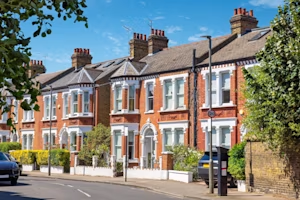
Still stuck? All is not lost. You could make an educated guess by studying the architectural style and features of the house.
Look out for the following features on the outside and inside of your home – these can help give you an idea of the historical period it was built in:
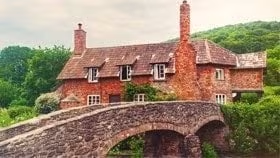
Tudor (1485 – 1603): small windows, made from timber and brick, upper floor juts out over the ground floor
Jacobean (1604 – 1713): flat-fronted and bare brick exterior, gothic-style windows and doors, steep gabled roofs, large living rooms with wide fireplaces
Georgian (1714 – 1820): tall and rectangular sash windows, central front door, large fireplaces
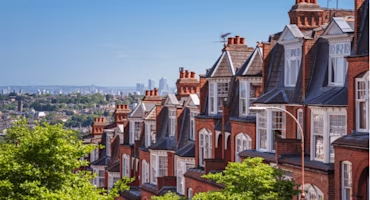
Victorian (1837 – 1901): bay windows, high ceilings, sloping roofs, red or coloured brickwork
Edwardian (1901 – 1914): broader build, wide hallways, dual-aspect rooms, hipped roof (where all four sides slope towards the walls) with dormer windows
Post-World War One (1918 – 1939): simple design, large bay windows, bare brick or pebble-dashed exterior, semi-detached
Your estate agent or possibly a friendly architect might also be able to help you identify these characters of your property (though watch out for charges for their time). Interior details such as plumbing and electrics may also prove useful in helping you identify the age of your building.
How does the age of my property affect my home insurance premiums?
Insurers want to know the age of your property so they can assess the likelihood of having to make a pay out in the future, as well as how expensive any claims may prove to resolve.
Older homes are usually more expensive to insure because insurance providers expect them to require more expensive repairs more often.
Properties that have features such as thatched roofs or original fireplaces and floorboards are also generally more expensive to repair properly. That’s because of the rare materials and expert knowledge needed to carry out the work.
This is especially true if your property is listed which can mean you may need permission to renovate or even repair your home, and may then have to stick with certain types of materials, construction or renovation techniques.
All these can push up the cost of cover, so if you live in an historic or listed home, you may need specialist home insurance for cover that won’t leave you out of pocket if you need to call in experts.
Could an old house be dangerous?
As appealing as their looks, character and history may be, older properties pose some risks. So, if you have your heart set on an old house or period property, it’s worth keeping in mind the potential problems it may have:
Asbestos
Buildings built before 2000 may have used materials containing asbestos in its construction.
Lead pipes
If your home was built before 1970, it may have lead pipes.
You can check by looking at your internal stop tap: the metal might be dull grey and soft, and often there’s a swollen joint next to the tap. If you scrape the pipe a little, you may see the shiny, silver-coloured metal underneath.
Woodworm
Period properties likely have experienced periods of damp where woodworm would thrive. So, it’s common to see the edges eaten off timbers in an old house, though these signs of past infestations usually don’t pose any structural risks.
However, when left untreated, active woodworm can damage old timber frames, and should be treated to prevent further damage.
Damp and mould
Older buildings are particularly at risk, as they lack the damp proofing measures of newer homes.
How can I find cheaper home insurance?
Whatever kind of home you live in, it’s easy to find and compare home insurance policies with MoneySuperMarket. Just give us a few details about you and your property and we’ll scour the market for great value deals.
Author
Jessica Bown
Insurance expert
Jessica Bown is an award-winning freelance journalist and editor who has been writing about personal finance for almost 20 years. She started her career on the Money team at the Daily Express, then...
Reviewer
Kate Hughes
Money & Savings Expert
Multi award-winner and best-selling author Kate Hughes has been a financial journalist for more than 20 years. She started out at the Financial Times at just 21 years old, holding several senior...