

It doesn’t take long
Pop in some details about your home and your belongings, and compare quotes in just a few minutes
Listed building insurance is a type of home insurance specifically designed for properties that are legally protected (listed) due to their historical, cultural, or architectural importance.
Because listed buildings must be restored and repaired using approved methods and materials, they require more specialist cover than standard homes.
A listed building insurance policy typically covers:
✔ Specialist repairs after fire, flood, storm, or subsidence using approved techniques.
✔ Approved heritage materials needed to meet conservation standards.
✔ Full or partial restoration if damage occurs, ensuring compliance with listing requirements.
✔ Public liability cover if damage to a listed structure affects third parties (e.g., falling masonry).
✔ Outbuildings and features such as historic walls, gates, or gardens that form part of the listing.

Listed building insurance works like regular home insurance: in exchange for your premiums, your property is protected in the event that it’s damaged or destroyed by fire, flooding and theft.
Listed building insurance is tailored to the unique needs of historic properties, ensuring repairs comply with heritage regulations.
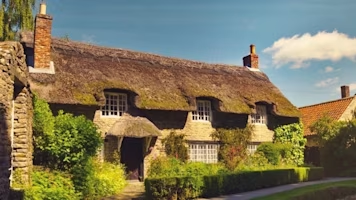
It covers the use of traditional materials (lime mortar, handmade tiles, oak beams) and specialist craftsmen (stonemasons, heritage carpenters), reflecting the legal duty to restore the property authentically.
Cover typically includes events like storm damage to slate roofs, fire destroying original plasterwork, or flooding affecting timber frames, and may extend to protected outbuildings or garden features.
Exclusions often apply to unauthorised alterations, non-standard construction risks (e.g., thatch, timber frames), and routine wear and tear, meaning the policy protects heritage features but not everyday maintenance.
Common add-ons for listed building insurance include accidental damage cover, legal expenses cover, and alternative accommodation cover. These are often more important for listed homes because of higher repair costs and the need to preserve unique structures.
📌 For example, accidental damage cover could pay for repairing a cracked stained-glass window or damaged period fireplace, while legal expenses cover may help with disputes over planning consent or boundary issues involving protected features.
Alternative accommodation cover is especially valuable, as repairs to listed properties often take longer, meaning owners may need rehousing for an extended period.
💡 Top tip: Other optional extras can include contents cover for antiques or specialist outbuilding protection (such as for listed barns or garden walls), personal belongings, legal expenses and unoccupied buildings cover.
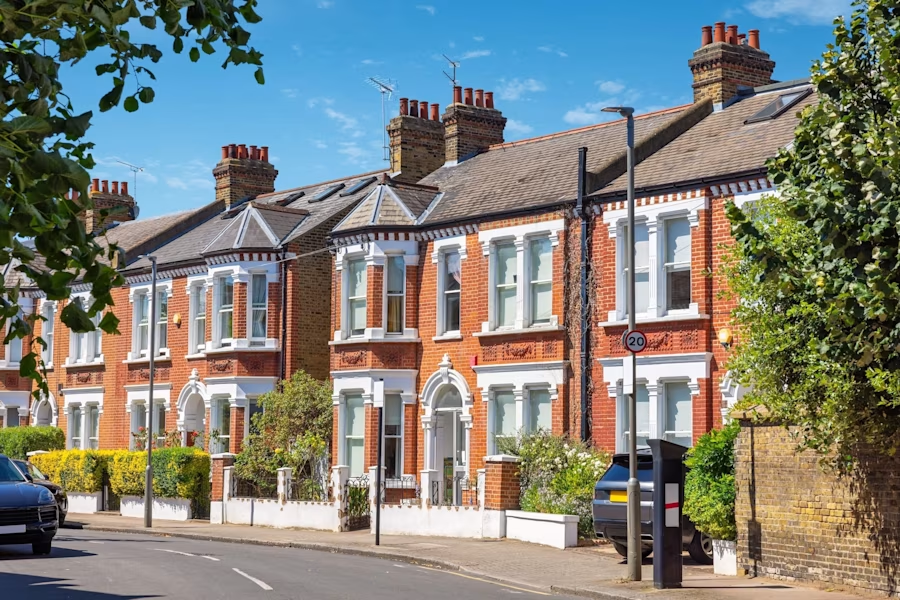
✔ Yes, it matters if a listed building is in Scotland, Wales or Northern Ireland.
The rules for listed buildings vary slightly between the UK nations, particularly in how listings are graded and how consent is managed.
The following table 👉 shows listed building grades and consent authorities across the UK nations:
When it comes to consent for repairs and alterations, owners should always check the official guidance for their nation:
England: Historic England
Wales: Cadw
Scotland: Historic Environment Scotland
Northern Ireland: Department for Communities – Historic Environment Division
Nation | Listing Grades / Categories | Meaning / Importance | Consent Authority |
|---|---|---|---|
England & Wales | Grade I, Grade II*, Grade II | I = exceptional; II* = particularly important; II = special interest | Local planning authority |
Scotland | Category A, B, C | A = national; B = regional; C = local | Local authority / Historic Environment Scotland |
Northern Ireland | Grade A, B+, B1, B2 | A = greatest; B+ = high quality; B1/B2 = special merit | Department for Communities – Historic Environment Division |
Listed buildings may cost a little more on average to insure, but that doesn’t mean it’s hard to find an insurer who can help out. Here’s how to compare listed buildings insurance with MoneySuperMarket:
Pop in some details about your home and your belongings, and compare quotes in just a few minutes

We’ll search the market for the cheapest deals, and help you choose the cover that suits your needs

We’ll show you claims experience for policies, to help you choose the right home insurance policy for you
We’re committed to finding the right cover for you and your home. That’s why we compare the biggest insurance providers in the country, including:






As of January 2025, the Building Cost Information Service (BCIS) reported that the House Rebuilding Cost Index (HRCI) increased by 3.8% compared to the previous year.
This marks a significant slowdown from the peak of 19.4% in 2022, indicating a cooling in construction cost inflation. Despite this moderation, costs remain elevated due to ongoing pressures in the construction industry.
Labour costs continue to rise, driven by factors such as increases in the National Living Wage and National Insurance contributions.


Home insurance premiums for a listed building can be more expensive due to rebuild and restoration costs, which involves sourcing appropriate materials and using specialist construction methods. However, if you own a listed building, you don't want to risk not having insurance. Otherwise, you would have to foot the bill yourself if anything went wrong and you didn't have insurance in place.
Recent data from the Association of British insurers (ABI) revealed that claims for subsidence alone hit £60 million between April and June 2024, which is the highest quarterly figure on record. When you compare that statistic with £203.79
^ , which is the average cost that 51% of our customers paid for buildings insurance, it makes sense to protect yourself financially with a policy.
Emma Lunn Personal finance expert
MoneySuperMarket has won the Feefo Platinum Trusted Service Award, an independent seal of excellence, which recognises businesses that consistently deliver a world-class customer experience.

Finding out if your property is listed is easy: the National Heritage List for England (NHLE) contains details of every listed building in England.
There are two ways that buildings can become listed. They can be nominated to Historic England, the organisation in charge of England’s listed buildings, or Historic England can designate the building itself, based on its own research.
You can make certain alterations to a listed building, but the higher the grade the less you can do.
Historic England’s website states that ‘listed buildings are to be enjoyed and used, like any other building. Listed buildings can be altered, extended and sometimes even demolished within government planning guidance’.
But before you make any changes, you must apply to your local authority for consent – making changes without permission is against the law.
Listed buildings do tend to be more expensive to insure on average, but as with every insurance policy, the exact cost of any policy depends on the value of the property being insured. But because listed buildings tend to be harder to repair, requiring rarer materials and amore expertise, premiums are normally higher to reflect this.
Almost certainly: most ordinary home insurance policies aren’t designed to cover the specific needs of a listed property. Specialist insurance should always be your first port of call.
You may well find that your home needs a specialist insurance policy if it’s in a conservation area. Local authorities which govern such areas have the power to make sure your building is preserved.
Yes – subsidence cover is particularly important for older listed buildings. Historic properties often have foundations, walls, or cellars built with traditional materials like timber, stone, or lime mortar, which can be more vulnerable to ground movement than modern construction. Additionally, many listed buildings were constructed before modern drainage systems, so changes in soil moisture or nearby tree roots can increase the risk of subsidence.
Yes – you can get extended unoccupied property cover for a listed building, but it’s usually more restricted than for modern homes. Listed properties often require ongoing maintenance to protect delicate materials (like timber, thatch, or lime mortar), so insurers are cautious about long periods of vacancy.
Insurers typically limit the period a listed building can be left unoccupied before standard cover lapses (often 30–90 days), so a specialist listed building policy is necessary to ensure protection during longer vacancies. Policies may also require a maintenance plan to prevent deterioration of heritage features.
Almost certainly: most ordinary home insurance policies aren’t designed to cover the specific needs of a listed property. Specialist insurance should always be your first port of call.
Yes – listed building insurance typically covers the cost of using specialist craftsmen. Because listed buildings must be repaired or restored in a way that preserves their historic character, insurers include the cost of hiring tradespeople skilled in traditional methods, such as stonemasons, heritage carpenters, or plasterwork specialists.
This is a key difference from standard home insurance, which generally assumes modern repair methods and materials.
Yes – outbuildings can be included in listed building insurance, but cover depends on whether they are part of the listing and their historical significance. Many policies automatically cover structures that are permanently attached or listed alongside the main property, such as historic barns, garden walls, gates, or stables.
If an outbuilding is separately listed or of special heritage value, insurers may require it to be specifically declared and may adjust premiums to reflect the higher cost of specialist repairs and materials.
We get paid by the companies we work with, but the payment we get doesn’t have any bearing on the information we provide. We get paid in different ways, depending on the type of product or service you buy through us. Our goal is to search deals from as wide a range of companies as possible, but we only show results from our partner providers.
Our comparison service is, and will always be, free to use.
One of the best ways to get the lowest prices and best deals is to compare quotes from different companies. We do the work for you, comparing quotes side-by-side and giving you all the information you need so you can choose the right deal for your needs and your wallet.
We don’t give recommendations or financial advice, but we give you clear information so you can choose financial products that suit your circumstances.
No, not every company can be included in our service. This is because some companies don’t want their products included on comparison sites, and some decide that they would rather not pay a fee. There are also a few smaller providers who can struggle to cope with the volume of customers that can find their products if they appear on MoneySuperMarket.
Our goal is to search deals from as wide a range of companies as possible so that you can choose the deal that suits you.
Yes, you can earn SuperSaveClub rewards when you buy home insurance through MoneySuperMarket.
This includes:
Up to £15, which you can withdraw as a pre-paid Mastercard or a gift card for brands like Sainsbury's and Amazon.co.uk
Free Days Out pass (worth £180), which gives free entry to a range of UK attractions
Cashback of up to 10% when you spend at brands including eBay, Just Eat and Argos
To earn SuperSaveClub rewards on purchases you must:
Sign up to SuperSaveClub (it's free)
Be signed in to your account when you make the purchase
More information can be found on our SuperSaveClub homepage.
Yes, home insurance is included in our Super Save Price Promise.
If you buy through us then find the same deal for less we will:
refund the difference
give you a gift card worth up to £20
Terms and conditions apply. More information can be found on our Price Promise page.
Reviewed on 1 Apr 2026 by
SuperSaveClub restrictions and T&Cs apply. Click here for details.
The annual premium that 51% of our customers paid in February 2026 where the cover type purchased was buildingsinsurance.
Accurate as of 01 April 2026.

