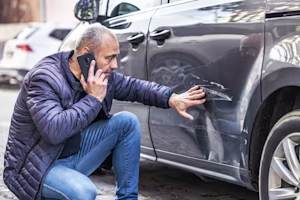
What happens if my car is written off?

Key takeaways
Your car can be written off if the damage is beyond repair, or if the cost of repairs exceeds its current market value.
If your car is written off, your insurer will pay you its pre-accident market value, minus your excess and any outstanding finance.
A write-off claim could affect your no-claims bonus and may increase your future car insurance premiums.

What does it mean if my car is a write-off?
A car insurance write-off, also called a total loss, happens when your insurer decides the cost of repairing your car exceeds its current market value, or the damage is so severe that your car cannot be safely repaired.
If your car is damaged in an accident, flood or fire, or even by something like hitting a pothole, your insurance company will assess the damage and decide whether your car should be written off.
Your insurer might declare your car a write-off if:
Your car is so badly damaged that it cannot be repaired safely
The cost of repairs would be too high compared to your car's market value
A write-off does not always mean your car has to be scrapped. Whether you can keep or buy back your car depends on which write-off category it falls into.
Did you know? In 2024 alone, 562,185 vehicles were written off in the UK, according to DVLA data. That equates to one vehicle being written off every minute.
What are the write-off categories for my car?
In the UK, written-off cars are placed into one of four categories (A, B, S, or N) based on the severity of damage and whether your car can be safely repaired and returned to the road. These categories have been in use since October 2017.
Write off category | Level of damage |
Category A | The car cannot be repaired and has to be crushed entirely |
Category B | The car cannot be repaired but only the body shell has to be crushed and you salvage other parts from it |
Category N | The car has suffered non-structural damage and if you get it repaired to a roadworthy condition you can use it again |
Category S | The car has suffered structural damage but if you get it repaired to a roadworthy condition you can use it again |
You might still see older cars for sale classified as Category C or Category D. These older categories were based on whether the insurer considered the car uneconomical to repair and have since been replaced by Category N and Category S.
If my car is written off how much will I get?
If your car is written off, your insurer will typically pay you the market value of your car just before the accident or damage occurred, minus your policy excess and any outstanding finance.
Important: The settlement amount is unlikely to be the same price you originally paid for your car or the amount you took out a finance agreement on. It will be your insurer's assessment of what your car is worth today.
The amount you receive will also depend on the type of accident and the level of cover you have:
Third-party only: If the accident was your fault, your insurer may not pay out. If another driver was at fault, you can claim against their insurance.
Third-party fire and theft: As with third-party only, your insurer may not pay out if you were at fault. You will also receive a payout if your car is damaged in a fire.
Fully comprehensive: You should receive a payout even if the accident was your fault.
If you have outstanding finance on your car, your insurer's payout may not be enough to cover the remaining balance. GAP insurance can help cover the difference between your insurer's payout and what you still owe on a finance or lease agreement.
How do I dispute my car write-off valuation?
If you believe your insurer's settlement offer is too low, you may be able to challenge it. It's worth researching your car's current market value before deciding whether to accept the first offer. To build your case, look for similar cars (same make, model, age, mileage and condition) being sold by reputable dealers. Having several examples will give you a stronger position than relying on just one. If your insurer does not increase the offer and you remain unhappy, you can follow their formal complaints process. If that does not resolve the issue, you may be able to escalate your complaint to the Financial Ombudsman Service.
What should I do if my car has been written off?
If your car has been declared a write-off, there are several steps you can take to protect yourself and make sure you get a fair outcome:
Contact your insurer to start the claims process as soon as possible.
Research your car's market value using reputable used car listings before accepting any settlement offer.
Notify the DVLA that your car has been written off (see the section below for details).
Keep all documentation, including photos of the damage, your insurance correspondence, and any repair estimates.
Check your finance agreement, if applicable, to understand any outstanding balance and whether you have GAP insurance.
Do I need to tell the DVLA my car has been written off?
Yes, you must tell the DVLA if your car has been written off. If you do not, you could face a fine of up to £1,000. You can notify the DVLA online via GOV.UK or by post. If you notify online, you will need:
Your insurance company's name and postcode
Your vehicle registration number
The 11-digit reference number from the yellow 'sell, transfer or part-exchange your vehicle to the motor trade' section of your log book (V5C)
If you send it by post, you will need to complete the yellow 'sell, transfer or part-exchange' section of your V5C and send the perforated section to the DVLA. If your insurer has already asked for your entire log book, write to the DVLA with your insurer's details and the date you handed over the vehicle. If you want to keep a personalised registration number, you will need to apply to remove it from the vehicle before notifying the DVLA.
Will I get a road tax refund if my car is written off?
Yes, if you inform the DVLA that your car has been written off, you can expect a full refund of any remaining complete months of your Vehicle Excise Duty (VED), also known as road tax. It is not possible to transfer your road tax to a different vehicle.
What do insurers do with my written-off car?
What happens to your car after it is written off depends on its category. Insurers often sell Category S and Category N vehicles, as these can be repaired and returned to the road. Category A and Category B cars must be crushed due to the severity of the damage, although some parts from a Category B vehicle can be salvaged and sold.
Frequently asked questions
If my car is written off, how long before I get my payout?
The time it takes to receive your write-off payout varies. In straightforward cases, you may receive payment within a few days to a few weeks. If you decide to dispute your insurer's valuation, the process could take several months.
If my car is written off, what happens to my insurance policy?
Your car insurance policy will usually be cancelled once your car is declared a write-off, as there is no longer a vehicle to insure. Every policy is different and so is every insurance provider, but most of the time, your insurer will give you around 30 days to find a new car and transfer your policy.
If you are unable to get a new car within your insurer's timeframe, this may be recorded as a cancelled policy. You would need to disclose this when taking out a new policy in the future.
Making a write-off claim is also likely to affect your no-claims bonus and may increase your future premiums.
Will I get an insurance refund if my car is written off?
In most cases, no. You are unlikely to receive a refund on your car insurance premium if your car is written off, even if you paid for the full year upfront.
Can I buy back my car if it is a write-off?
It depends on the write-off category. You can buy back Category S and Category N vehicles from your insurer after receiving your settlement payout, but Category A and Category B cars must be scrapped and cannot return to the road.
If you do buy back your car, carefully assess the repair costs and make sure the vehicle can be made safe and MOT compliant. Keep in mind that insurance costs may be higher after the vehicle is repaired.
Is it worth buying a car that has been written off?
Buying a Category S or Category N write-off can be a more affordable way to purchase a used car, but you should be aware that insurance is likely to cost more and not all insurers will offer cover.
If you are considering buying a previously written-off vehicle, it is a good idea to have an independent inspection carried out, run a vehicle history check, and review the full service history.
Can I insure a car that has been written off?
Yes, you can insure a previously written-off car once it has been fully repaired and has passed its MOT.
Even if your insurer does not ask about write-off history at the quote stage, it is worth disclosing it. If you later need to make a claim and your insurer discovers the undisclosed write-off, it could invalidate your policy.
What happens if I have outstanding finance on my written-off car?
If you have outstanding finance on your car, your insurer's payout may not be enough to cover the remaining balance. You may need to negotiate with your insurer or finance provider, or rely on GAP insurance to cover the shortfall. See our full guide to GAP insurance for more details.
Will a write-off affect my no-claims bonus?
A write-off claim is likely to affect your no-claims bonus, particularly if the accident was your fault. Some insurers offer no-claims bonus protection, which may help preserve your discount even after a claim. The impact on your premiums will vary between insurers.
How can I find the right car insurance cover?
Having the right level of cover is important if your car is ever written off, as it affects the payout you receive. Comparing car insurance quotes can help you find a policy that offers the cover you need at a price that works for you.
Author
Sara Newell
Commercial Director
Sara Newell is the Commercial Director for Motor & Home Insurance at MoneySuperMarket. With almost 20 years of experience in insurance, Sara has built a reputation as a results-driven leader who...