


Fully comprehensive
✔ Highest level of protection
✔ Injuries and damage to you and your car
✔ Medical expenses
✔ Fire and theft
✔ Injuries and damage to others
✔ Legal protection

If you’re a disabled driver you can take out the same car insurance as everyone else.
You might also want to consider a policy specifically tailored to people with disabilities. These may offer useful features such as a modified courtesy car or cover for mobility equipment that you need to transport in your vehicle.
No. Insurers are not legally allowed to discriminate based on disabilities so they won’t be able to refuse cover or charge higher premiums because of your disabilities.
This is because disability is one of nine ‘protected characteristics’ under the Equality Act 2010. The Equality Act replaced three separate pieces of anti-discrimination legislation, one of which was the Disability Discrimination Act 1995.
Whichever policy you choose, you’ll need to let your insurer know about any modifications that have been made to your car to improve accessibility.
This could include:
Specialised steering wheel
Wheelchair clamps
Wheelchair ramps
Wheelchair lifts
Altered pedals
This is the average cost for disabled and non-disabled drivers taking out a fully comprehensive policy.
Your car insurance premium will be tailored to individual factors such as your age, location and car type, but your disability will not be factored into your cost.
When getting a quote for insurance you must declare if you have a ‘notifiable’ medical condition, which can impair your ability to drive.
You can find a full list of medical conditions which you must declare on the Driver and Vehicle Licensing Agency (DVLA) website.
Failing to inform the DVLA could lead to a fine of up to £1,000 and you could also be prosecuted if you have an accident.
Failing to inform your insurer if you develop a health condition or have a pre-existing condition that may impact your driving could mean your policy is invalid.
➡️ Read more about car insurance for drivers with medical conditions
Heart conditions
Strokes (or mini strokes)
Diabetes
Visual impairment (such as glaucoma)
Epilepsy
A severe head injury
A brain condition (such as dementia)
A physical disability
Sleep apnoea
Syncope (fainting)
Yes, some car insurance providers offer a discount if you hold a Blue Badge, which lets people who have mobility problems park closer to shops and public facilities.
That’s because Blue Badge holders may be able to park in safer or more secure locations than others, which can reduce the risk of damage or theft. However, a discount is not guaranteed so it’s worth shopping around.
Bear in mind that your premium will still be influenced by other factors, such as your postcode and your claims history.
According to the Department for Transport, you can get a Blue Badge if:
You have a disability which means you are unable to walk or have difficulty walking
You have a disability which means that you are likely to come to harm when you are walking
You have a disability and you are likely to harm someone when you are walking
You are registered blind
You receive certain qualifying benefits
You get some categories of Personal Independence Payment (PIP)
You became disabled while you were serving in the armed force
You can use your Blue Badge as a driver and as a passenger.
You can apply, renew and check whether you qualify for a Blue Badge on the GOV.UK website.
You’ll need to provide:
A recent digital head-and-shoulders photo
Proof of identity, such as a birth certificate, passport or driving licence
Proof of address, such as a Council Tax bill or government letter
Proof of benefits (if you get any)
Your National Insurance number (if you have one)
The Blue Badge scheme is run by local councils. Your council will decide if you can have a Blue Badge. They may ask you to see a doctor or other health professional before they issue you with a Blue Badge.
In 2025, a Blue Badge costs:
£10 in England
£20 in Scotland
£0 in Wales
Disabled drivers will be able to choose from the same options as everyone when it comes to level of cover:
✔ Highest level of protection
✔ Injuries and damage to you and your car
✔ Medical expenses
✔ Fire and theft
✔ Injuries and damage to others
✔ Legal protection

✔ Injuries and damage to others
✔ Fire damage to your car
✔ Theft of your car

✔ Legal requirement
✔ Injuries and damage to others
Motability is a scheme that lets people use their government mobility allowance to lease a new car, scooter or powered wheelchair.
You’ll be able to lease a new car or wheelchair-accessible vehicle (WAV) for at least three years, with a variety of accessories and adaptations available. You can also get a new scooter or powered wheelchair every three years.
You’ll be eligible for a Motability vehicle if you receive one of these qualifying mobility allowances, with at least 12 months left:
Department for Work and Pensions (DWP)
Higher rate mobility component of Personal Independence Payment (PIP)
Higher rate mobility component of Disability Living Allowance (DLA)
Social Security Scotland
Enhanced rate mobility part of Adult Disability Payment (ADP)
Higher rate mobility component of Child Disability Payment (CDP)
Higher rate mobility component of Scottish Adult Disability Living Allowance
Veterans UK
Armed Forces Independence Payment (AFIP)
War Pensioners' Mobility Supplement (WPMS)
You can check if you're eligible on the Motability website.
When you lease a vehicle through Motability, it comes with its own insurance policy included.
A Motability insurance policy offers cover for the following:
Vehicle loss
Vehicle damage
Accidental damage
Fire and theft damage
Glass repair or replacement
Permanently fitted in-car equipment such as a sound system
Any required and agreed-upon modifications
Any supplied vehicle accessories
Replacement locks if the keys have been stolen and the theft reported to the police
Charitable or voluntary work (as long as you don’t get a regular fixed payment)
Commuting
Personal accidents up to £5,000 per person
Taking your car or Wheelchair Accessible Vehicle to the European Union (EU), and to Iceland, Norway, Switzerland and Liechtenstein at no extra cost, for up to 90 days in total, over any 12-month period (longer periods might be possible, with permission)
A replacement vehicle if yours is lost or damaged, or loss-of-use benefit if no suitable vehicle is available
However, Motability insurance won’t cover you for:
Lost keys
Personal belongings
Non-essential accessories or modifications
Interior damage such as rips, burns or stains
Driving other cars unless they’ve been provided or approved by the insurer
Other people driving your car, even if they have driving other cars on their insurance
Business use other than commuting (although you may be able to get this added)
Specialist car insurance policies tailored for disabled car owners can offer the following inclusions as standard or as add-ons:
Accessibility modifications such as altered pedals and ramps may be covered as standard.
Cover for your mobility equipment if it’s damaged or lost. May be subject to cover limits e.g. up to £2,500 per claim.
Cover for any other equipment required for your disability. You might need to prove their value to your insurer.
Personal accident cover offers a payout to you or named beneficiaries if you are seriously harmed by a road accident.
Also known as legal expenses cover, this offers cover for legal fees you might have to pay as a result of a car insurance claim.
Access to roadside assistance if your vehicle breaks down, including transport to a safe location.

If you have an adapted vehicle check whether your insurer can provide a courtesy car with the same modifications as your car should yours be off the road, and make sure any equipment you need is covered. If you need a carer, family member, or trusted friend to drive your car consider taking out an any-driver policy, although it may be cheaper to add them as a named driver.
Sarah Tooze Car & Van Insurance Expert

All the insurers we work with are authorised and regulated by the Financial Conduct Authority (FCA)

We're also the UK's most recommended price comparison website

Save up to £513

Buy through us and get up to £15
MoneySuperMarket has won the Feefo Platinum Trusted Service Award, an independent seal of excellence, which recognises businesses that consistently deliver a world-class customer experience.

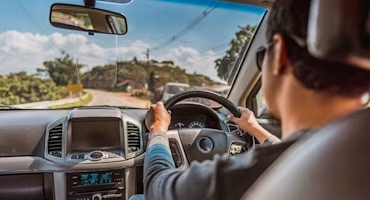



Yes, if you own a car but don’t drive yourself, you should still be able to get disabled driver car insurance cover. Most insurers offer the option to either add:
A named driver, someone you specifically add to the policy who is insured to drive your car
An any-driver option that covers anyone to drive your car – though there may be a minimum age requirement they must meet
Yes, most insurers will let you nominate someone to manage your car insurance policy on your behalf. This could be a family member, carer, or legal representative.
You’ll usually need to give the insurer written or recorded permission for them to discuss your policy details, make changes, or handle claims.
If you have taken out disabled driver car insurance from a specialist provider a modified courtesy car is likely to be included while you wait for your car to be repaired at an insurer’s approved garage. But it’s important to check your policy documents or contact your insurer to be certain.
If an adapted vehicle isn’t available while yours is off the road being repaired you may be given a mobility allowance to pay for alternative transport, such as taxis or trains.
Yes, you can usually add your carer as a named driver. Because they're not the main driver, their no claims bonus won't be affected by any incidents involving your car.
You can also take out an ‘any driver’ policy, where anybody can drive your car. You won’t need to name people individually so this could be easier to manage if you have multiple carers. However it can be more expensive and there may be a minimum age requirement. Check your policy documents or speak to your insurer to find out.
You should be able to get a young driver added to your policy to drive your disability car but there may be a minimum age requirement or other restrictions.
For instance, on the Motability insurance scheme you are only allowed one driver under 21 on your insurance (either yourself or someone else living at the same address).
Be aware that adding a young driver to your car insurance is likely to push up your premium.
You are exempt from paying road tax if you get the higher or enhanced rate mobility component of a qualifying benefit:
Disability Living Allowance (DLA)
Personal Independence Payment (PIP)
Child Disability Payment (CDP)
Adult Disability Payment (ADP)
Scottish Adult Disability Living Allowance (SADLA)
Armed Forces Independence Payment (AFIP)
War Pensioners Mobility Supplement (WPMS)
You can only use your exemption on one vehicle at a time so if you own multiple vehicles you’ll need to decide which one will be exempt from vehicle tax.
If you’re buying a new vehicle from a car dealership you’ll need to give the dealership your certificate of entitlement.
If you have a used vehicle, you’ll need to apply through a Post Office branch that deals with vehicle tax.
Renewals can be done online on GOV.UK
If you have a Blue Badge, your vehicle has a disabled tax disc, or your car is registered under the Motability Scheme, you are likely exempt from paying for London's Congestion Charge and the Blackwall and Silvertown tunnels charge.
You will need to register in advance with Transport for London to get the discount unless your V5C log book shows you have a 'disabled' taxation class, in which case the discount is automatic.
Other UK cities may have similar exemptions, but you should always check the local rules before travelling.
Vehicles with a disabled tax class or that are registered under the Motability Scheme are also generally entitled to a 100% discount on the Ultra Low Emission Zone (ULEZ) charge. Blue Badge holders without a disabled tax class on their vehicle are not.
The ULEZ discount for disability vehicles is only in place until October 2027, at which point your vehicle will need to meet emission standards to avoid the charge.
For other UK clean air zones, rules vary, so it’s always best to check the local council’s exemption list before driving.
At MoneySuperMarket, we want to give you clear, accurate and trustworthy information so you can make confident financial decisions for your circumstances.
Every page on our website goes through a careful editorial process before it is published. It’s written or reviewed by one of our experienced experts, checked for accuracy, and updated regularly to reflect the latest information.
We do use AI tools to support our research and drafting, but a human editor is always in the loop to review, fact-check and approve everything before it’s published, so you can trust that what you’re reading is both reliable and up to date.
You can read more in our editorial guidelines.
We get paid by the companies we work with, but the payment we get doesn’t have any bearing on the information we provide. We get paid in different ways, depending on the type of product or service you buy through us. Our goal is to search deals from as wide a range of companies as possible, but we only show results from our partner providers.
Our comparison service is, and will always be, free to use.
One of the best ways to get the lowest prices and best deals is to compare quotes from different companies. We do the work for you, comparing quotes side-by-side and giving you all the information you need so you can choose the right deal for your needs and your wallet.
We don’t give recommendations or financial advice, but we give you clear information so you can choose financial products that suit your circumstances.
No, not every company can be included in our service. This is because some companies don’t want their products included on comparison sites, and some decide that they would rather not pay a fee. There are also a few smaller providers who can struggle to cope with the volume of customers that can find their products if they appear on MoneySuperMarket.
Our goal is to search deals from as wide a range of companies as possible so that you can choose the deal that suits you.
Yes, you can earn SuperSaveClub rewards when you buy car insurance through MoneySuperMarket.
This includes:
Up to £15, which you can withdraw as a pre-paid Mastercard or a gift card for brands like Sainsbury's and Amazon.co.uk
Free Days Out pass (worth £180), which gives free entry to a range of UK attractions
Cashback of up to 10% when you spend at brands including eBay, Just Eat and Argos
To earn SuperSaveClub rewards on purchases you must:
Sign up to SuperSaveClub (it's free)
Be signed in to your account when you make the purchase
More information can be found on our SuperSaveClub homepage.
Yes, car insurance is included in our Super Save Price Promise.
If you buy through us then find the same deal for less we will:
refund the difference
give you a gift card worth up to £20
Terms and conditions apply. More information can be found on our Price Promise page.
Reviewed on 25 Mar 2026 by
YouGov Survey 1st July 2024 to 30th June 2025. Net Recommend score derived from “Which of the following online service websites would you recommend to a friend or colleague, or tell them to avoid?” Base: Current Customers of (MoneySuperMarket n=18,382, Compare the Market n=16,802, Go.Compare n=10,162, Confused.com n=8,229, Uswitch n=528).
51% of consumers could save up to £513.25 Consumer Intelligence , Jan 2026 Exc NI, CI, IOM
T&Cs apply to SuperSaveClub and Price Promise.
SuperSaveClub restrictions and T&Cs apply. Click here for details.
Based on the median annual price of comprehensive car insurance policies sold through MoneySuperMarket between October 2025 and January 2026.

