What are the rules on using my car lights?


Key takeaways
Use headlights and fog lights during the day in poor visibility
Use headlights at night, but dip them in built-up areas or when near other road users
Check brake lights each time you drive and replace faulty bulbs immediately

What are the rules on using my car lights?
The Highway Code has different rules about using your sidelights, headlights, brake lights, tail lights (which sit next to your brake lights), fog lights and hazard warning lights, depending on the driving conditions and time of day.
When should I use my car lights in the daytime?
There are instances when you should use car lights during daylight hours:
Brake lights: Should come on when you hit the foot brake, but not be used continuously in stationary queues of traffic – it causes unnecessary glare for drivers behind you
Headlights and fog lights: Should be used in daytime hours when visibility is seriously reduced. But you must switch them off when visibility improves to avoid dazzling other road users (Rule 226)
Dipped headlights: Should be turned on in dull weather to ensure you can be seen
All sidelights and rear registration plate lights: Must be lit between sunset and sunrise, even if it still seems light enough to manage without them (Rule 113)
What are daytime running lights and does my car have them?
Daytime running lights (DRLs) are low-wattage lights at the front of a car that come on automatically when you start the engine and turn off when the engine stops or you turn your headlights on. Whether your car has DRLs depends on how old it is. Many cars are fitted with DLRs as manufacturers have been required to fit them to new types of cars since February 2011.
💡 Top tip: Daytime running lights are not designed for night time use so you’ll need to switch on your headlights as it starts to go dark, unless your car is also fitted with automatic headlights.
When should I use my car lights at night?
When driving at night, you need to have sufficient light to see clearly where you are going, and to ensure that you can be seen, while not dazzling other road users.
You must always use your headlights at night, which is considered to be half an hour after sunset and half an hour before sunrise (Rule 113)
You must dip your lights in built-up areas or when you are behind or approaching other road users, including pedestrians, cyclists and horse riders (Rule 115)
When overtaking at night you should always keep your headlights dipped until you are level with the other vehicle and then change to main beam if necessary, unless this would dazzle oncoming road users (Rule 115)
If you are on the receiving end of dazzling headlights you should slow down or stop, and only continue once you can see the road ahead properly (Rule 115)
💡 Top tip: You can legally just use your sidelights at night if you're driving under 30mph in a well-lit area. However, most drivers use dipped headlights for better visibility of the road ahead.
What are automatic headlights and does my car have them?
Automatic headlights are lights which come on automatically when sensors on your car detect low levels of light, such as when you’re driving through a tunnel, in poor weather or at night time.
If your car has automatic headlights there will be an ‘auto’ option on the stalk on the left side of your steering wheel or with the headlight switch knob. However, it’s best to check your car handbook as there are different types of automatic headlights and you need to be familiar with how they work.
Which type of automatic headlights does my car have?
Check your handbook to see if these type of automatic headlights are mentioned:
Basic automatic headlights: These turn on in low lights and turn off when there’s sufficient daylight
Adaptive headlights: These adjust the direction, shape and brightness of your headlights depending on the road conditions and the angle you’re steering
Auto high beam assist: These switch between high and low beams based on the road lighting and whether there are oncoming vehicles
When should I turn my automatic headlights off?
You shouldn’t rely entirely on your automatic headlights. You might need to manually turn your headlights on and off in certain circumstances, such as:
During heavy fog or rain
When leaving a tunnel
Driving through forests or other areas with patchy lighting
📣 Did you know? More than half of UK drivers have have stopped or reduced driving at night (or would if they could) due to headlamp glare, according to research by TRL.
What are the rules on my car brake lights?
Make sure your brake lights are working and keep them clean. It can also be extremely dangerous if you have a dodgy brake light as the cars behind won't be able to tell when you're slowing down, especially if you brake suddenly.
Because of the safety issues, you’re likely to get pulled over by the police if your brake lights aren't functioning correctly. You risk:
A verbal warning
A fixed penalty notice - a £60 fine and three points on your licence
A Vehicle Defect Rectification Notice - 14 days to fix the fault and provide proof of the fix
Your car being taken off the road immediately
💡 Top tip: You should check your vehicle is ‘roadworthy’ before you drive. This includes checking your brake lights work by getting someone to stand behind your car while you apply the brakes. Replace any faulty bulbs straight away. You should also check all other lights at the same time and replace any that are faulty.
When should I use my car hazard warning lights?
Hazard warning lights should only be used when your vehicle is stationary and a potential hazard to other road users. For example, if your car breaks down you can use hazard lights to warn other drivers that your vehicle is temporarily obstructing traffic or is in a dangerous location.
The only time you can use your hazard lights while moving is if you are driving or being towed on a motorway or unrestricted dual carriageway and you need to warn drivers behind you of a hazard or obstruction ahead.
If your use of hazard lights is considered to constitute 'dangerous driving' you can be fined up to £5,000.
When should I use my fog lights?
It’s recommended that you use fog lights when visibility is ‘seriously reduced’ (Rule 226 of the Highway Code) but you must switch them off when visibility improves. Remember that you are legally required to use your headlights in poor visibility.
When driving in fog, visibility can be reduced to just a few feet. By law, all cars manufactured after 1979 must be fitted with rear fog lights. Some cars are also fitted with optional front fog lights.
Never use your fog lights when visibility is clear, especially at night when other drivers can easily be dazzled. This is dangerous and illegal (Rule 236). It could result in an on-the-spot Fixed Penalty Notice of £50 (but usually no penalty points).
💡 Top tip: Poor visibility is generally defined as not being able to see further than 100m - roughly the length of a football field.
Will my car lights be checked at an MOT test?
Yes, your headlights, sidelights, brake lights, indicators, hazard lights, rear fog lights, and number plate lights will all be checked as part of an MOT test. Your car could fail its MOT if you have a non-working light.
Can I upgrade my car headlights?
Yes, you can upgrade your car headlights, as the Driver and Vehicle Standards Agency (DVSA) changed the MOT rules in England, Scotland and Wales in October 2026. You’re now allowed LED replacement bulbs in halogen headlamp units, provided:
You use ECE-approved LED replacement headlamp bulbs - this means they have been type-approved to meet European vehicle lighting standards
You have a manufacturer-issued approval sticker permanently applied to your vehicle in a visible place such as inside the engine bay so it can be checked during the MOT test
💡 Top tip: You can’t convert an existing halogen headlamp unit for use with High Intensity Discharge (HID) bulbs. You’ll need to buy completely new HID headlamps.
What are the rules for my car windows?
Rules for tinted windows
If you can’t see out of your windscreen, your lights aren’t going to help you much.
That’s why the government insists that drivers with tinted windows have glass that lets at least 75% of light through the front windscreen and 70% through the front side windows.
There are no rules about how much light tinted rear windscreens or rear passenger windows must allow through.
If you break this rule, not only do you risk invalidating your insurance policy, you could have your vehicle seized.
Rules for windscreen cracks
Windscreen cracks can cause a car to fail its MOT if they are:
In the driver’s line of vision and larger than 10mm in diameter
Elsewhere and more than 40mm in diameter
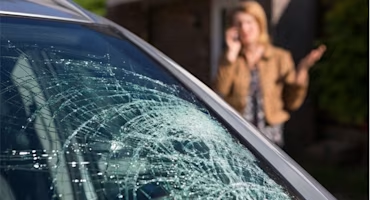
Driving around with a significant crack in your windscreen could also be considered a motoring offence.
Rules on cleaning windows
You should keep your windows clean on the inside and out, especially over the winter months. This includes not having condensation (which could cause glare) or uncleared snow or ice.
If you don’t keep your windscreen and windows clear you risk a £2,500-fine and three penalty points if your car is considered to be ‘in dangerous condition’.
How can I compare car insurance?
The easiest way to find the best deal on car insurance is to use MoneySuperMarket to compare providers. All you do is provide us with a little bit of information about yourself, your car and your situation, and we will show you a range of deals from hundreds of insurance providers.
Author
Sarah Tooze
Car & Van Insurance Expert
Sarah Tooze has been a motoring journalist for more than 15 years, specialising in company cars and vans, and has won a number of awards during her career, including the Newspress ‘Automotive...

Reviewer
Beth Leslie
Senior Insurance Content Editor
Beth is an experienced writer and editor who specialises in financial and economic content. She is currently the Senior Insurance Content Editor for MoneySuperMarket. Beth is passionate about making...