Save energy with solid wall insulation

Solid wall insulation is a way of insulating houses that were built without a gap between the inner and outer walls. Find out more with our guide.
Key takeaways
Many homes in the UK built before the 1920s have solid brick or stone walls, rather than cavity walls.
Solid walls can lose up to 45% of a home’s heat, more than double that of uninsulated cavity walls
Solid wall insulation can be internal or external. Both types reduce energy loss, making your home up to £710 a year cheaper to heat
Internal insulation costs about £7,400 on average and external insulation about £13,000. Both require professional, specialist installation.
You may be able to get help with the cost from the Great British Insulation Scheme

What is solid wall insulation?
Solid wall insulation is a way of adding insulation to houses built without a gap between the inner and outer walls (common in pre-1920s homes).
It can be fitted on the outside (external wall insulation) or the inside (internal wall insulation).
The aim is to cut heat loss, lower energy bills, and make the home warmer and more comfortable.
How much does solid wall insulation cost?
The Royal Institution of Chartered Surveyors (RICS) estimates about £7,400 for internal insulation and £13,000 for external insulation. The Energy Saving Trust suggests slightly lower costs. The cost will depend on various factors, especially the size of your property.
The following table compares internal and external wall insulation costs and other factors.
Feature | Internal wall insulation | External wall insulation |
Cost (UK avg.) | £4k–£13k (≈£7k for 3-bed semi) | £6k–£22k (≈£11k for 3-bed semi) |
Pros | Cheaper, keeps outside look, good for listed/conservation | No loss of space, best thermal results, fresh new exterior |
Cons | Reduces room size, disruptive inside, less effective overall | Expensive, changes outside appearance, may need planning |
Best for | Flats, terraces, listed buildings, room-by-room upgrades | Detached/semi houses where exterior change is acceptable |
Disruption | Interior works (plastering, electrics, redecorating) | External works (scaffolding, rendering) |
Space impact | 25–100mm lost per wall | None |
Planning permission needed | Rarely | Sometimes |
If you're considering solid wall insulation, compare quotes and choose an installer that's a member of the National Insulation Association to ensure the work complies with current building regulations.
How much can you save with solid wall insulation?
Despite the upfront investment, solid wall insulation can be worth it for the potential savings. Annual savings on energy bills could be around £660 for detached homes and £180 for flats, according to the Energy Saving Trust. Insulation may also add value to your property.
What funding is available for solid wall insulation?
The following schemes and grants may help with the cost of solid wall insulation:
Great British Insulation Scheme: Government funding for home insulation; mainly for lower-income households.
ECO4 scheme: Energy suppliers fund insulation for eligible homes (low income, benefits, or poor EPC rating).
Boiler Upgrade Scheme: Focuses on low-carbon heating, but can complement insulation retrofits.
Local council programmes: Many councils offer grants or subsidies for low-income or vulnerable households.
Check eligibility and application details with your local authority or approved installers. You can also search for grants that are available in your postcode on the Energy Saving Trust’s website.
How does solid wall insulation work?
There are two main types of solid wall insulation:
External wall insulation (EWI): Insulating boards or layers are fixed to the outside of your walls, then covered with render, cladding, or brick-effect finishes. This changes the outside look of your home but keeps the inside space the same.
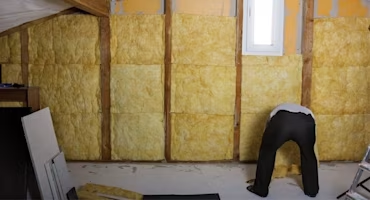
Internal wall insulation (IWI): Insulating boards or stud walls with insulation are added to the inside of your external walls. This keeps the outside appearance but can slightly reduce room size.
Internal insulation is often cheaper but it can be disruptive as the process requires moving radiators, sockets, and furniture, followed by re-plastering and decorating the affected walls.
External solid wall insulation is less disruptive and can be tailored to match your home's aesthetic with various decorative coatings.
Is solid wall insulation worth it?
Energy savings per year: Can cut heating bills by £400–£1,000 depending on house size and heating system.
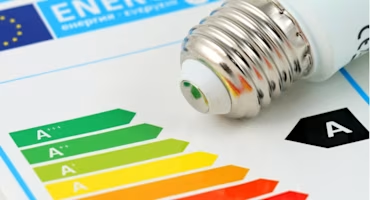
Impact on EPC ratings: Typically improves rating by one or two bands, making the home more energy efficient.
Payback periods: Usually 15 to 30 years, shorter if combined with other energy-saving measures or grants.
Other benefits: Reduces draughts, improves indoor comfort, and adds some soundproofing.
Do I need planning permission for solid wall insulation?
If your home is listed or in a conservation area, you may need planning permission for external insulation. Even internal insulation in listed buildings can require consent. For most non-listed homes, installing solid wall insulation usually doesn’t need planning permission.
If you’re a tenant, remember that since April 2020, all privately rented properties must have a minimum EPC rating of E. If your home is rated F or G, you can ask your landlord to make energy efficiency improvements, including solid wall insulation.
In some cases, local councils and energy providers may also offer financial support or grants to help cover the cost.
How do I know if my home has solid walls?
Before insulating, you need to know your wall type. Homes built before 1920 often have solid walls (usually under 260mm thick). Measure your wall – less than 260mm usually means solid. Brick patterns can help too: alternating short and long bricks indicate solid walls, while uniform bricks suggest a cavity. For timber or concrete homes, it’s best to consult a specialist.
What are other popular types of insulation?
Cavity wall insulation is a type of home insulation only suitable for properties that have cavity walls. It is the process of filling the gap (cavity) between a building’s inner and outer walls with insulating material. It helps reduce heat loss, keeps the home warmer, and lowers energy bills. It’s usually easier and cheaper to install than solid wall insulation.
Loft insulation is a layer of insulating material installed in the roof space of a home to reduce heat loss. It keeps homes warmer in winter and cooler in summer, lowers energy bills, and improves overall energy efficiency. Common materials include mineral wool, sheep’s wool, or foam boards.
Author
Alan Cairns
Senior Content Editor
Alan helps MoneySuperMarket break down complicated financial topics into plain English, to help you find the right deals. When he’s not writing or editing you might find him cycling the South Downs.