Should I switch to an electric car?

Written by
Sarah Tooze

Reviewed by
Alicia Hempsted
4 min read
Updated: 15 Oct 2025
EVs are the future of motoring. But is now the right time to make the switch? And what do you need to consider? We take a look.
The number of car buyers making the switch to electric is growing rapidly, ahead of the Government’s ban on the sale of new diesel and petrol cars from 2035.
In August 2025 electric and hybrid cars grabbed a bigger share of the new car market than diesel, according to industry body the Society of Motor Manufacturers and Traders (SMMT)1. Battery electric vehicles in particular are rising in popularity, nabbing 26.5% market share in 2025 of new car registrations.
So should you take the plunge and go electric too?
To help you decide whether an electric car is right for you, here are the key things you need to consider.
What journeys do you do?
A good starting point is to understand the journeys you do regularly. If you have black box car insurance, also known as telematics insurance, you’ll already have data on this. If not, you could simply write down the journeys you make over a week or month.
Due to the rise in remote working, we're driving less day to day. The average annual commuter mileage is 2,200 - 500 miles less than in 20022. So, if you use your car mostly for work, switching to electric might be a good choice.
The average distance an electric car can travel on a single charge is around 200 miles, although some models can handle as much as 300 miles or more. So even if you’re a high-mileage driver, there could be an electric car that’s right for you.
But budget is still important to consider, as the cars with the biggest batteries and the greatest range are more expensive.
If you need to tow, there are some EVs capable of this but bear in mind the extra weight will affect the vehicle’s range.
You’re also unlikely to get near the official range if you do lots of motorway driving, as EVs work best in cities and towns where there’s more chance for regenerative braking.
Be prepared for the range to drop during winter too as cold temperatures affect battery efficiency, but you can preheat your electric car’s battery and cabin before you start your journey (known as preconditioning).
To get the most range out of an electric car you’ll need to adapt your driving style, but most EV drivers enjoy the instant torque and the quietness of driving an EV. The only way to find out if it suits you is to test drive one.

Where can you charge?
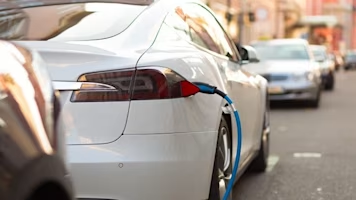
Having off-road parking and the ability to fit a home charger makes it far easier, and cheaper, to own and run an electric car.
You can then charge your car up overnight, and benefit from a lower tariff from your electricity provider.
You don’t necessarily have to fit a home charger as you can charge an EV from a standard three-pin socket if it’s within easy reach of your car.
However, it’s much slower, particularly if you have a car with a bigger battery. So check the charging time of the EV you’re interested in.
If you don’t have a driveway, garage or off-road parking space it doesn’t mean you can’t have an EV, but you will have to plan when and where you can charge.
Community charging, where you essentially rent a neighbour’s EV charger, is an option.
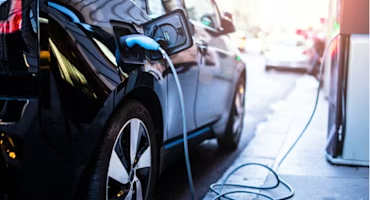
There are also on-street solutions, such as lamppost chargers, gully/channel charging, flat and flush chargers and overhead charging arms, although it’s still early days for some of these solutions and the prices can be steep.
Check whether your employer has fitted any workplace chargers or intends to do so. If you visit an office or site regularly this could be a good solution, alongside using public chargers.
There are currently more than 82,000 public EV charging points across the UK according to Zapmap, and the number is still growing3. Of those, around 1,800 are free to use. There are also plenty of public chargers with rapid charging that can provide 60 to 200 miles of range in 20 to 30 minutes, depending on the EV.
Make sure you check the capability of the EV you’re thinking of buying, as it’s the car’s onboard system and not the power of the charger itself which will determine the maximum rate it can charge at.
You can search for your nearest charging point, and check whether it’s available and whether it’s working via apps like Zapmap.
As well as charging stations along motorways and major routes, there are ‘destination chargers’ such as supermarkets, gyms, shopping centres, and hotels.
What’s your budget?
To work out whether you can afford an electric car it’s important to look at how much it will cost to run - not just the upfront price or monthly lease cost.
If you’re a low-mileage driver and you can charge at home overnight, an EV will be more affordable than it would be for a high-mileage driver who is reliant on the public charging network.
The average cost per mile to charge an electric car using a public rapid charger in August 2025 was 81p, compared to 8p using a 7kW home charger and an Ofgem capped tariff, according to RAC Charge Watch. That compares to 15p per mile (ppm) for petrol and 16p for diesel.4
Aside from electricity costs, you need to factor in the cost of having a home charger fitted as well as the cost of insurance.

Alicia Hempsted
Insurance Expert
Insurance Expert
Electric vehicles tend to be more expensive to insure
For now, electric vehicles are more expensive to insure compared to diesel and petrol vehicles. The average annual price of comprehensive car insurance for an electric vehicle is £572
^ .This is for a number of reasons, including higher costs for repairs and replacement parts, the need for specially trained technicians to repair software and electrical components, and higher purchase costs.
However, the price of insurance for electric vehicles has been steadily coming down as insurers become more knowledgeable of the risks. You can also find more affordable insurance by shopping around, renewing at the right time, and comparing EV insurance quotes.
So should you switch to an EV?
Ultimately, deciding whether to go electric now might rest with how you feel about the environmental benefits.
EVs aren’t perfect but they do have the huge advantage of zero tailpipe emissions, compared to petrol and diesel cars. Some car drivers simply decide going electric is the ‘right thing’ to do, find a way to make it work, and never look back.
Others are more cautious about the used car market, and battery life (although most have an eight to 10-year-warranty) or want to wait for price parity with petrol and diesel cars.
So you need to decide which are the most important factors for you.
For more information about the costs of owning an electric vehicle and how they compare, check out our Electric car insurance index.
Sources
1 https://www.smmt.co.uk/new-car-market-shrinks-in-august-but-evs-reach-record-share-for-the-year/
2 https://www.gov.uk/government/statistical-data-sets/nts09-vehicle-mileage-and-occupancy
3 https://www.zap-map.com/ev-guides/free-ev-charging-points-where-are-they
4 https://www.rac.co.uk/drive/electric-cars/charging/electric-car-public-charging-costs-rac-charge-watch/
Author
Sarah Tooze
Car & Van Insurance Expert
Sarah Tooze has been a motoring journalist for more than 15 years, specialising in company cars and vans, and has won a number of awards during her career, including the Newspress ‘Automotive...

Reviewer
Alicia Hempsted
Insurance Expert
Alicia is MoneySuperMarket's editorial content manager. She specialises in insurance, with a background in copywriting, digital marketing, and insurance advice. Since joining MoneySuperMarket in...