Animal collisions – all you need to know

Written by
Alicia Hempsted
5 min read
Updated: 15 Oct 2025
Accidentally hitting an animal with your car can be a traumatic experience, but it helps to keep calm and know what to do. Here's our advice.
How would you react if an animal appeared in your path while you were driving?
Your instinct might be to swerve to avoid a collision, but what if there was a car coming the other way? You could slam on the brakes, but would the car behind stop in time?
It might be too late for any kind of evasive action and you might have no choice but to hit the animal, resulting in injury and even death, not to mention damage to your car.
Whether it’s a loose dog or a roaming badger, a vehicle collision with an animal can be distressing for the driver and other occupants of the car.
So what are your responsibilities in such a situation?
Stop at the scene
If you hit an animal, you are legally required to stop at the scene and report the incident to the police within 24 hours.
However, the definition of an 'animal' is curious as it doesn't cover all kinds of animals. Legislation lists these specific animals as being covered by the law:
Dog
Horse
Goat
Cattle
Sheep
Ass
Mule
Pig
In other words, if you hit an animal like a deer or a cat, you are technically within your rights to drive on. But regardless whether it's legal, it's still a good idea to pull over somewhere safe to assess the situation.
Make sure you stop in a safe location that doesn't obstruct the road and take caution when exiting or walking around your vehicle.
If you decide to exit your vehicle once you've stopped, don't approach the animal that's been hit. The animal could react aggressively if you get too close or become startled and run into traffic. Keep your distance.
While your vehicle is stopped, check on any other people that were involved in the incident. Animal collisions can cause serious injury, so make sure nobody is hurt or in need of emergency services.
Deer collisions are more common than you think
The AA reported a 42% increase in deer collisions between 2021 and 20241, and they don't just happen on country roads but on A-roads as well.
Deer are particularly vulnerable to collisions, especially during the rutting season – autumn for fallow and red deer and early summer for roe deer – when males are particularly restless.
The British Deer society estimate that between 40,000 and 7,000 deer are killed in collisions on UK roads every year2, making vehicle collisions one of the main causes of mortality among wild deer populations.
Badgers are specially protected
In the UK, it's illegal to be in possession of a badger, dead or alive, so don't try to move one if you come across one in the road.
If you spot a healthy looking badger wandering dangerously into a road, you can contact National Highways England, Traffic Wales, or 101 to report it and they will arrange to safely relocate it.
If you injure a badger with your vehicle, don't try to transport it on your own. Call the RSPCA or, if the badger is decease, report it to your local council.

Contact the police
Regardless of what kind of animal you've hit, it's worth contacting the police to report the situation. If you do, they can contact the right people to help or remove the injured or deceased animal.
If the accident caused any serious injuries you should also request an ambulance, especially if the injured person is a driver. If anyone has received a head injury, don't move them unless they're in immediate danger.
Check your vehicle
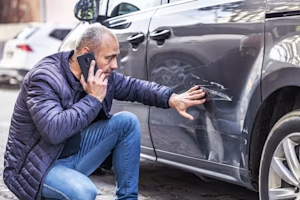
When it's safe to do so, check your vehicle for damages and take photographic evidence.
If your car is damaged or the driver or passengers are injured as a result of a collision with an animal, you should be able to claim on your car insurance if you have comprehensive cover.
When inspecting your car, you should check that it's still safe to drive. Damage to the lights, engine, or tyres could put you at risk, so the safer option may be to call for a tow.
You should also contact your insurer as soon as you get the chance and tell them what happened. Depending on your cover, they can help you arrange a tow or emergency repairs to get you back on the road as soon as possible.
For full guidance on what to do if you're involved in a car accident, check out our guide How to make a car insurance claim.
Drive with care
It’s not always possible to avoid a collision with an animal, particularly if it suddenly runs onto the road.
But drivers can take sensible precautions to minimise the risk of an accident. You should take particular care during the early morning and early evening when wildlife is often at its most adventurous.
Take note of road signs, especially deer warnings, and drive with caution and within the speed limit.
Sources
1https://www.theaa.com/about-us/newsroom/deer-strikes-increase-since-2021
2https://bds.org.uk/information-advice/issues-with-deer/advice-for-drivers/
Author
Alicia Hempsted
Insurance Expert
Alicia is MoneySuperMarket's editorial content manager. She specialises in insurance, with a background in copywriting, digital marketing, and insurance advice. Since joining MoneySuperMarket in...