

How much public liability cover do I need?
How much public liability cover you need will depend on the work you do
We work with a panel of the best UK business insurers to help you can find the right policy for your business at a competitive price
Public liability insurance is a type of business insurance that covers the costs if a member of the public (a “third party”) is injured or their property is damaged because of your business activities.
This includes both compensation payments and legal fees if someone makes a claim against you. It is also known as third-party liability insurance.
Here are some scenarios where public liability cover can help protect your business:
A customer trips over equipment left in your shop, injures themselves, and brings a claim against you. In this situation, public liability insurance covers the compensation and your legal costs.
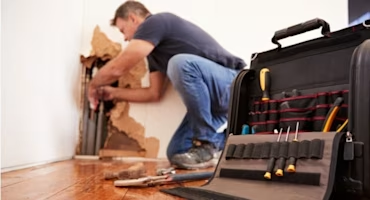
You accidentally damage a client’s furniture while carrying out a job in their home. Public liability insurance pays for the repairs or replacement, as well as any associated legal expenses.
Public liability insurance is not legally required. However, it can protect your business from unexpected and expensive costs. Some companies and organisations will only award contracts to businesses that have public liability insurance.
Employers’ liability insurance protects you if an employee is injured or becomes ill because of their work, not members of the public
Professional indemnity insurance covers you against claims arising from professional mistakes, advice or service failures, not physical injury or property damage
Anyone who interacts with the general public can benefit from public liability insurance. This includes sole traders, self-employed individuals, freelancers, limited companies, and small to medium-sized businesses.
Whether you're a hairdresser, make up artist, builder, market trader, or a café owner, if you come into contact with other people, it's worthwhile considering public liability insurance.
Not having public liability insurance can mean that you risk financial and reputational damage if a member of the public is injured due to your business activities. Legal fees and compensation payments can run up costs of hundreds of thousands of pounds. Public liability insurance can protect you from having to pay these costs out of pocket.
A customer slips on the floor of your business premises and injures themselves, and you have to pay for damages
You spill a cup of coffee on a client’s laptop and have to pay for a replacement
You work as a contractor and cut through an electric cable, leading to expensive repairs being required
You sell a food product that causes a customer to have an allergic reaction and the customer makes a claim against you
Profession | Average annual price |
|---|---|
Builder | £168.24^ |
Roofer | £305.10^ |
Painter/Decorator | £87.54^ |
Electrician | £88.30 ^ |
Plasterer | £78.61 ^ |
Caterer | £135.66^ |
The price of public liability insurance can range from under a fiver a month to hundreds of pounds per year for riskier enterprises.
The cost of your premium will depend on:
Your claims history: If you have made claims in the past, your premiums could increase
The size and value of your business: Your premiums are likely to increase depending on the size of your business. You can get a quick estimate on the value of your business using our business valuation calculator
Your business: Your premiums are heavily based on the nature of your business itself, and the risks associated with it
Excess: The higher the amount of excess you choose, the lower your premiums are likely to be
According to our latest data, 10% of customers paid this when taking out an annual public liability insurance policy.
The cost of fixing insurable problems yourself is usually significantly more expensive than taking out insurance.
💡 Top tip: Your policy will also be subject to a cover limit. This is the upper limit that your insurer is willing to cover.
Always check your policy to make sure you have a cover limit you are comfortable with.
Compensation claims: Covers third-party injury or property damage. Claims can range from a few thousand pounds to hundreds of thousands or more
Legal expenses: Pays legal defence costs
Repairs: Covers accidental damage you cause to someone else’s property
Medical fees: Includes NHS treatment and ambulance charges
Accidental damage only: Deliberate or negligent damage isn’t covered
Your own injuries: you need income protection for this
Your property: this is covered by commercial buildings and business contents insurance
Your employees: is covered by employers’ liability insurance
Professional mistakes: you need professional indemnity insurance for these types of claims
Intentional harm or damage: made by you or any of your employees
The right cover level depends on your business size, the type of work you do, how much you interact with the public, and any client or industry requirements.
£1 million cover: suitable for small, lower-risk businesses with limited public contact, such as home-based or office-based services
£2–£5 million cover: common for tradespeople, retailers and businesses working regularly in customers’ homes or public spaces, where accidents are more likely
£10 million+ cover: often required for high-risk work, large contracts, public-sector jobs, or when working in busy environments like construction sites or public venues
Clients or trade bodies may specify a minimum level. In which case, choose the amount they require or higher if your risk profile warrants it.

You can increase this to £2 million or £5 million if that fits your risk profile.
🚩 It’s important that you get a level of cover that suits your business. If you underinsure, you risk being liable for paying huge compensation costs and legal fees in the event of a high value claim — possibly even enough to put you out of business.
Employers’ liability insurance protects you if your staff become ill or injured at work.
Professional indemnity insurance protects you if you are accused of negligence.
Business interruption insurance protects against disruption from events like fires.
Tool insurance covers costs if your tools are stolen, damaged, or lost.
Business contents insurance protects equipment, including in home offices.
Business van insurance protects your work vehicle and its contents.
Product liability insurance covers legal fees if your product causes injury to a customer.
Cyber insurance protects against losses from scams and ransomware attacks.
Income protection insurance pays out for accidents, illness and unemployment.

Public liability insurance should be a priority for any business that interacts with the public. UK data shows that public liability claims continue to rise, with over 64,000 claims recorded in 2024–25, around 10% higher than the previous year, highlighting how common these incidents are.
At the same time, the Association of British Insurers reports that insurers paid out billions in general and property-related claims last year, highlighting the scale of financial risk businesses face from unexpected loss. Having the right public liability cover helps protect your business from potential significant compensation and legal costs from third-party claims.
Lucas Mansilla Life & Health Insurance Expert
MoneySuperMarket has won the Feefo Platinum Trusted Service Award, an independent seal of excellence, which recognises businesses that consistently deliver a world-class customer experience.

Most public liability policies last 12 months, after which you can renew. Some policies auto-renew, but it’s usually best to review your options at each renewal to ensure you’re getting the best deal.
Policies can often start immediately or on a chosen future date, depending on the insurer. If you only need insurance temporarily, for example, to cover an event, some providers offer monthly policies or one-off event insurance, which usually includes public liability.
If cover lapses between policies, you won’t be insured during that period, leaving you exposed to financial risk.
At each renewal, check your cover level and business details, especially if your turnover, staff numbers, or business activities have changed. Updating your policy ensures you remain protected.
The cost depends on the type of event, number of attendees, duration, location, cover level, and any special risks.
Small events (e.g. a community fair or workshop with fewer than 100 attendees) may cost a few hundred pounds
Larger events (e.g., festivals, exhibitions, or conferences with hundreds or thousands of attendees) can cost several thousand pounds
Tip: Quotes vary based on the specific risks involved. To get an accurate price, have these details ready:
Event type and activities
Number of attendees
Event duration and dates
Venue requirements or restrictions
Any special hazards (e.g., rides, catering, alcohol)
This ensures your insurer can provide a quote that reflects the true level of risk.
Public liability insurance covers costs if someone is injured or their property is damaged because of your work.
If a customer trips over your equipment at their home, public liability covers their medical bills and any legal costs.
Product liability insurance covers costs if a product you supply, sell, or manufacture causes harm or damage.
For example, a defective toaster you sold starts a fire in a customer’s kitchen, product liability covers the claims cost.
Some public liability policies automatically include product liability, while others require it to be added separately. Always check your policy to see whether both are covered.
Personal liability insurance covers incidents that happen in a non-work context. It protects you if a third party claims you or your family caused injury or property damage. This cover is usually included as part of home insurance or contents cover.
For example, if you accidentally knock over a neighbour’s expensive vase while visiting their home, personal liability covers the claim.
Public liability insurance covers third-party claims that arise because of your business activities. It is a business insurance policy. For example, if a customer trips over a tool left in your workshop, public liability covers their medical costs and any legal fees.
Use this distinction to identify which cover applies: if the incident is work-related, it’s public liability; if it’s personal or at home, it’s personal liability.
If you don’t have public liability insurance, you’ll have to pay legal fees and compensation yourself, either from your business funds or personally. These costs can easily reach six or seven figures, far exceeding the cost of insurance.
For example, if a customer trips over equipment at your workshop and suffers a broken leg, legal costs to defend the claim could be £20,000–£50,000, while compensation might exceed £150,000 for medical treatment, lost earnings, and pain and suffering.
Without insurance, you could also face cashflow problems, stress from managing the claim, and reputational damage if the dispute becomes public. Public liability insurance helps protect your finances, your business operations, and your reputation.
Yes, public liability insurance is available to individuals, freelancers, and self-employed people, even if you’re not a registered business. It’s also called third-party liability insurance and is available to:
Volunteers or community group organisers running events
Hobby sellers or craft makers selling products occasionally
Freelancers providing occasional services to clients
Cover differences:
Limits are often lower than standard business policies, reflecting the smaller scale of risk
Some insurers offer specialist personal or event policies rather than full business cover
In many cases, you can use a similar comparison process to business insurance, but for some hobby or community situations, you may need a specialist product designed for short-term or lower-risk activities.
Public liability insurance isn’t legally required for a limited company, but it’s highly recommended if your business interacts with clients or the public, including:
Visiting client sites or working in customers’ homes
Operating from retail premises or offices open to the public
Hosting or participating in public events or exhibitions
Directors can have personal responsibilities that aren’t covered by public liability insurance. For full protection, consider directors’ and officers’ liability, employers’ liability, and other relevant business insurance policies alongside public liability.
At MoneySuperMarket, we want to give you clear, accurate and trustworthy information so you can make confident financial decisions for your circumstances.
Every page on our website goes through a careful editorial process before it is published. It’s written or reviewed by one of our experienced experts, checked for accuracy, and updated regularly to reflect the latest information.
We do use AI tools to support our research and drafting, but a human editor is always in the loop to review, fact-check and approve everything before it’s published, so you can trust that what you’re reading is both reliable and up to date.
You can read more in our editorial guidelines.
We get paid by the companies we work with, but the payment we get doesn’t have any bearing on the information we provide. We get paid in different ways, depending on the type of product or service you buy through us. Our goal is to search deals from as wide a range of companies as possible, but we only show results from our partner providers.
Our comparison service is, and will always be, free to use.
One of the best ways to get the lowest prices and best deals is to compare quotes from different companies. We do the work for you, comparing quotes side-by-side and giving you all the information you need so you can choose the right deal for your needs and your wallet.
We don’t give recommendations or financial advice, but we give you clear information so you can choose financial products that suit your circumstances.
No, not every company can be included in our service. This is because some companies don’t want their products included on comparison sites, and some decide that they would rather not pay a fee. There are also a few smaller providers who can struggle to cope with the volume of customers that can find their products if they appear on MoneySuperMarket.
Our goal is to search deals from as wide a range of companies as possible so that you can choose the deal that suits you.
No, at this time business insurance is not an eligible product for unlocking our SuperSaveClub rewards. It is also not included in our Price Promise.
Simply Business is one of the largest insurance brokers in the UK. They work with leading and specialist insurers to provide cover for small business owners, landlords and self-employed workers.
MoneySuperMarket has a commercial partnership with Simply Business. They offer various business and landlord insurance policies from different insurers through our platform, allowing our customers to find affordable quotes and policies that suit your specific needs.
Reviewed on 2 Apr 2026 by
SuperSaveClub restrictions and T&Cs apply. Click here for details.
Average claims value for MoneySuperMarket customers who claimed on their business insurance in the last 12 months. Data provided by SimplyBusiness.
According to Simply Business data, 10% of customers paid £5.61 or less monthly for a public liability insurance policy. Figure based on annual quotes purchased between 1st Jan - 31st Mar 2026 The price is for up to £2 million of public liability insurance and excludes the extra costs for paying monthly
Accurate as of Dec 2024

