How to reduce your carbon footprint

Written by
Kara Gammell

Reviewed by
Alicia Hempsted
5 min read
Updated: 10 Sep 2025
Don't think the summer is the time to cut energy bills? We show you how you can save money and the planet.
The UK has got a tough target of moving towards being a carbon ‘net zero’ economy by 2050, but you as a consumer can also do your bit for the planet.
By taking steps to lower energy consumption around the home, and reduce household CO2 emissions, you can make a real difference.
Not only will this give you the warm fuzzy feeling of knowing you’re reducing your carbon footprint, but will also mean you save some money on your bills at the same time.
Summer is a good time to start thinking about energy saving. While your central heating has probably been switched off for some time, and thoughts about your boiler haven’t even crossed your mind, there’s a strong case for taking steps now to reduce your energy usage.
Replace your boiler
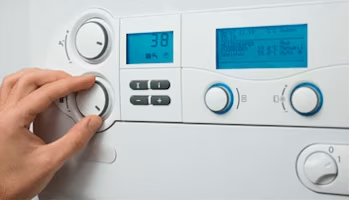
If you’ve got an old boiler, now could be the perfect time to upgrade to an energy-efficient model. Not only can this save you energy but also reduce your energy bills.
The summer is a good time to do this, as you’re not relying on your boiler as much, plus plumbers tend to be less busy.
According to the Energy Saving Trust, replacing a G-rate gas boiler with an A-rate one in 2025 costs an average of £3,700, but with the savings you could make you can recoup the cost over time. Based on the Energy Trust's July 2025 data, here's how much you could save on your fuel bill per year by replacing an old gas boiler with a new A-rated condensing boiler with a programmer, room thermostat and thermostatic radiator controls.
Property type | Annual savings switch from G-rate to A-rate gas boiler* |
|---|---|
Bungalow (detached) | £300 |
Detached house | £500 |
Flat (mid floor) | £130 |
Semi-detached house | £320 |
Mid-terrace house | £270 |
*Figures based on fuel prices in England, Scotland, and Wales as of July 2025, calculated by Energy Saving Trust
Equally, if you’ve already got an energy efficient boiler, it’s still important to get it serviced once a year to check it’s working as it should be. This ensures it will staying running as it should throughout the winter months of the year and also protect your home insurance cover. Always use a Gas Safe engineer.
In addition, you might also want to think about boiler cover to help with the costs of servicing and repairs.
But don’t fork out for a policy until you’ve checked whether cover is included in your home insurance. You don’t want to end up doubling up.

Dry clothes on the washing line
Tumble dryers can use a lot of energy to power, so take advantage of the warm weather while it's there, and hang clothes to dry on a washing line. Not only does this save energy and money, but can also extend the lifespan of your clothes, reducing shrinkage, fading, and wear and tear.
As the weather starts getting colder and wetter, and the tumble dryer starts getting used more often, there are a number of ways you can improve its efficiency and still save some energy.
Clean the lint trap regularly to improve air flow in the dryer, and towel-dry clothes before putting them in the dryer to dry them faster, reducing the need for long and high-heat cycles. You can achieve similar results by throwing a dry towel into the dryer with your laundry load.
Fill your fridge
You might not realise it, but refrigerators and freezers run more efficiently when they aren’t empty, so if yours is more than half empty, fill some of the space with jugs of water. But don’t overfill it, as your fridge does need some space and air for it to run at an optimal level.
Check the temperature, too. Ideally, your fridge should be set at 4° C, while your freezer should be set at -18° C.
Turn your thermostat down by one degree
While you shouldn’t really need your heating on at all over the summer, it’s worth being pre-emptive for the autumn, and notching your thermostat down a touch now, ahead of the colder months.
By turning down your room thermostat by one degree, you can save £55 and 300kg of carbon dioxide, according to the Energy Saving Trust.
Another good way to reduce your carbon emissions is by investing in a smart thermostat. This clever little device senses when you’re in the house and adjusts itself in line with this.
Tips to save energy – and money – if you’re going away on holiday:
Reduce the time your hot water comes on for, or better still, think about switching off your hot water and heating altogether if you're going away while the weather's warm
Switch gadgets off standby. This advice applies not only if you’re heading away on holiday, but also when you’re home. Turn appliances off standby when you are not using them. This includes televisions, set-top boxes, games consoles, laptops and mobile phone chargers. They all use small amounts of electricity when they are plugged into a socket but not switched on
If you want to deter burglars while you’re away this summer by having lights on when it gets dark, use a timer. This will mean your lights are not left on for long periods. While you’re at it, switch your light-bulbs to energy-saving ones.
Author
Kara Gammell
Personal Finance & Insurance Expert
Kara Gammell is an award-winning financial journalist with nearly two decades of experience writing for national newspapers and magazines such as the Daily Telegraph, the Sunday Times, Good...

Reviewer
Alicia Hempsted
Insurance Expert
Alicia is MoneySuperMarket's editorial content manager. She specialises in insurance, with a background in copywriting, digital marketing, and insurance advice. Since joining MoneySuperMarket in...