Skip to content

Commercial buildings insurance

Compare insurance quotes for commercial properties

  • Quickly compare from a range of providers

  • Protect your commercial building

  • Get peace of mind and security now

What is commercial property insurance?

Commercial property insurance (also known as business buildings insurance) helps keep the bricks and mortar of your business safe.

It works just like the buildings cover on your home insurance – if there’s unexpected damage to the structure of any building your business owns, your insurer will cover the cost of repairs.

Workers in an office building

What is classified as a commercial property?

In the UK, a commercial property is any property or land used for business purposes rather than as a living space.

Essentially, if a property is used to generate income or support a business, it’s considered a commercial property.

Examples of commercial property are:

  • Offices

  • Shops

  • Warehouses

  • Factories

  • Hotels

  • Restaurants

  • Cafes

  • Land used for development or investment

Do I need insurance for my commercial property?

There is no legal requirement to have commercial buildings insurance. However, some key reasons business owners purchase it are:

It provides financial protection

If your business property is damaged it prevents you from having to cover costly repairs out of your own pocket

Financial protection

It provides financial protection if your business property is damaged, preventing you from having to cover costly repairs out of your own pocket

Fulfil lender requirements

It can fulfil lender requirements – for example, if a mortgage provider insists you have commercial property insurance

Ensure business continuity

It helps to ensure business continuity by assisting with repairs and getting your premises back up and running if it’s damaged

Protects you against loss of rent

It protects you against loss of rent if this is part of your business model – for example, if you’re a commercial landlord and tenants have to move out while repairs are completed

Provides peace of mind

It provides peace of mind that you won’t be hit with unexpected costs, and that your business can still operate even if the unexpected happens

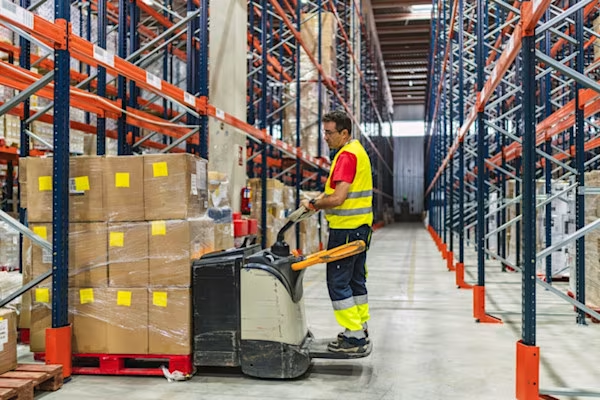
Worker in warehouse

What does commercial property insurance cover?

Commercial property insurance keeps you protected against a range of risks – but not everything is included. Here’s what a good policy should cover:

  • What’s included:

    • Natural disasters like flooding, storms, and subsidence

    • Any damage to your building from fire

    • Deliberate vandalism, including from break-ins, arson, burglary, or rioting

    • Accidental damage – as long as it isn’t considered negligence

    • Damage caused by burst pipes on your property 

    • If you’ve lost income as a result of the damage you can claim it back

  • What isn’t:

    • Damage to an unoccupied building (usually 30 days without occupancy)

    • Damage caused by negligence, for example, failing to fix a known leak, ignoring safety hazards, or not securing the premises properly

    • Damage resulting from poor craftsmanship

    • Damage from pests and other animals

    • General wear and tear

How much does commercial property insurance cost?

There’s no one answer – the cost of commercial property insurance is determined by different factors.

Here’s what goes into the price you’ll pay:

  • icon-improve-50

    Your business

    A bigger business will naturally have more to cover – and more at stake if cover isn’t in place. Larger premises, higher footfall, and more valuable equipment or stock can all increase the level of cover needed, which leads to higher premiums.

  • Icon-House-50x50

    Your property

    To work out rebuild costs, insurers factor in risks such as flood zones and area crime rates, and consider size construction materials, specialist features, labour and material costs, and accessibility for builders and emergency services.

  • Icon-Map-50x50

    Your locations

    If you operate across multiple sites, for example, a chain of shops or both an office and a warehouse, each location is evaluated on its own risk profile. Some may be cheaper or more expensive to insure depending on their size, purpose, and location-specific risks.

Different providers will work out their prices differently – so another factor affecting the cost of cover is which provider you choose.

That’s why it’s always best to shop around for insurance online, so you can be sure you’re getting the best possible deal.

What information do I need to get a quote?

To get a commercial property insurance quote, insurers will ask a series of questions to understand your business and the property you want to insure. They’ll usually ask about:

  • Your personal details

  • The nature of your business and what happens on the premises

  • The level of cover you need

  • Whether you have any employees

  • Your claims history

  • Key details about the property, such as its construction, security features, and occupancy

This information helps insurers determine which policy is right for your business and set an accurate premium.

It’s important to answer these questions correctly and honestly. Providing incomplete or inaccurate details can lead to:

  • Incorrect pricing, meaning you might pay more than necessary or end up underinsured

  • Delays or complications during a claim, if the insurer discovers discrepancies

  • In serious cases, a claim being reduced or refused altogether

Being precise upfront ensures you get the right level of protection and avoids problems when you need your cover most.

Our expert says…

“Nobody wants to think about their business premises being seriously damaged, but unfortunately, incidents do happen and can be financially devastating.

The British Fire Industry Association estimates that a fire at a business property costs an average of £657,074 to the company, with 43% of this cost being due to building damage. Flood damage, another significant threat, costs affected businesses a smaller but still significant £82,000 on average. Such costs can be crippling, particularly to small businesses.

Fortunately, commercial property insurance can be purchased for a fraction of this cost, making it a very worthwhile investment, should the worst happen.”

Katie Bishop Insurance writer

What other business insurance do I need?

If you need commercial property insurance you may also require:

Will business buildings insurance cover me if I work at home?

Usually not. Business buildings insurance is designed for commercial premises, so it generally won’t apply to homes used as your main workspace.

If you only work from home occasionally or in a hybrid role, your standard home insurance may cover this but you should still tell your insurer. If your home is the primary base of your business, you’ll likely need home business insurance or extra cover for equipment, stock, or any clients who visit.

Using an outbuilding, shed, or garage for business purposes isn’t always covered either, especially if it contains valuable tools or stock.

To avoid problems at claim time, always tell your insurer if you:

  • Work from home regularly

  • Store business equipment or stock

  • Use an outbuilding for work

  • Have clients or deliveries related to your business

  • Handle sensitive data or use specialist machinery

Being clear upfront ensures you get the right cover and don’t unintentionally invalidate your policy.


What if my building is damaged and the tenants can no longer work there?

Most commercial property insurance includes loss-of-rent cover, which can pay for rental income lost if your building is damaged and tenants cannot use it. To claim, insurers usually require that:

  • The damage is caused by an insured event (fire, flood, storm, vandalism)

  • The premises are officially deemed unfit for use

  • The loss of rent is directly linked to the damage, not tenant financial issues

Fire, flood, storm, or vandalism making the property unusable are all usually covered.

However, tenants defaulting on rent, choosing to leave, or the property being vacant without notice, aren't typically covered.

Always check your policy terms so you understand when loss-of-rent cover applies

Can commercial buildings insurance cover rental income?

Yes, many policies include loss-of-rent cover if the building becomes unusable due to an insured event like fire, flood, or storm. Standard cover usually has limits on rent paid and a maximum indemnity period (e.g., 12–24 months) and does not cover tenant defaults.

You can often add optional extensions to increase limits, extend the indemnity period, or cover additional perils. Always check your policy to see what’s included and whether an add-on is needed.

Can I get protection for if my tenants leave?

Yes, but it’s different from standard loss-of-rent cover. Loss-of-rent insurance only pays if tenants cannot use the building due to damage from an insured event (fire, flood, storm). It does not cover tenants leaving voluntarily or defaulting on rent.

To protect against income loss when tenants leave unexpectedly, you may need business interruption insurance or a rent guarantee policy. This can cover lost rental income for a fixed period or until you re-let the property.

Business interruption insurance is most suitable if your income depends heavily on tenants and you want financial protection while finding new occupants. Always check policy terms to understand limits and eligibility.

Does commercial property insurance cover unoccupied properties?

No, most commercial property insurance policies limit cover for unoccupied buildings, often to around 30 days, because empty properties are at higher risk of damage.

Insurers typically require you to:

  • Secure the property with locks, alarms, or shutters

  • Carry out regular inspections to check for leaks, vandalism, or other issues

  • Maintain utilities like heating to prevent frost damage

If you plan to leave a building empty for longer than the allowed period, you may need specialist unoccupied property insurance, which is designed to cover vacant premises and can include adjusted terms, higher premiums, or stricter security requirements.

Always check your policy and notify your insurer if the property will be empty.

Can I get mixed commercial and residential landlord insurance?

Yes. Mixed-use or multi-property landlord insurance lets you combine cover for both commercial and residential properties under a single policy.

Pricing and cover differ because insurers assess each part of the property separately:

  • Residential units are priced based on tenant type, property size, and contents cover

  • Commercial units are priced based on business type, risk of damage, and potential loss of income

Common mixed-use scenarios include:

  • A shop on the ground floor with apartments above

  • A café with a self-contained office above

  • A small warehouse with a live-in caretaker’s flat

Combining them in one policy can simplify administration, but premiums and cover limits will reflect the different risks of commercial and residential use.

How does MoneySuperMarket create and review the content on the website?

At MoneySuperMarket, we want to give you clear, accurate and trustworthy information so you can make confident financial decisions for your circumstances.

Every page on our website goes through a careful editorial process before it is published. It’s written or reviewed by one of our experienced experts, checked for accuracy, and updated regularly to reflect the latest information.

We do use AI tools to support our research and drafting, but a human editor is always in the loop to review, fact-check and approve everything before it’s published, so you can trust that what you’re reading is both reliable and up to date.

You can read more in our editorial guidelines.

How does MoneySuperMarket make money?

We get paid by the companies we work with, but the payment we get doesn’t have any bearing on the information we provide. We get paid in different ways, depending on the type of product or service you buy through us. Our goal is to search deals from as wide a range of companies as possible, but we only show results from our partner providers.

Our comparison service is, and will always be, free to use.

You can find out more about how we make money here.

Why should I use a price comparison website?

One of the best ways to get the lowest prices and best deals is to compare quotes from different companies. We do the work for you, comparing quotes side-by-side and giving you all the information you need so you can choose the right deal for your needs and your wallet.

We don’t give recommendations or financial advice, but we give you clear information so you can choose financial products that suit your circumstances.

Does MoneySuperMarket work with all the providers on the market?

No, not every company can be included in our service. This is because some companies don’t want their products included on comparison sites, and some decide that they would rather not pay a fee. There are also a few smaller providers who can struggle to cope with the volume of customers that can find their products if they appear on MoneySuperMarket.

Our goal is to search deals from as wide a range of companies as possible so that you can choose the deal that suits you.

Is business insurance eligible for SuperSaveClub and rewards?

No, at this time business insurance is not an eligible product for unlocking our SuperSaveClub rewards. It is also not included in our Price Promise.

Who are Simply Business?

Simply Business is one of the largest insurance brokers in the UK. They work with leading and specialist insurers to provide cover for small business owners, landlords and self-employed workers.

MoneySuperMarket has a commercial partnership with Simply Business. They offer various business and landlord insurance policies from different insurers through our platform, allowing our customers to find affordable quotes and policies that suit your specific needs.

➡️ Read more about Simply Business

Reviewed on 18 Dec 2025 by