Most stolen cars in the UK

Written by
Alicia Hempsted
5 min read
Updated: 15 Oct 2025
Car theft is on the rise in the UK as criminals adopt increasingly sophisticated techniques. But which makes and models are being targeted by thieves and how can you prevent your car from being stolen?
Which vehicles are thieves targeting?
One vehicle is stolen about every four minutes according to crime statistics from the ONS1. Between March 2024 and 2025, there were over 130,000 vehicles stolen in England and Wales. But when it comes to crime trends, they can come and go based on the demands of the market.
Right now, Ford and Land Rover vehicles are the most popular target for thieves, partly due to their popularity but also because they retain a decent amount of their value when resold.
Criminals also have a preference when it comes to car colour, with black and grey being the top two most common colours of stolen vehicles.
Ultimately, when it comes down to which vehicles are more likely to be stolen, convenience is an important factor. While criminals might covet high value vehicles, they're more likely to target ones that are easier to steal and resell.

Kara Gammell
Personal Finance & Insurance Expert
Personal Finance & Insurance Expert
The preference of thieves can affect your insurance
Be aware that insurance prices can go up for vehicles that are popular among thieves.
Insurers use all kinds of data to determine insurance prices, one of them being vehicle theft statistics. So, if your vehicle model becomes a popular target, you might see renewal prices go up. This is something that happened to Land Rovers in 2023.
In cases like this, it's worth comparing car insurance quotes before deciding to renew or switch to get the best possible deal.

Top ten stolen car models
Using data from the DVLA, we've put together a list of the top ten stolen cars in the UK3.
Rank | Model |
|---|---|
1 | FORD FIESTA |
2 | LAND ROVER RANGE ROVER |
3 | VOLKSWAGEN GOLF |
4 | FORD FOCUS |
5 | LAND ROVER DISCOVERY |
6 | TOYOTA RAV4 |
7 | NISSAN JUKE |
8 | VAUXHALL CORSA |
9 | VAUXHALL ASTRA |
10 | TOYOTA C-HR |
What tricks do thieves use to steal cars?
Since 2019, the number one method criminals have used to steal a vehicle has been by manipulating the signal of a remote locking device.
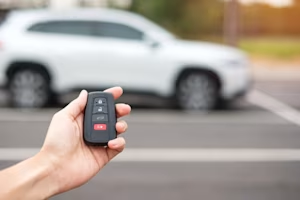
Thieves have invested in special devices, and often work in pairs, to steal cars which have keyless entry (where the vehicle automatically unlocks when the key fob comes within a short distance of the car).
They use a device which ‘tricks’ the car into thinking the key fob is close by so the car unlocks and they can start the ignition.
Thieves using remote hacking devices only need to be within a few metres of your key fob to pick up the signal from it and ‘relay’ it to the car, so even if it’s inside your home they can still steal your car.
You should also be aware of less sophisticated ways thieves steal cars. According to ONS vehicle crime data, the most common ways thieves of all kinds gain access to a vehicle is through an unlocked door. So, more than adding anti-theft devices to your vehicle, owners need to be aware of the risks of accidentally leaving their car unlocked.
What to do if your car is stolen
If your car is stolen you should report it to the police as soon as possible. They will give you a crime reference number which you’ll need to give to your insurer.
Whether your insurer covers car theft depends on the type of cover you have. If you have the most basic insurance, third-party only, you won’t be covered, you need to have fully comprehensive and third-party fire and theft (TPFT).
Even with fully comprehensive insurance and TPFT the circumstances around the theft might mean your insurer doesn’t pay out.
Kara Gammell
Personal Finance & Insurance Expert
Personal Finance & Insurance Expert
Insurance won't cover you if you leave doors unlocked
Most car insurance policies specify that you must take reasonable care to prevent your car from being stolen or broken into.
That means your insurance is unlikely to cover you if you leave your car unlocked or leave a window open, allowing thieves or vandals to gain access.
For this reason 'frost jacking' is a common and serious risk that drivers need to be aware of around winter time, as well as allowing potential buyers to test drive vehicles without the owner being in the car with them.
Stay vigilant, and never leave an unlocked vehicle unattended.
How to reduce the risk of your car being stolen
Don’t make the thieves’ job easy for them. Read on for a few tips on what you can do to lower the risk of your car being swiped by criminals.
Double-check locks and windows
Check your vehicle is locked and the windows and sunroof (if you have one) aren’t open. This greatly reduces the risk of being targeted by an opportunist thief, the Met Police says.
It also suggests that thieves look to see if door mirrors are folded - if they’re not it could be a clue that the car is unlocked.
Secure your keys
Keep your keys (including the spare key) hidden away at a safe distance from where your car is parked, and from the front door.
If your car has keyless entry, use a signal-blocking pouch such as a Faraday Bag and make sure it’s working every few months. You can also turn off the wireless signal on your fob when it’s not in use.
Get an alarm or immobiliser
Improve your car’s security by fitting a car alarm or immobiliser (if your car doesn’t have one), which should help lower insurance costs, and also use a visual deterrent such as a steering wheel lock.
Fit a tracker
Fit a Thatcham-approved vehicle tracker to your car. Consider one that uses VHF technology rather than a GPS tracking system as thieves could jam the GPS signal.
Although fitting a tracking or telematics device won’t necessarily deter a thief, it should mean the police can recover the vehicle.
Keep your car visible
According to ONS data, the majority of vehicle thefts occur at night2, so where and how you store your vehicle at night makes a difference.
Keep your car in a garage if you can. If not, install security lighting and CCTV at your home (this could be a video doorbell) or park in a well-lit area with surveillance cameras. The more visible your car is, the more difficult it will be to steal.
Sources
1https://www.ons.gov.uk/peoplepopulationandcommunity/crimeandjustice/datasets/crimeinenglandandwalesappendixtables
2https://www.ons.gov.uk/peoplepopulationandcommunity/crimeandjustice/datasets/natureofcrimevehiclerelatedtheft
3Data acquired from a freedom of information request made by MoneySuperMarket to the Driver and Vehicle Licensing Agency, covering all vehicle thefts between Februrary 2024 and January 2025
Author
Alicia Hempsted
Insurance Expert
Alicia is MoneySuperMarket's editorial content manager. She specialises in insurance, with a background in copywriting, digital marketing, and insurance advice. Since joining MoneySuperMarket in...