What are the rules for car lights in the UK?


Key takeaways
Use headlights and fog lights during the day in poor visibility
Use headlights at night, but dip them in built-up areas or when near other road users
Check brake lights weekly and replace faulty bulbs immediately

What are the rules for car lights in the UK?
Rules for using lights in the daytime
There are instances when you should use lights during daylight hours.
Brake lights should come on when you hit the foot brake, but not used continuously in stationary queues of traffic – it causes unnecessary glare for drivers behind you
Headlights and fog lights should be used in daytime hours when visibility is seriously reduced – although you must switch them off when visibility improves to avoid dazzling other road users
Dipped headlights should be turned on in dull weather to ensure you can be seen
All sidelights and rear registration plate lights must be lit between sunset and sunrise, even if it still seems light enough to manage without them
Since 2011 all new cars are required to have daytime running lights that come on automatically when the engine is started, and which turn off automatically when headlights or sidelights are lit.
Your headlights and your rear lights won't come on automatically - you'll need to switch on your lights as it starts to go dark.
Rules for using lights at night
When driving at night, you need to have sufficient light to see clearly where you are going, and to ensure that you can be seen, while not dazzling other road users.
You must always use your headlights at night, which is considered to be half an hour after sunset and half an hour before sunrise.
You must dip your lights in built-up areas or when you are behind or approaching other road users, including pedestrians, cyclists and horse riders.
When overtaking at night you should always keep your headlights dipped until you are level with the other vehicle and then change to main beam if necessary, unless this would dazzle oncoming road users.
If you are on the receiving end of dazzling headlights you should slow down or stop, and only continue once you can see the road ahead properly.
You can legally just use your sidelights at night if you're driving under 30mph in a well-lit area. However, most drivers use dipped headlights for better visibility of the road ahead.
Rules for brake lights
Make sure your brake lights are working and keep them clean. It can also be extremely dangerous if you have a dodgy brake light as the cars behind won't be able to tell when you're slowing down, especially if you brake suddenly.
Because of the safety issues, you’re likely to get pulled over by the police if your brake lights aren't functioning correctly. You could receive:
a verbal warning
a fixed penalty notice - a £60 fine and three points on your licence
a Vehicle Defect Rectification Notice - 14 days to fix the fault and provide proof of the fix
your car taken off the road immediately
You should check your brake lights at least once a week by getting someone to stand behind your car while you apply the brakes. Replace any faulty bulbs straight away. You should also check your indicator lights at the same time and replace any that are faulty.
Rules for hazard lights
Hazard warning lights should only be used when your vehicle is stationary and a potential hazard to other road users. For example, if your car breaks down you can use hazard lights to warn other drivers that your vehicle is temporarily obstructing traffic or is in a dangerous location.
The only time you can use your hazard lights while moving is if you are driving or being towed on a motorway or unrestricted dual carriageway and you need to warn drivers behind you of a hazard or obstruction ahead.
If your use of hazard lights is considered to constitute 'dangerous driving' you can be fined.
Rules for fog lights
When driving in fog visibility can be reduced to just a few feet. By law, all cars manufactured after 1979 must be fitted with rear fog lights. Some cars are also fitted with optional front fog lights.
Although you must use headlights when visibility is seriously reduced, it's not a legal requirement to use your fog lights. However, it is recommended to switch them on in foggy conditions to make it easier for other road users to see you.
Never use your fog lights when visibility is clear, especially at night when other drivers can easily be dazzled. This dangerous and illegal. It could result in a non-endorsable Fixed Penalty Notice of a £50 fine (but no penalty points).
💡 Top tip: Poor visibility is generally defined as not being able to see further than 100m - about the length of a football field.
What are the rules for car windows in the UK?
Rules for tinted windows
If you can’t see out of your windscreen, your lights aren’t going to help you much.
That’s why the government insists that drivers with tinted windows have glass that lets at least 75% of light through the front windscreen and 70% through the front side windows.
There are no rules about how much light tinted rear windscreens or rear passenger windows must allow through.
If you break this rule, not only do you risk invalidating your insurance policy, you could have your vehicle seized.
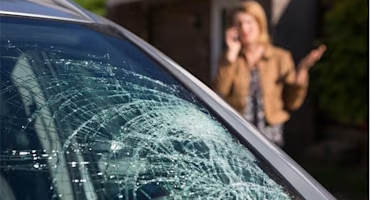
Rules for windscreen cracks
Windscreen cracks can cause a car to fail its MOT if they are:
in the driver’s line of vision and larger than 10mm in length
elsewhere and more than 40mm in length
Driving around with a significant crack in your windscreen could also be considered a motoring offence.
Rules on cleaning windows
You should keep your windows clean on the inside and out, especially over the winter months, to help minimise sun glare.
Author
Rebecca Goodman
Personal Finance & Insurance Expert
Rebecca is an award-winning financial journalist with over a decade of experience writing for print and online media. Her mission is to take the jargon out of personal finance and to help everyone...

Reviewer
Beth Leslie
Senior Insurance Content Editor
Beth is an experienced writer and editor who specialises in financial and economic content. She is currently the Senior Insurance Content Editor for MoneySuperMarket. Beth is passionate about making...