BUSINESS ENERGY
Business energy price trends UK 2026

Read time: 5 minutes

By Les Roberts, Business Energy Expert
8th September, 2026
Business energy prices move frequently and can be volatile. Knowing the current picture helps you time your next contract and avoid overpaying.
This guide tracks UK business energy prices through 2026. It covers current rates, what's driving them, and when switching makes sense.

In this guide to business energy price trends…
- We break down the current average business electricity and business gas prices for micro, small, medium, and large UK businesses.
- We track how prices have moved month by month through 2026, and what's driven each shift.
- We explain the network and policy charges, including TNUoS and DUoS, that now make up most of a typical bill.
- We cover the main factors pushing prices up in 2026, from grid investment to regional network costs.
- We set out a realistic forecast for the rest of 2026, based on current market signals.
- We give practical switching strategies, so you can time your next contract with confidence.
- We answer the most common questions businesses ask about energy pricing, switching, and forecasts.
Current business energy prices in September 2026
Business energy rates depend on your business size, contract type, and location. Here's a snapshot of where prices sit right now.
Electricity rates by business size
| Business size | Annual usage | Unit rate (fixed) | Standing charge |
| Micro | 5,000 to 15,000 kWh | 26.4p per kWh | 91.3p per day |
| Small | 15,001 to 25,000 kWh | 27.2p per kWh | 107.4p per day |
| Medium | 25,001 to 55,000 kWh | 26.2p per kWh | 223.8p per day |
| Large | More than 55,000 kWh | 26.2p per kWh | 293.9p per day |
Gas rates by business size
| Business size | Annual usage | Unit rate (fixed) | Standing charge |
| Micro | 5,000 to 15,000 kWh | 8.0p per kWh | 60.1p per day |
| Small | 15,001 to 30,000 kWh | 8.2p per kWh | 43.8p per day |
| Medium | 30,001 to 65,000 kWhh | 8.1p per kWh | 43.8p per day |
| Large | More than 65,000 kWh | 7.7p per kWh | 49.0p per day |
Note: Prices are correct as of September 2026. Rates and bill size may vary according to your meter type and business location. The prices you’re quoted may be different from the averages shown. The figures shown are the average unit rates and standing charges received by Bionic from our panel of suppliers (inclusive of maximum Bionic commission), per business size thresholds, from September 1 to September 8, 2026.
Out-of-contract and deemed rates
Out-of-contract rates are the price you pay by default when a fixed contract ends, and no new agreement is in place. So, if your contract lapses without a renewal, you move onto your supplier's default rate. The average customer saves 35% by signing a direct contract with MoneySuperMarket and Bionic instead of going out of contract
Out-of-contract electricity rates currently sit at 40.0p per kWh, with a standing charge of 254.0p per day. For gas, out-of-contract rates currently sit at 12.0p per kWh, with a standing charge of 338.0p per day.
Monthly movement and 2026 trends
Business electricity prices moved gradually higher through the first half of 2026 and have seen a recent spike, as shown in the graphs below.
Latest wholesale gas prices
Spot market wholesale gas costs are currently around 188p per therm* (around 29 kWh)
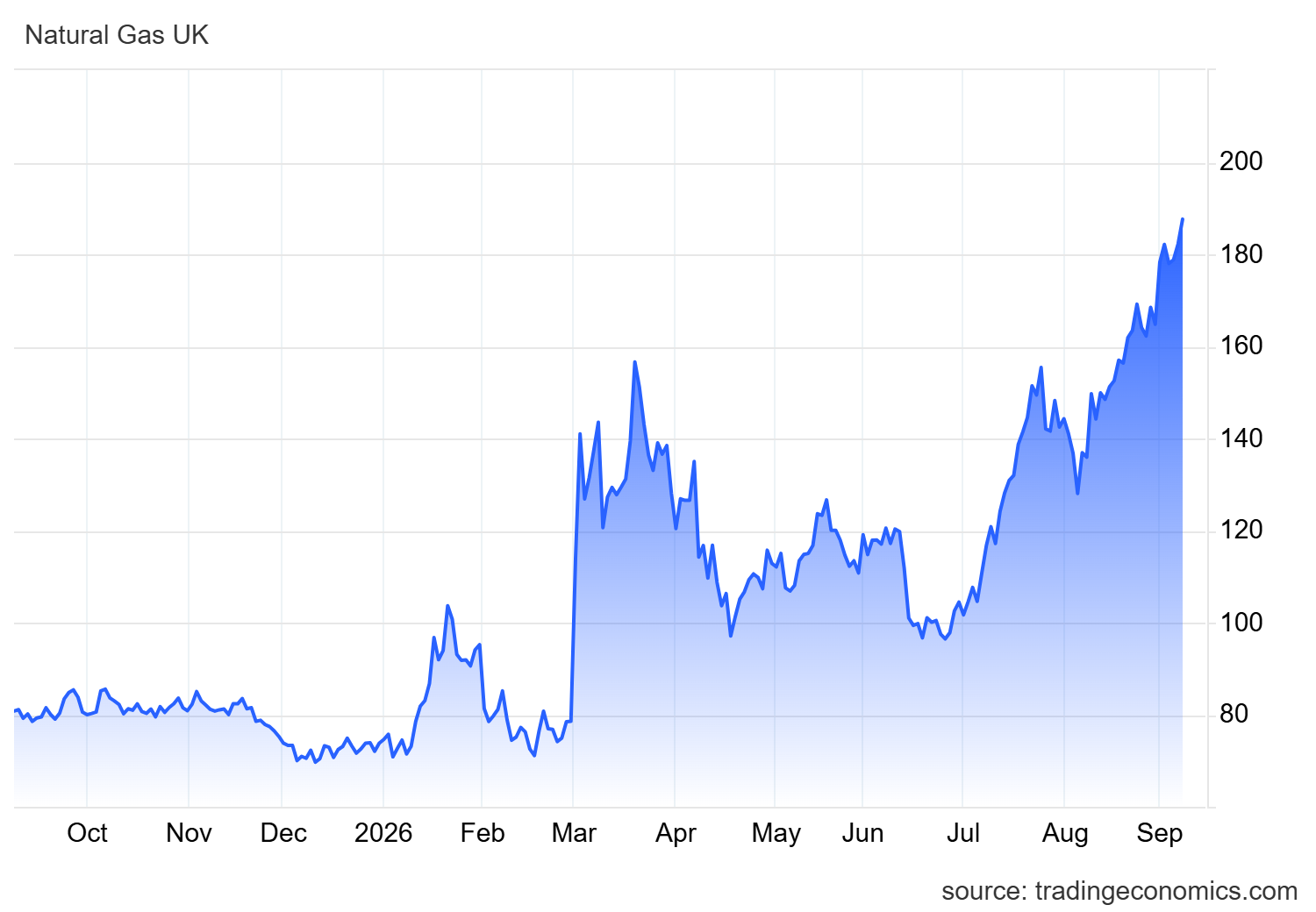
Source - Trading Economics
*Prices correct as of 11 am on September 8, 2026.
Latest wholesale electricity prices
Spot market wholesale electricity costs are currently around £144 per MWh* (1,000 kWh)
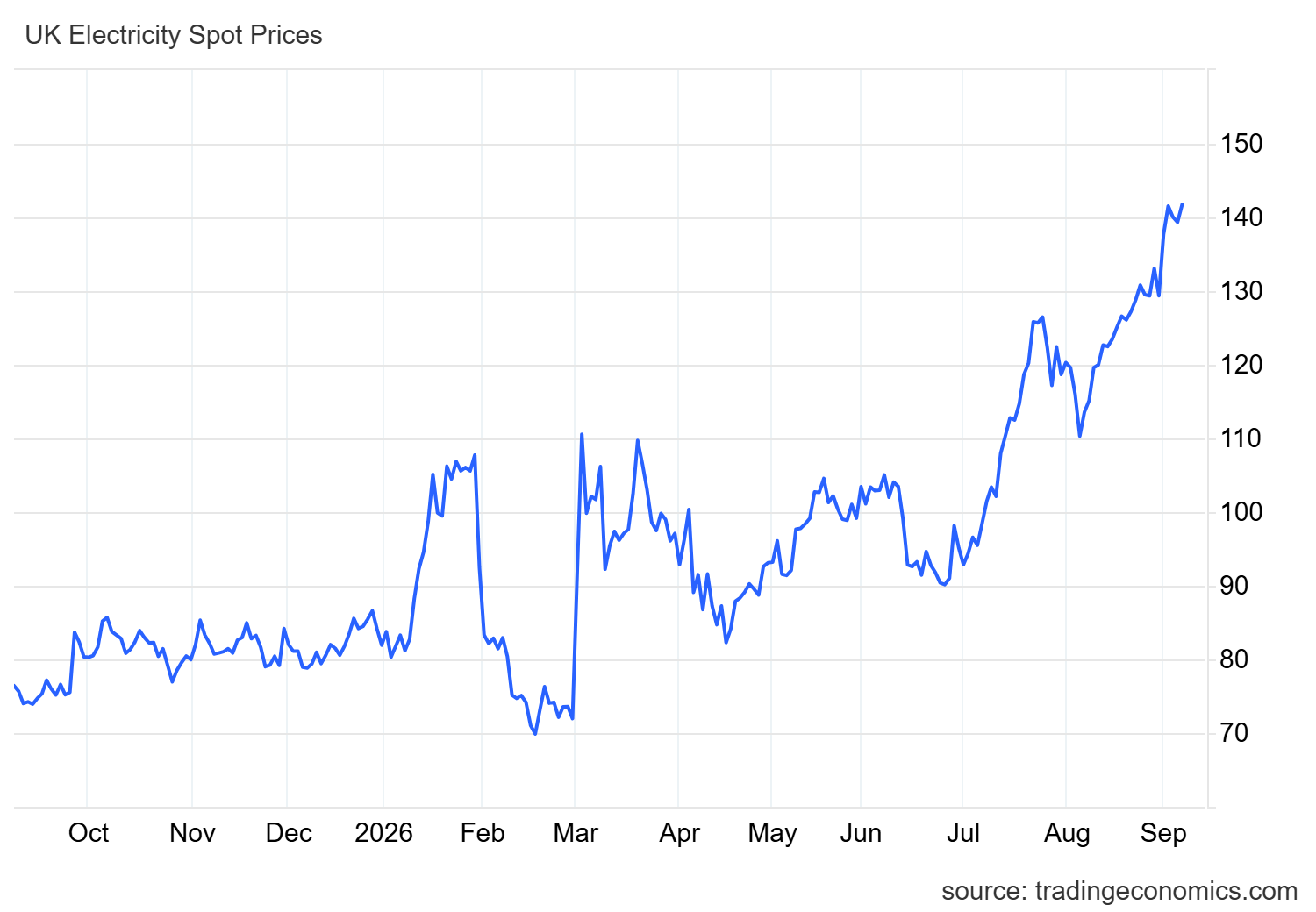
Source - Trading Economics
*Prices correct as of 11 am on September 8, 2026.
Wholesale gas costs, which drive much of the electricity price, spiked sharply in March 2026 following renewed conflict in the Middle East. Prices have since fallen back but remain above late-2025 levels and stay volatile.
The biggest recent shift came from network costs, not wholesale energy. TNUoS (Transmission Network Use of System) charges rose by more than 60% from April 2026, pushing up standing charges across most contract types.
Non-commodity charges explained
Non-commodity charges cover everything on your bill that isn't the wholesale cost of gas or electricity itself. In 2026, they make up around 60–64% of a typical business electricity bill.
- TNUoS (Transmission Network Use of System) funds the high-voltage network that carries electricity from power stations to local areas. Charges rose from roughly £16 per MWh to £31 per MWh from April 2026, a rise of more than 60%.
- DUoS (Distribution Use of System) covers the local network that delivers power to your premises. Rates vary by region and time of day.
- RIIO-3 is Ofgem's current five-year price control period for network operators, running from April 2026. It sets how much network companies can recover through charges like TNUoS.
- RAB (Regulated Asset Base) charges fund specific infrastructure projects, including new nuclear capacity, and add a small amount to every unit rate.
Most small businesses won't see these charges listed separately. They sit inside your standing charge and unit rate, which is why bills can rise even when your usage stays flat.
Factors affecting prices in 2026
Several forces are shaping business energy prices this year, including:
- Grid investment. The UK is spending heavily to connect new offshore wind farms and to reinforce the transmission network. This cost is recovered through TNUoS and DUoS charges, pushing standing charges higher through 2026 and beyond.
- Wholesale volatility. Gas prices still set the marginal cost of UK electricity generation. Global events, including conflict-driven supply shocks, can move wholesale prices quickly, even if the change is short-lived.
- Regional network costs. Business electricity prices vary by Distribution Network Operator (DNO) region. Two businesses with identical usage can see bills differ by 8–12% purely due to where they're located.
- Business size and contract type. Smaller businesses tend to pay a higher unit rate than larger ones, since fixed costs are spread across less usage. Contract length and timing also affect the rate you're offered.
How do prices vary by region in the UK?
A DNO (Distribution Network Operator) is the company responsible for maintaining the local electricity network and delivering power to your business premises. Unlike your energy supplier, a DNO does not sell electricity but manages the infrastructure that transports it to your site.
The UK has 14 DNO licence areas covering six regional operators. Businesses in these areas typically see lower network charges:
- East Midlands
- Yorkshire
- Eastern England
Businesses in these areas tend to pay more:
- North Scotland - Businesses in North Scotland often face higher electricity costs due to the region's remote geography and low population density. Maintaining extensive electricity networks across large rural areas increases distribution costs, which are reflected in energy bills.
- South West England - Electricity prices in South West England can be higher than the national average because the region's rural geography requires extensive distribution infrastructure. With fewer businesses and households sharing network costs, charges are often higher than in more densely populated regions.
- Merseyside & North Wales - Businesses in Merseyside and North Wales may pay higher electricity prices because the region's network serves both major urban centres and remote rural communities. The additional cost of maintaining infrastructure across these areas contributes to higher distribution charges and, ultimately, energy bills.
Northern Ireland sits on a separate pricing system.
Will energy prices continue to rise in 2026?
Forecasting energy prices is difficult. Wholesale markets react to weather, geopolitics, and supply disruptions that are hard to predict months ahead. That said, a few trends look set to continue through the rest of 2026:
- Non-commodity charges are likely to keep rising as grid investment continues under RIIO-3.
- Wholesale gas prices could stay elevated compared with 2025, given ongoing volatility linked to Middle East supply risks.
- Fixed contract pricing for 24-month to 36-month terms is currently close to 12-month rates, which narrows the usual premium for locking in longer.
Ofgem's household price cap, a useful proxy for underlying wholesale trends, rose by 13% for July to September 2026. This points to continued upward pressure on the energy market as a whole, even though business tariffs aren't capped in the same way.
Businesses should treat any forecast as a guide, not a guarantee. Rates can move sharply within weeks.
Should you switch energy suppliers?
If your business energy contract is up for renewal, it's worth comparing quotes to see if you can save money against your current supplier's renewal offer or out-of-contract rates.
But, given current conditions and the fact that your current contract may not end for several months, here's how to approach your next contract:
- Compare quotes early: Most suppliers let you compare and switch several months before your renewal date. Starting early gives you more tariff options and avoids default rates.
- Compare fixed terms carefully: With 24 to 36-month deals currently priced closely to 12-month rates, a longer fix could offer better value and more budget certainty right now.
- Check your TNUoS exposure: If you're on a pass-through contract, ask your supplier how April 2026 network cost increases will affect you mid-term.
- Avoid rolling onto default rates: For micro businesses, out-of-contract rates are currently 22% higher for gas. For small businesses, that difference jumps to 27%. For electricity, micro businesses pay 35% more by going out of contract, while small business rates increase by 36%.
- Use a broker or comparison service. When you get a quote with MoneySuperMarket, we compare tariffs from trusted UK suppliers. This makes it easier to find a deal that reflects current market conditions rather than outdated pricing.
Business energy price trends FAQs
Got more questions on business energy price trends? Check out the answers to our most frequently asked questions.
Are business energy prices falling in 2026?
No, not overall. Wholesale gas has stabilised compared with the 2022 peak, but non-commodity charges, especially TNUoS, are rising sharply. Most businesses will see standing charges increase through 2026.
What drives price increases for businesses?
Wholesale gas costs, network investment charges like TNUoS and DUoS, environmental levies, and regional distribution costs all feed into your final rate. From April 2026, network charges are the biggest driver of increases.
Should businesses wait before switching?
Waiting rarely pays off, since energy markets are volatile and prices can rise quickly. Comparing and switching ahead of your renewal date, typically 3–6 months out, usually gives you more options and protects against default rates.
Are fixed contracts still good value in 2026?
Yes, for most businesses. Fixed contracts protect you from mid-term price rises and give budget certainty. Currently, 24 to 36-month fixes are priced close to 12-month rates, which makes longer terms worth considering.
How accurate are energy price forecasts?
Forecasts offer a useful guide but aren't guarantees. Wholesale prices can shift quickly due to weather, geopolitical events, or supply disruptions, so treat any forecast as a starting point for planning.
Do different sectors pay different rates?
Not directly, but usage patterns vary hugely by sector. Refrigeration-heavy businesses like cafés and convenience stores use far more electricity per square metre than offices, which pushes their total bills higher even at the same unit rate.
Are gas and electricity price trends aligned?
Partly. Gas still sets the marginal price of UK electricity generation, so the two are linked. However, electricity carries additional network and policy costs that gas doesn't, so their price trends can diverge.
Can brokers predict pricing movements?
Brokers can track wholesale trends and network charge announcements closely, which helps with timing. No broker can guarantee future prices, since energy markets respond to events that are impossible to forecast precisely.
Compare business energy deals
Business energy prices are likely to keep shifting through 2026, driven mainly by rising network costs. Locking in a fixed rate now protects you from further standing charge increases.
When you get a quote with MoneySuperMarket, we compare options from trusted UK suppliers. You can see current rates for your business size and choose a tariff that fits your usage.
This page reflects rates and forecasts as of July 2026. Business energy prices change frequently, and this page is reviewed and updated quarterly to reflect current market data.
Is it time to compare business energy quotes and switch?
Take the hassle out of sorting your next energy deal. We compare from a panel of suppliers. You choose the rates that are right for your business.
By clicking ‘COMPARE TODAYS RATES’ you agree for us to search your current energy supplier and usage though industry held data. Enter manually
Our experts share essential knowledge on business energy







All related guides
View all energy guides
- A complete guide to business energy for offices
- A complete guide to business energy for restaurants
- A complete guide to business energy for shops
- Average business energy consumption - How much does your business use?
- How to get a business energy audit to save money and boost efficiency
- A complete guide to business energy bills
- Business energy brokers – everything you need to know
- What are no standing charge business energy tariffs?
- Business energy efficiency: how to save energy at your business
- Business energy price trends UK 2026
- How is business energy different to household energy?
- Change of Tenancy - Moving business premises and your energy contract
- Commercial property landlord energy advice
- Energy performance certificate for business
- Fixed vs variable business energy contracts
- A complete guide to half hourly electricity meters
- How does the energy market affect the cost of your energy bills?
- How switching to energy efficient lighting can save your business money
- How to make a business energy complaint
- How to pay your business energy bills to save money and avoid late fees
- How to reduce business energy costs
- How your business credit score affects your energy deals
- Compare large and industrial business energy prices
- Non-Commodity Costs & TNUoS/DUoS Charges: What Every UK Business Needs to Know in 2026
- Prepayment meters for business: The complete 2025 guide for SMEs
- What are renewable energy certificates and REGOs for small businesses?
- Renewable Energy for Business
- Business Smart Meters: Your Guide to Savings, Installation, and Supplier Comparison
- Commercial solar panel electricity
- The nuclear RAB levy explained: what it means for your business
- A business guide to time-of-use energy tariffs
- Deemed and Out-of-Contract Rates. What happens when your fixed rate business energy contract ends?
- Business energy tariffs explained
- Everything you need to know about the Smart Export Guarantee (SEG)
- A guide to small business energy and micro business energy
- UK business energy suppliers: who are they and what do they offer?
- What is the Climate Change Levy?
- Could your business benefit from green energy?
- Business energy meter installation: Your complete guide
- Multi-site meters and business energy management
- Business energy procurement strategy: fixed rates, brokers & risks
- How much is VAT on business energy?
- What affects gas prices for UK businesses?
- What happens when your energy supplier goes bust?
- What is a letter of authority (LoA) for business energy?
- What is Market-wide Half-Hourly Settlement (MHHS) and how does it work?
- What is business microgeneration?
- When should you switch business energy?
- Why is business energy so expensive?
How to switch business energy suppliers with MoneySuperMarket
We can switch your business to a better energy deal in three simple steps
1
We find your details
Just enter your business address and we'll use industry data to accurately find and understand your energy usage.
2
We talk through your quotes
One of our UK-based energy experts will search our supplier panel and give you a call to talk through your quotes.
3
You choose the deal you want
With all the information to hand, you choose the deal that best suits your business and we’ll handle the switch for you.
Compare today’s business energy rates
By clicking ‘COMPARE TODAY'S RATES’ you agree for us to search your current energy supplier and usage though industry held data. Enter manually

If you don’t complete the form we may use your details to understand what went wrong or to promote our products or special offers. We may contact you by phone or email.
Contact MoneySuperMarket.com at MoneySuperMarket House, St David's Park, Ewole, Flintshire, CH5 3UZ. © MoneySuperMarket.com Ltd 2013.
Moneysupermarket.com Limited is an appointed representative of Moneysupermarket.com Financial Group Limited ©, which is authorised and regulated by the Financial Services Authority (FSA FRN 303190). Moneysupermarket.com Financial Group Limited, registered in England No. 3157344. Registered Office: Moneysupermarket House, St. David's Park, Ewloe, CH5 3UZ. Telephone 01244 665700.
Important Information
Here's some important information about the services MoneySuperMarket provides. Please read and retain for your own records. About our service


We use cookies to ensure you have the best experience on our website. Cookie Policy